
Career Guides.
Practical, evidence-led guidance for experienced STEM professionals at every stage of career change and progression — sequenced against the Career OS™ methodology, with worked examples, templates and checklists.
Browse by topic
Six topic hubs. Each one curates the guides, articles, Career OS™ stages, case studies and tools that belong to a single decision.
- Career OS™ MOVE
Career Direction & Change
Stay-or-go decisions, redundancy, sector change, career pivots and transferable capability — choosing a direction on evidence rather than instinct.
Open the Career Direction & Change hub → - Career OS™ MOVE
Positioning, CV & LinkedIn
Positioning, value proposition, quantified evidence, engineering CVs, leadership CVs and LinkedIn as a discovery surface.
Open the Positioning, CV & LinkedIn hub → - Career OS™ MOVE
Job Search & Networking
Search strategy, target employers, recruiters, the hidden market and outreach run as a tracked pipeline.
Open the Job Search & Networking hub → - Career OS™ MOVE
Interviews, Offers & Negotiation
Interview mastery, structured evidence, technical and director-level panels, offer evaluation and package negotiation.
Open the Interviews, Offers & Negotiation hub → - Career OS™ PROPEL
Progression, Leadership & Managing Up
Promotion, visibility, objectives and evidence, leadership craft, managing up, influence and saying no professionally.
Open the Progression & Leadership hub → - Career OS™ MOVE / SPECIALIST
International Careers & Right to Work
Skilled Worker routes, sponsorship realities, UK and Ireland employer targeting and progression against a visa timeline.
Open the International Careers hub →
What are you trying to achieve?
Start from the outcome rather than the topic. Each route below leads straight to the relevant material.
- Change careerDirection, redundancy, sector change and pivotsGo →
- Get promotedScope, visibility, objectives and evidenceGo →
- Improve my CVPositioning, quantified impact and LinkedInGo →
- Find opportunitiesTarget employers, recruiters and warm routesGo →
- Prepare for interviewStructured evidence and senior panelsGo →
- Negotiate an offerPackage, scope and title — Career OS™ Stage 6Go →
- Become a stronger leaderPresence, influence and leadership craftGo →
- Work in the UK or IrelandWork routes, sponsorship and search strategyGo →
Featured guides
The most used starting points across the library.
- How to Change Career When You Don’t Know What Comes Next →
- CV Writing for Engineers: Technical Impact, Scope and Value →
- Career Impact Metrics and the XYZ Formula →
- How to Find a Job in the UK: Stop Applying More →
- Germany’s Automotive Reset →
- German Industrial Transformation & STEM Labor Outlook (2027–2030) →
- Network to Opportunity →
- Engineering Leadership at Scale: Technical Director Interviews →
- Who Do You Really Need in Your Corner? Mentor vs Sponsor vs Coach vs Manager →
- How to Say No to Your Boss Without Damaging Your Career →
- Engineering Management: The Full Guide →
- The Art of Listening at Work: 9 Types of Listening →
- Working in the UK & Ireland: International Professionals →
The full guide library.
Everything in the Career Guides library, grouped by topic. Filter by pathway if you already know whether you are making an external MOVE or progressing from where you are with PROPEL.
Filter by Career OS™ pathway
Show every guide · 51 resources shown
 GuideMOVE
How to Change Career When You Don’t Know What Comes Next
Define what your next move must provide, test assumptions about pay and entry routes, evidence transferable skills, and trial a direction before committing to it.
- Career change
- Career direction
 GuideMOVE
Career Coach for Mid-Career Change: A Structured Approach
Transferable skills, positioning, career narrative, job-search strategy, interview preparation and negotiation — sequenced, with an honest account of when structured support helps.
- Mid-career
- Career change
 GuideMOVE
How to Change Careers After Automotive Redundancy
Losing an automotive role is not starting again. Translate career capital, test adjacent sectors and rebuild confidence through small, evidence-led moves.
- Redundancy
- Automotive
- Sector change
 GuideMOVE
Academic to Industry Transition: A Career Guide for STEM Professionals
Translating research, funding, supervision and teaching evidence into industry roles — adjacent role mapping, CV and LinkedIn, search, interviews and salary.
- Academia
- STEM
- Career change
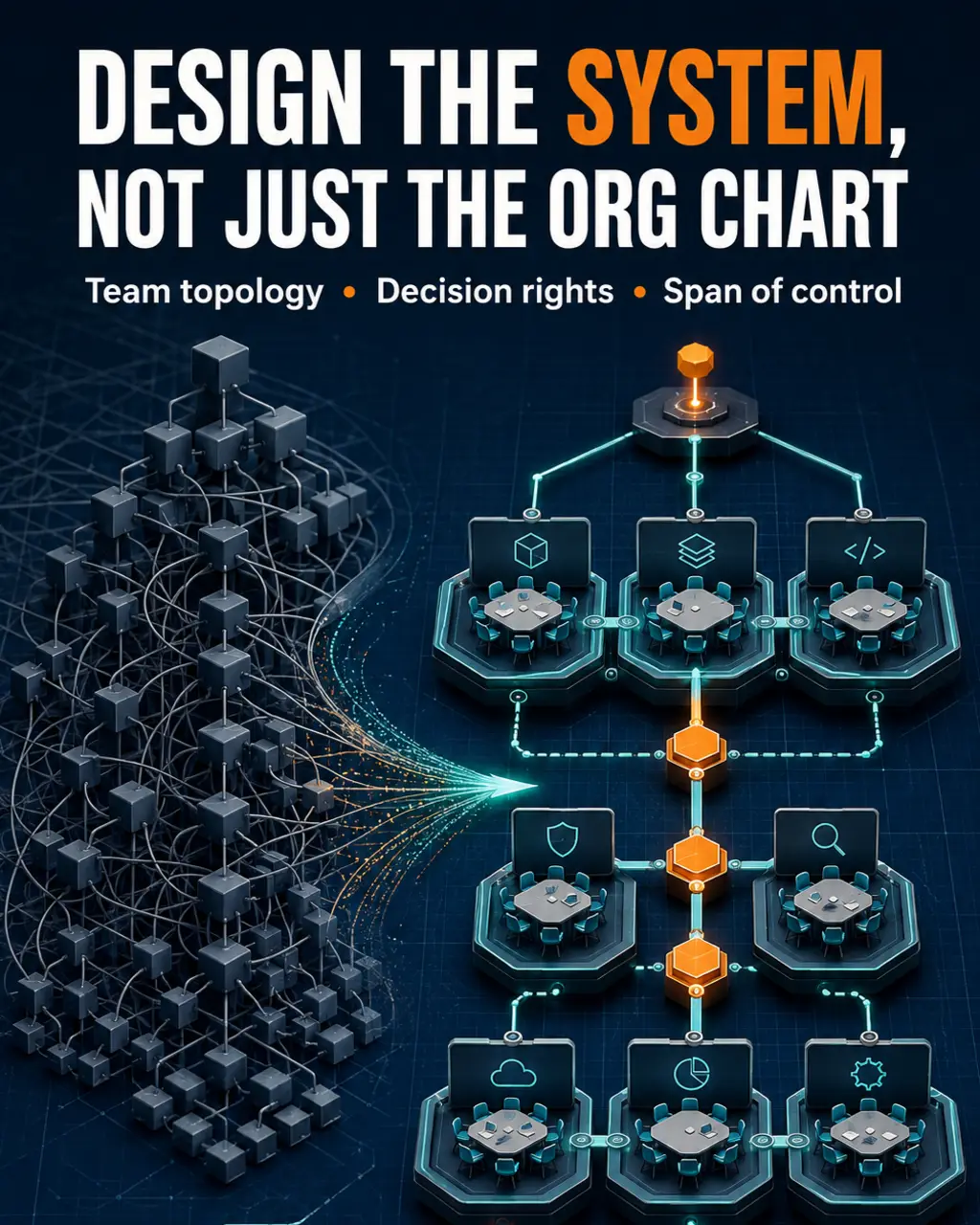 GuideMOVE / PROPEL
Staff Engineer vs Engineering Manager
Choosing between the senior individual-contributor track and people management — leverage, evidence, reward and the reversibility of each decision.
- Engineering
- Career decision
 ArticleMOVE
When to Quit — 12 Indicators That It May Be Time to Leave
Twelve signals that separate a difficult period from a role you have genuinely outgrown, and what to test before you resign.
- Stay or go
- ArticleMOVE
Automotive Redundancy: Your Career Capital Is Bigger Than Your Sector
Why changing sector is not starting again — how engineers translate experience, test new markets and create a credible next move.
- Redundancy
- Automotive
 Market intelligenceMOVE
UK Engineering Jobs 2026–2028: Clean Energy, Defence and AI
Where government spending, major programmes and workforce shortages are creating opportunity for experienced engineers and senior STEM professionals.
- Market intelligence
- Sector demand
 Career OS™MOVE
Career OS™ MOVE Stage 1 — Career Diagnosis
The diagnostic stage: what the next move must provide, what you will not repeat, and the evidence needed before choosing a direction.
Read Career OS™ MOVE Stage 1 — Career Diagnosis → Case studyMOVE
From Automotive Risk to Nuclear Opportunity
A senior automotive commercial leader repositioned for small modular reactors: one application, two interviews and an offer at the top of the band from 512 applicants.
- Sector change
 Case studyMOVE
From Redundancy to Wind-Energy CTO
A former automotive Chief Engineer moved from a reduced-earnings interim role to Chief Technology Officer after a network introduction and three interview stages.
- Redundancy
- Executive
 ArticleMOVE / PROPEL
Career OS™ — the Operating System for Senior Careers
A walk-through of the six stages — Career Diagnosis, Positioning, Evidence, Search, Interviewing and Offer — and why each one compounds into the next for experienced operators.
- Career OS™
- Methodology
 Market intelligenceMOVE
Germany’s Automotive Reset
How EV transition, China exposure, workforce restructuring and government intervention are reshaping German automotive — and what it means for engineering careers.
- Market intelligence
- Germany
- Automotive
- EV
 Market intelligenceMOVE
German Industrial Transformation & STEM Labor Outlook (2027–2030)
How public investment, inward FDI, industrial realignment and upskilling are reshaping Germany’s five high-growth STEM domains through 2030.
- Market intelligence
- Germany
- STEM
- Industrial transformation


 GuideMOVE
CV Writing for Engineers: Technical Impact, Scope and Value
Engineering decisions, programme scale, complexity, risk, quality, cost and delivery — plus ATS guidance and when to switch to a leadership CV instead.
- CV
- Engineering
 GuideMOVE / PROPEL
Career Impact Metrics and the XYZ Formula
Two free Career OS™ downloads: the 50-metric Impact Metric Dictionary and the XYZ Formula walkthrough for stronger CV, resume and LinkedIn achievement statements.
- Evidence
- Metrics
- XYZ Formula
- Free downloads
 GuideMOVE
Engineering Manager CV & Resume Guide
Repositioning a technical CV around leadership evidence — team outcomes, delivery governance, hiring, cost and stakeholder scope.
- CV
- Engineering management
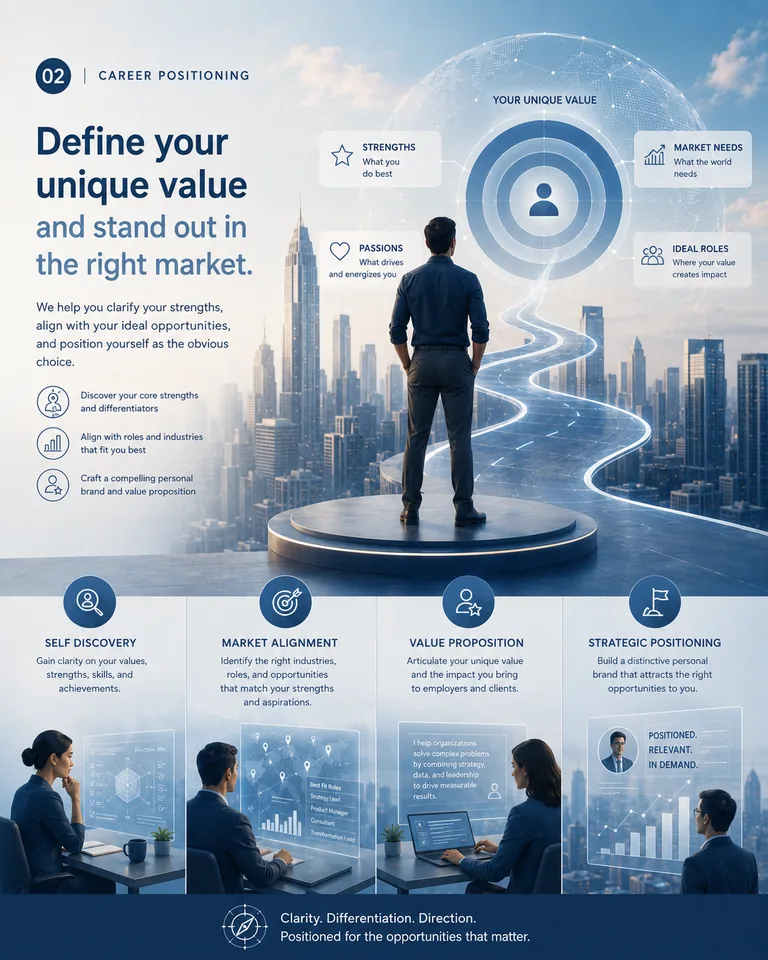 Career OS™MOVE
Career OS™ MOVE Stage 2 — Positioning Strategy
Choosing the market you compete in, and the positioning statement everything else is then built to support.
Read Career OS™ MOVE Stage 2 — Positioning Strategy → Career OS™MOVE
Career OS™ MOVE Stage 3 — Evidence & Profile
CV, LinkedIn profile and career narrative treated as one evidence system rather than three separate documents.
Read Career OS™ MOVE Stage 3 — Evidence & Profile →


 ArticleMOVE
How to Find a Job in the UK: Stop Applying More
Why volume applications fail experienced professionals, and how to build access through target employers, referrals and informed conversations instead.
- Job search
- UK market
- ArticleMOVE / PROPEL
Networking Skills: The Career Superpower You Can’t Ignore
Practical networking for senior professionals — reciprocity, warm routes into target employers, and a rhythm you can sustain while working full time.
- Networking
 Market intelligenceMOVE
UK, Germany and US Job Market 2026
August 2026 employment market update: what current UK, German and US data says about skills demand, candidate competition and how to compete for the right roles.
- Market intelligence
- International
 GuideMOVE
Network to Opportunity
Build professional relevance, run the 3:1 Give-to-Get discipline and turn career conversations into warm introductions, referrals and opportunities.
- Networking
- Referrals
- Job search strategy
 Career OS™MOVE
Career OS™ MOVE Stage 4 — Search & Networking
Target lists, warm routes, recruiter handling and a weekly outreach pipeline that produces conversations rather than applications.
Read Career OS™ MOVE Stage 4 — Search & Networking →


 GuideMOVE
Engineering Leadership at Scale: Technical Director Interviews
Answering Technical Director interview questions on scaling engineering organisations — the Star Model, team topology, decision rights, span of control and the SCALE framework.
- Executive interviews
- Technical Director
 GuideMOVE
Engineering Manager Interview Questions
The questions engineering management panels actually ask, what each one is testing, and how to structure evidence-led answers.
- Interviews
- Engineering management
 GuideMOVE
Director of Engineering Interview Questions
Executive-level interview preparation across scaling, strategy, commercial judgement and stakeholder management.
- Executive interviews
- ArticleMOVE / PROPEL
Did You Negotiate Your Salary Offer? Most People Don’t
An evidence-based walkthrough for evaluating, preparing and negotiating an offer without damaging the relationship, with acknowledgement to the Harvard Program on Negotiation.
- Negotiation
 ArticleMOVE / PROPEL
Salary Negotiation 2026: 11 Methods from Career OS™
Eleven negotiation methods for base, bonus, equity, scope and title — with the preparation each one depends on.
- Negotiation
- Salary
 ArticleMOVE / PROPEL
Salary Negotiation Isn’t a Conversation — It’s a Setup
Why the outcome of a negotiation is largely decided by the positioning and evidence built long before the offer call.
- Negotiation
 ArticleMOVE
Interview Prep for Engineering Managers — What Actually Works
A preparation method for leadership interviews: evidence bank, decision stories, delivery metrics and the questions you ask back.
- Interviews
- Engineering management
 Career OS™MOVE
Career OS™ MOVE Stage 5 — Interview Mastery
Structured evidence, panel dynamics, senior-level judgement questions and rehearsal that improves performance rather than memory.
Read Career OS™ MOVE Stage 5 — Interview Mastery → Career OS™MOVE
Career OS™ MOVE Stage 6 — Offer Negotiation
Evaluating the whole package, establishing leverage, and negotiating terms while protecting the working relationship.
Read Career OS™ MOVE Stage 6 — Offer Negotiation →- Career OS™MOVE / PROPEL
Negotiation Strategies
The Career OS™ negotiation reference: anchoring, concession discipline, alternatives, and negotiating scope and title as well as money.
Read Negotiation Strategies →


 GuideMOVE / PROPEL
Who Do You Really Need in Your Corner? Mentor vs Sponsor vs Coach vs Manager
When to use a manager, mentor, sponsor, network, leader, coach or consultant — and how to build a career support system rather than a dependency.
- Mentoring
- Sponsorship
- Career coaching
- Networking
 GuidePROPEL
How to Say No to Your Boss Without Damaging Your Career
Fifteen professional ways to challenge priorities, protect delivery and stay credible when you cannot take on more.
- Managing up
- Workload
- Prioritisation
 GuideMOVE / PROPEL
Engineering Management: The Full Guide
Roles, responsibilities, skills and career options across engineering management, from first-line leadership to director and VP.
- Engineering management
 InsightMOVE / PROPEL
The Art of Listening at Work: 9 Types of Listening
Nine distinct modes of listening — from pretend and selective through to empathic and reflective — and how senior leaders use them to question better and decide well.
- Leadership
- Communication
 GuideMOVE / PROPEL
How to Become an Engineering Manager
Preparing for a first engineering management role — readiness signals, evidence gaps and the conversations that create the opportunity.
- Engineering management
- Promotion
 GuideMOVE / PROPEL
Engineering Manager Career Path
Progression from engineer through manager, senior manager and director to VP — scope, evidence and reward at each level.
- Career path
- GuideMOVE / PROPEL
Software Engineer to Engineering Manager
Making the individual-contributor to leadership transition: readiness signals, evidence gaps and the steps that make the move credible.
- Engineering management
- GuideMOVE / PROPEL
Tech Lead to Engineering Manager
Moving from technical leadership into formal people management — authority, accountability and the parts of the craft you must now delegate.
- Engineering management
- GuidePROPEL
First-Time Engineering Manager Guide
Leading your first engineering team: the operating-model shift, delegation, one-to-ones, former peers and delivery under new accountability.
- Leadership
- First 90 days
 GuidePROPEL
Engineering Manager 30-60-90 Day Plan
A credible first ninety days: diagnose, establish an operating rhythm, then demonstrate leadership impact that others can verify.
- First 90 days
 InsightPROPEL
From Burnout to Breakthrough (Career Bites™)
Sustainable high performance, professional boundaries and learning when to say No — what engineering leadership teaches about capacity as responsibility grows.
- Leadership
- Boundaries
 ArticlePROPEL
Why Senior Engineers Stall at the Manager Threshold
The evidence gap that stops strong engineers being seen as leadership candidates, and how to close it before the next promotion round.
- Promotion
 ArticleMOVE / PROPEL
Engineering Management Career Paths: Senior Engineer to CTO
How technical careers ladder into executive leadership, and the scope and evidence expected at each transition.
- Career path
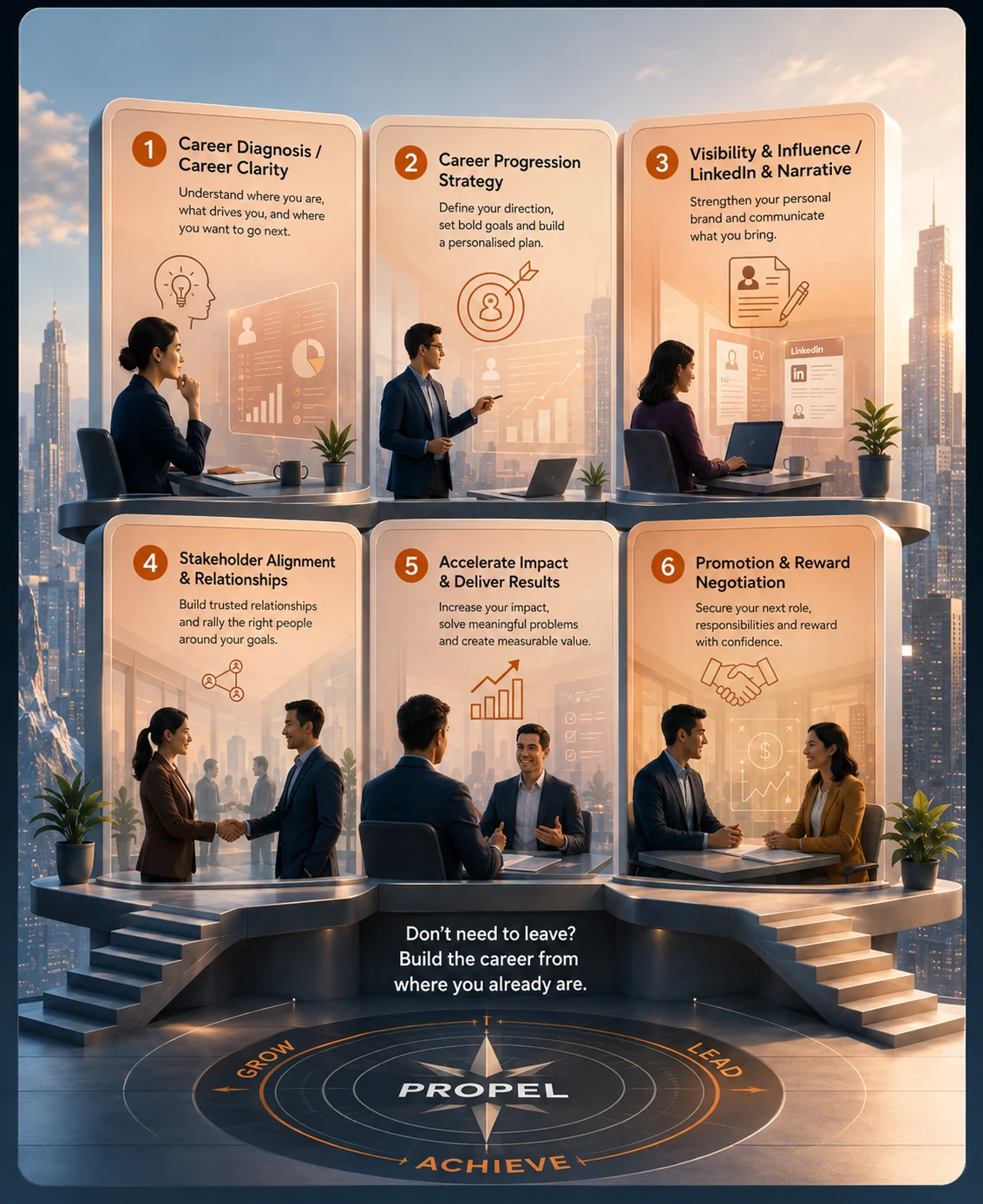 Career OS™PROPEL
Career OS™ PROPEL — The Six Stages
Purpose and direction, role positioning, outcomes and evidence, presence and influence, execution, then leverage and progression.
Read Career OS™ PROPEL — The Six Stages →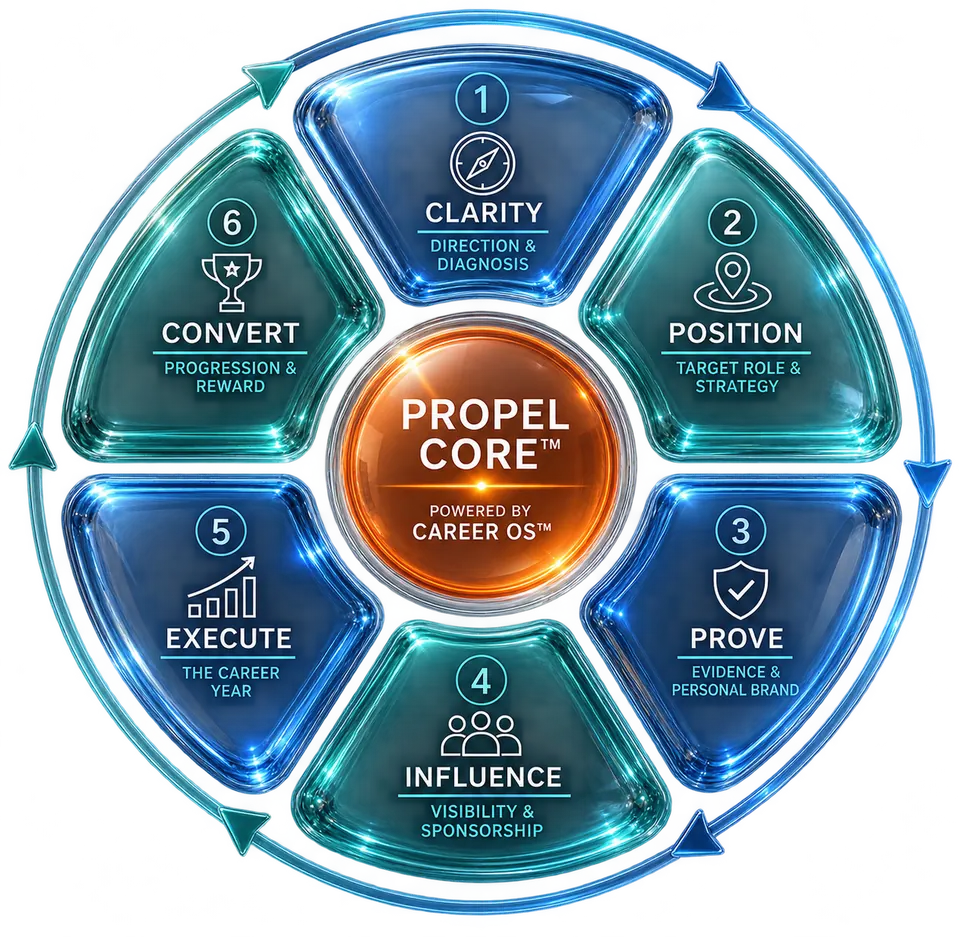 Career OS™PROPEL
Career OS™ PROPEL Stage 4 — Presence & Influence
Visibility with decision-makers, influence without authority, managing up and being credited for the work you already do.
Read this resource →


International Careers & Right to Work
MOVE / SPECIALIST GuideMOVE / Specialist
Working in the UK & Ireland: International Professionals
The principal professional work routes for the UK and Republic of Ireland, employer sponsorship considerations, and what each means for job-search strategy.
- Right to work
- UK
- Ireland
 Case studyMOVE / Specialist
Seven Months Remaining: An Engineer’s Internal Progression Strategy
A manufacturing engineer secured an internal move against a seven-month visa deadline, including a failed first interview, feedback-led second attempt and employer-supported visa.
- Skilled Worker visa
- Internal progression


More in the Knowledge Centre
- Tools & AssessmentsFree Career OS™ tools and the routed Career Diagnosis journey.
- Market IntelligenceWhere demand, investment and competition are actually moving.
- Career Strategy InsightsLong-form commentary on career strategy and leadership.
- Career OS™ BlogArticles, market notes and the open discussion thread.
Prefer one practical directory? Browse Career Resources for Everyone →
Join the Career OS™ discussion.
Drop your view, ask a question, or share what's working in your search. Open mic — no hurdles.