

Did You Negotiate Your Salary Offer? Most People Don't. This Is How.
A practical, evidence-based Career OS™ walkthrough guide to evaluating, preparing and negotiating a job offer — without damaging the relationship. With acknowledgement to the Harvard Law School Program on Negotiation.
A practical, evidence-based Career OS™ walkthrough guide to evaluating, preparing, and negotiating a job offer — without damaging the relationship.
With acknowledgement to Harvard Law School, Program on Negotiation.

How To Use This Guide
Use this guide after receiving a written job offer and before pressing Accept. It is designed to slow the process down, separate emotion from evidence and help you prepare a professional counteroffer. The aim is not to force a confrontation or to pursue a higher number for its own sake. The aim is to understand the full value of the role, identify genuine flexibility in the package and enter the organisation on terms that reflect the contribution you are expected to make.
| Before the conversation | During the conversation | Before you accept |
|---|---|---|
| Review the written offer, benchmark the market, map your value and determine your walk-away position. | Stay calm, justify your request, test constraints and negotiate the complete package rather than one number. | Confirm every agreed term in writing, review the contract and make a conscious decision rather than an emotional one. |
1. The Moment Most Candidates Stop Thinking
You may have spent six months looking for the right role. Perhaps nine. During that period you have rewritten your CV, adjusted your LinkedIn profile, contacted recruiters, searched job boards, attended networking calls and completed applications that appeared to disappear into an automated recruitment system without trace. Eventually something works. You pass the initial application screen, complete the recorded AI interview and progress through a recruiter conversation, a hiring-manager interview and perhaps two further panel discussions involving presentations, competency questions, technical assessments and repeated explanations of why you want to leave your current organisation.
By the time the offer arrives, you are no longer responding to it as a detached commercial decision-maker. Emotionally, you believe the process is over. The relief is immediate. The organisation has chosen you, the uncertainty has ended and the months of rejection, silence and self-doubt suddenly appear worthwhile. Your attention moves quickly from evaluation to celebration. Then the email arrives with the words, 'We are delighted to offer you the position', and beneath it sits the Accept button.
Most candidates press it. They do not stop to assess the salary architecture, compare the package against the actual scope of the role or test whether the offer reflects the value they are expected to create. They rarely ask whether the grade, bonus, pension, flexibility, holiday allowance, development budget, or review date can be improved. They accept because they are delighted, which is entirely understandable, but it can also be extremely expensive.
2. An Offer Is An Opening Position, Not A Ceremonial Conclusion
Many candidates misunderstand what a job offer represents. They view it as the employer's final decision, when in most professional appointments it is better understood as the organisation's opening commercial position following its decision to hire you. Once a formal offer has been issued, the employer has already invested heavily in the process. Managers have reviewed applications, conducted interviews, attended panel discussions, secured approvals and rejected other candidates.
The organisation therefore does not normally want to restart the entire process simply because you make a reasonable, evidence-based request. Research summarised by the Harvard Program on Negotiation suggests candidates substantially overestimate the danger of an offer being withdrawn. In a study involving almost 1,500 employers with management and hiring experience, respondents reported withdrawing only a small proportion of offers, often because the candidate behaved rudely or inappropriately rather than because they attempted to negotiate.
There is a significant difference between saying, 'I will not join unless you give me another £15,000', and saying, 'I am very enthusiastic about the position. Having reviewed the scope, market range and value I can bring, I would like to discuss whether there is flexibility within the package.' One is an ultimatum. The other is a professional business conversation.
3. Stop Negotiating Against Yourself
The first concession is frequently made before the employer has said anything. A candidate sees the salary and immediately begins generating reasons not to question it. The company has probably reached its limit. The recruiter said the range was fixed. I am changing industries. I have been out of work for several months. I do not want to appear greedy. This is negotiation against yourself.
Deborah Kolb and Jessica Porter describe how people 'get in their own way' by focusing on their weaknesses, failing to recognise opportunities to negotiate and making concessions internally before the discussion begins. This is particularly common among people who are pivoting industries. They discount their leadership, technical competence, commercial judgement, programme delivery, stakeholder management and transferable expertise because the industry label has changed.
The hiring organisation may see something entirely different. Cross-sector knowledge may be part of the value proposition rather than a defect requiring a salary discount.
4. The Starting Salary Is A System Input, Not An Isolated Number
A starting salary becomes the baseline for future percentage increases, pension contributions, bonus calculations, redundancy terms, internal promotions and subsequent salary negotiations. Your next employer may also use it, directly or indirectly, as evidence of your market level. A difference of £5,000 is therefore not simply £5,000 in the first year. Over ten or twenty years, the compound effect can become substantial.
The Harvard report illustrates the principle with two MBA graduates who receive identical $100,000 offers. One accepts immediately, while the other negotiates to $115,000. Using assumptions concerning annual raises and investment returns, the difference over their careers could exceed $1.5 million. The point at which you enter a pay system matters.
5. Create Space Before You Respond
Before responding, create space. Thank the employer and confirm your enthusiasm, but do not feel pressured to accept immediately. Ask for the complete offer in writing and request a reasonable period to review it.
'Thank you. I am delighted to receive the offer and remain very enthusiastic about the role. I would like to review the complete package carefully and come back to you by Thursday. Could you please send the full details in writing, including salary, bonus, pension, benefits, holiday entitlement, working arrangements and the proposed start date?'
During that period, move away from the emotional question of whether you want the job and examine the commercial question of whether the package reflects the role.
6. Research What The Role Is Worth
Do not rely on a single online salary website. Salary information can be incomplete, self-reported, outdated or distorted by geography, organisation size and title inflation. Use several sources, including recruiter intelligence, current advertisements, specialist salary surveys, professional networks and genuinely comparable roles. Where possible, separate the salary attached to the title from the salary attached to the actual responsibilities, because identical titles can conceal radically different levels of accountability.
AI can help organise and interrogate this information, but it should not be treated as the sole authority. The output is only as reliable as the sources it draws upon and the questions you ask of it.
7. Build A Value Case, Not A Wish List
The employer will not increase a salary because you would like more money. They may increase a salary because you present a defensible commercial case. Identify three to five achievements which demonstrate value directly relevant to the new role — commercial impact, technical delivery, leadership outcomes, cost savings, revenue growth or risk reduction. Translate each into a language the employer already respects: outcomes, metrics, decisions influenced and problems solved.
8. Anchor With Evidence, Not Emotion
A well-prepared candidate anchors the conversation with a specific, evidenced range rather than a vague hope. This introduces a favourable reference point without presenting an aggressive demand. You might say: 'Please correct me if my understanding is wrong, but the comparable roles I have reviewed appear to sit between £90,000 and £100,000, particularly where the position includes this level of programme and team responsibility.' You are not claiming entitlement; you are inviting the employer to engage with your evidence.
9. Negotiate The Complete Package
Salary matters, but it is not the only variable. The most effective negotiations expand the number of issues under discussion, creating room for trade-offs. Depending on the position, the discussion may include base salary and review timing, joining bonus, annual performance bonus, pension contribution, holiday allowance, remote or hybrid working, job title, organisational grade, reporting line, decision authority, professional-development budget, car allowance, relocation support, share options, start date and a documented six-month salary review.
A recruiter may genuinely have limited authority to increase the base salary but may be able to secure a joining bonus. The organisation may be unable to move beyond a formal grade boundary but could appoint you at a higher grade. The Harvard report specifically recommends looking beyond salary towards role scope, authority and development opportunities.
10. Ask Directly Without Apologising For The Request
Candidates often weaken their request before making it. Phrases such as 'I am terribly sorry to ask' or 'I completely understand if it is impossible' do not make the conversation more polite. They signal that you do not believe your own case.
'I am genuinely excited about joining the organisation. Before I accept, I would like to discuss the base salary. Having reviewed the scope of the role and the market evidence, I believe £92,000 would more accurately reflect the level of responsibility and the experience I would bring. Is there flexibility to move the offer closer to that figure?'
Once you have asked, stop talking. Do not immediately reduce the number, negotiate against the silence or add that you would probably accept less. Allow the employer to respond.
11. Prepare For Predictable Objections
If the employer says that the salary is the maximum for the grade, ask whether the grade itself is correct, whether there is scope for a joining bonus or whether an earlier salary review can be documented. If the response concerns internal equity, acknowledge the constraint and ask what flexibility exists across bonus, pension, annual leave, development funding or role scope. If the concern is your lack of direct experience in the industry, connect your transferable evidence to the organisation's actual problem.
When told the offer is non-negotiable, test the statement professionally by asking whether the base salary is fixed or the complete package is fixed. Frequently, one component is constrained while others remain open.
12. Protect The Relationship And The Long-Term Opportunity
A salary discussion is your first significant commercial interaction with the organisation, so how you conduct it matters. Be assertive, evidence-led and calm. Avoid threats, emotional reactions or attempts to manufacture leverage. Never claim to have another offer when you do not, and do not present an ultimatum unless you are genuinely willing to walk away.
The employer wants the right person in the role, while you want a package that reflects the contribution you will make. Those objectives are not inherently in conflict. Negotiating does not obligate you to reject an offer that does not move. You may conclude that the role, development opportunity, flexibility or long-term trajectory justifies accepting the original package. The important distinction is that you have made the decision consciously.
Salary Negotiation Preparation Checklist
| Checkpoint | Required evidence or action |
|---|---|
| Written offer received | Do not negotiate from a verbal summary. Obtain salary, bonus, pension, benefits, holiday, location, flexibility, start date and reporting line in writing. |
| Market range established | Use at least three credible sources and compare responsibilities, geography, company size and grade rather than job title alone. |
| Value case prepared | Select three to five achievements that prove commercial, technical, operational or leadership value relevant to the new role. |
| Target and floor defined | Set your preferred outcome, a realistic acceptable outcome and the point below which the complete package no longer works. |
| Package variables mapped | Identify alternatives across bonus, pension, holiday, hybrid working, grade, title, development budget, start date and review timing. |
| Objections rehearsed | Prepare calm responses to budget limits, internal equity, industry-pivot concerns, fixed grades and competing candidates. |
| Written confirmation secured | Do not rely on verbal agreement. Ensure every changed term appears in the revised offer letter or contract before accepting. |
A Concise Counteroffer Script
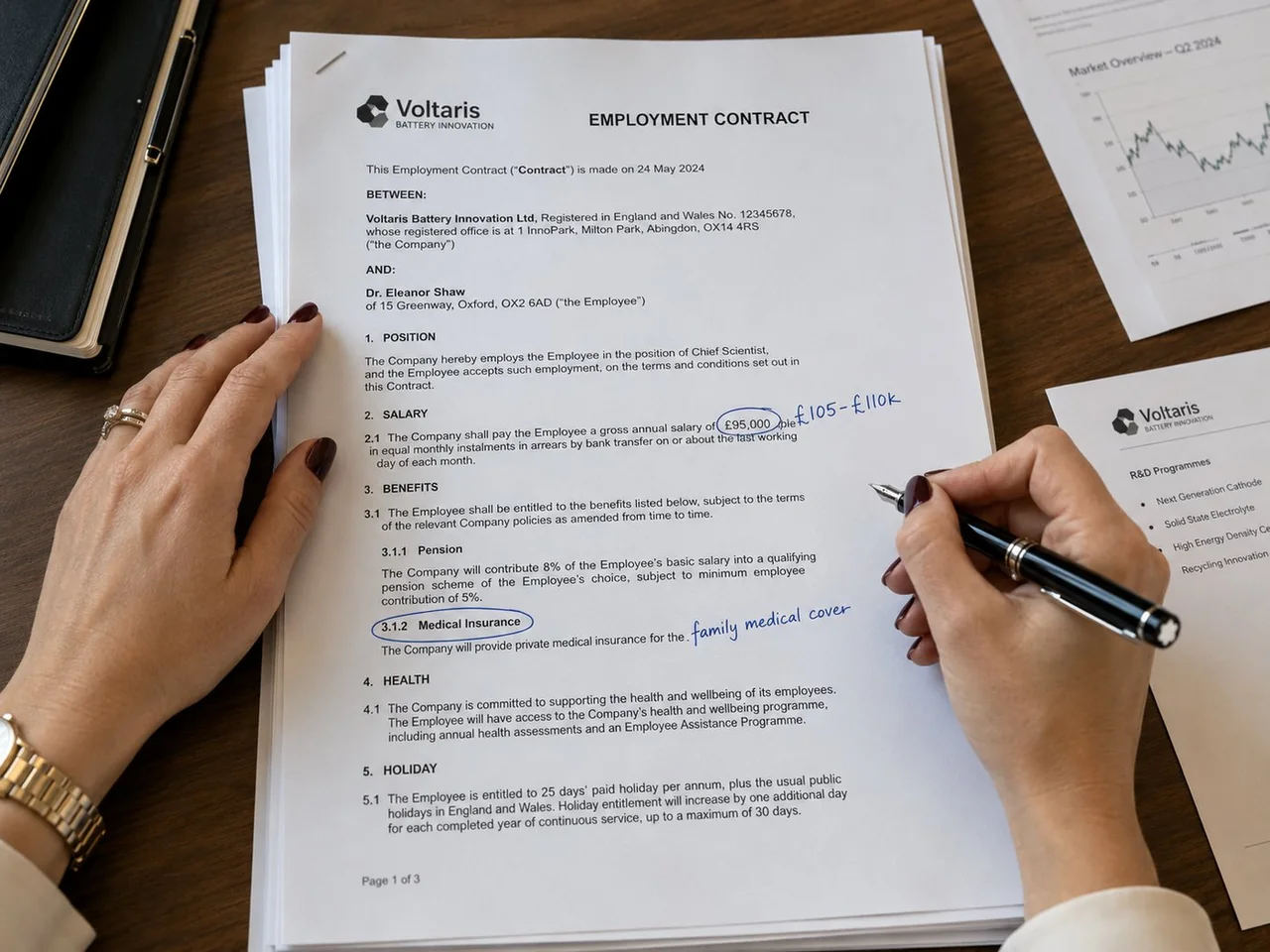
'Thank you again for the offer. I am genuinely enthusiastic about the role and the opportunity to contribute. Having reviewed the responsibilities, the market evidence and the experience I would bring, I would like to discuss the base salary. I believe a figure in the region of £105,000 to £110,000 would more accurately reflect the scope and value of the appointment. Is there flexibility to move the offer closer to that range? I would also like to clarify the medical cover, pension contribution, holiday entitlement and timing of the first formal salary review.'
Conclusion — Do Not Press Accept Until You Understand The Deal
The offer is not the ceremonial end of the recruitment process. It is the final and potentially most valuable stage. Before accepting, review the complete deal, understand your market position, build a value case, test the organisation's constraints and negotiate professionally. You may not secure every improvement you request, but you will make a better-informed decision and avoid entering the role with preventable doubt about what might have been possible.
At Eich Dyn Career Services, we help professionals prepare the evidence, market benchmarks, negotiation architecture, scripts and counteroffer strategy required to handle this stage properly. The last two negotiations we supported produced a 15% uplift worth £8,000 and an increase of just under £11,000. Both candidates were pivoting into different industries — precisely the point at which many professionals assume they possess less negotiating power. They did not demand more because they wanted it; they built a defensible case for why the offer should change.
Contact Eich Dyn Career Services for the advice, preparation and Career OS™ tools you need to secure a significant salary uplift and enter your next role on terms that properly reflect your value.
Reference: Program on Negotiation at Harvard Law School (2025), 'How to Negotiate Your Salary and Raises'. Adapted and extended for this Career OS™ walkthrough guide.