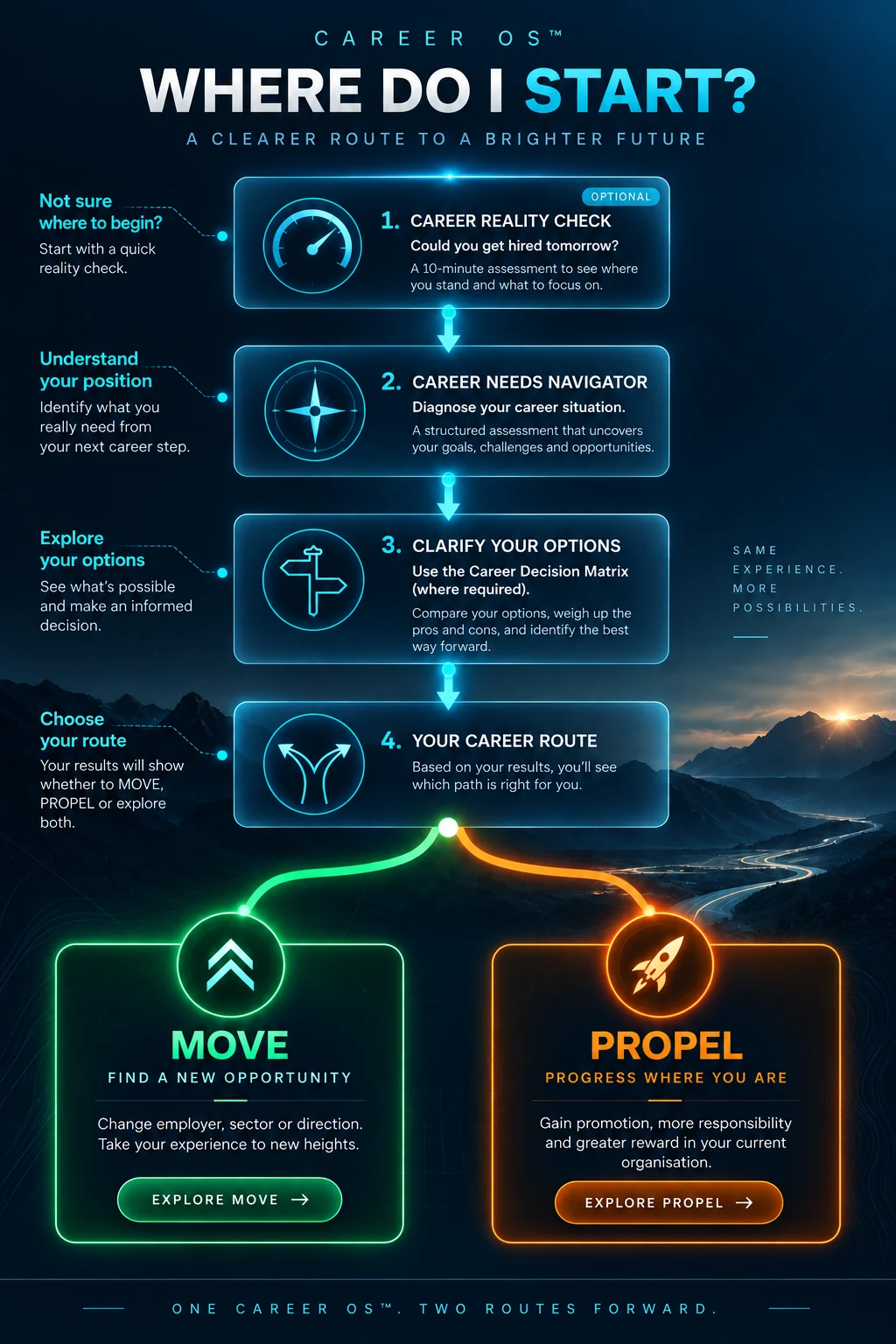
Could You Get Hired Tomorrow?
A free reality check for experienced professionals who have not tested their market value recently.
Up to 18 questions plus an evidence audit, returning readiness feedback, an evidence-quality view and priority actions.
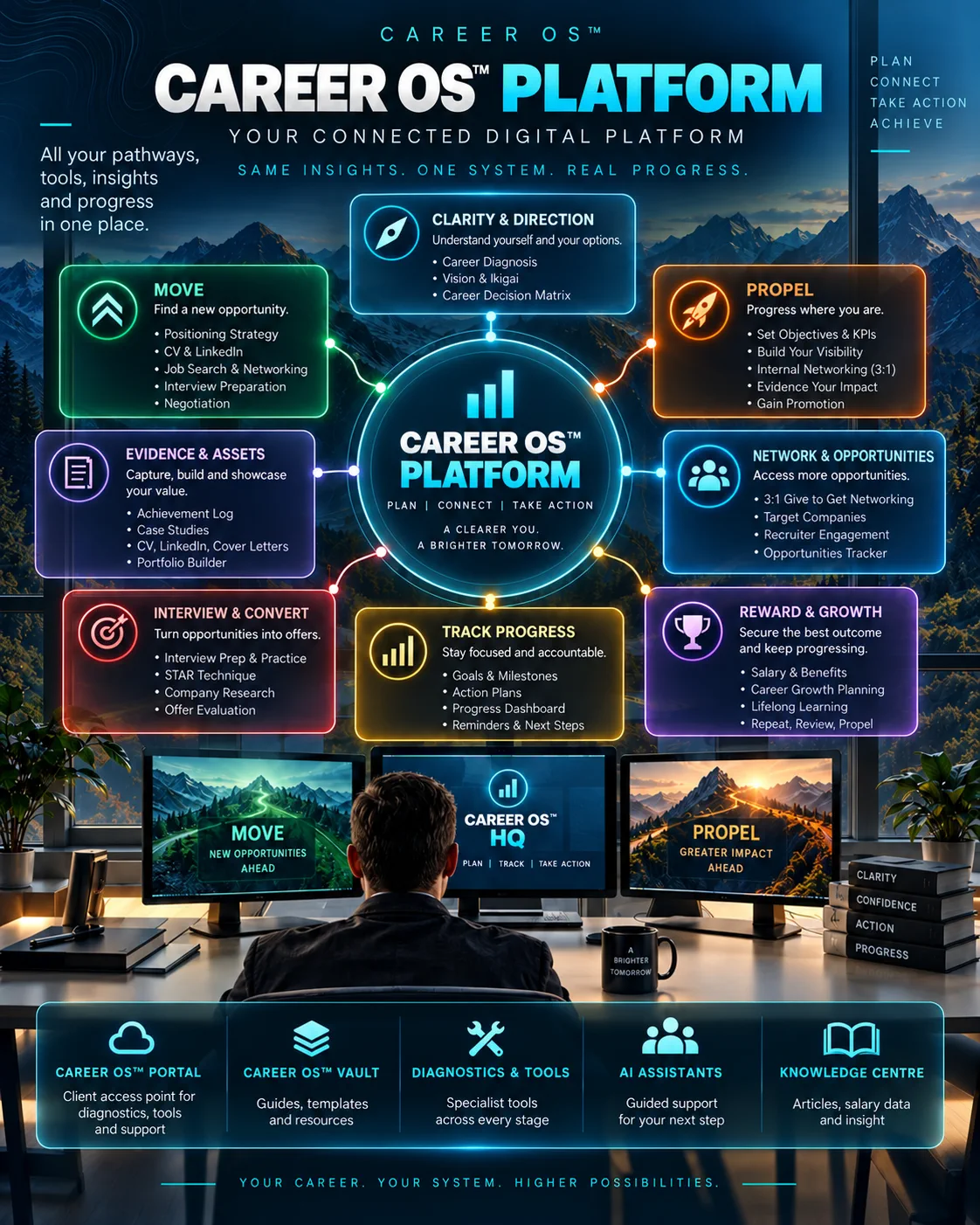
Career OS™ tools turn career strategy into structured action.
From diagnosis and positioning through to opportunity creation, interviews, progression conversations and negotiation, each tool supports a specific decision within the Career OS™ system.
Use them to help you MOVE into the right opportunity or PROPEL your career from where you are.
Previews shown intentionally softened. Full toolkit shared inside Career OS™ consulting.
Begin with a reality check and the Career Needs Navigator rather than a tool chosen at random. Diagnosis first establishes your direction; the Navigator then routes you to MOVE for external change or PROPEL for progression where you already are.
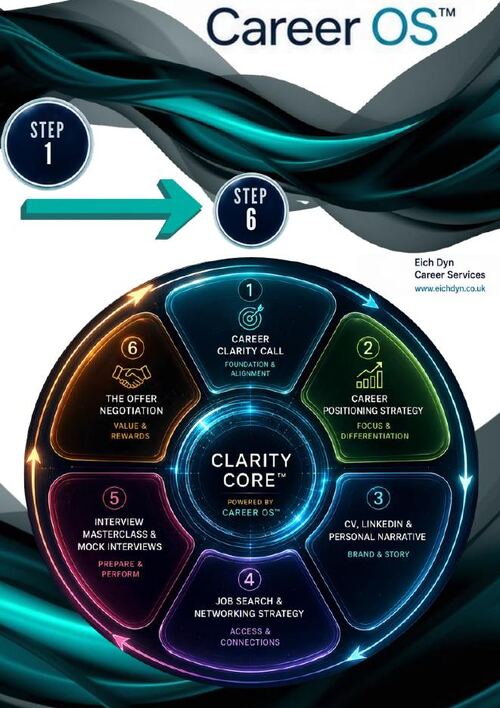
One Career OS™. Two governed pathways. Every tool below belongs to a stage of one of them.
A CV template can improve formatting.
An interview worksheet can improve preparation.
A negotiation checklist can improve one conversation.
But isolated tools cannot determine whether you are targeting the right outcome in the first place.
Career OS™ tools are designed to work as connected components of a wider career operating system.
Each tool should help answer a defined question, produce a useful output or support a specific career decision.
Career OS™ tools are reflection and implementation aids, not official MBTI®, CliftonStrengths®, clinical, psychological or employment-selection assessments.
The Career Diagnosis journey runs in a deliberate order: Clarity and Vision Board → Career Decision Matrix → Career Needs Navigator, the overarching Career Positioning Diagnosis → the MOVE or PROPEL Readiness Assessment that your Navigator result points to.
The overarching Career Positioning Diagnosis. Start here if you are unsure which path you need.
Determines whether your appropriate execution path is MOVE or PROPEL. It is not the MOVE or PROPEL readiness score itself — it tells you which Readiness Assessment to take next.
Already clear on your direction? Go straight to the assessment that matches it.
For external change: a new role, employer, sector, geography or career direction.
For internal progression: visibility, influence, recognition, scope, promotion and reward.
If you do not yet know your next step, begin with the Positioning Vision Board and the Career Decision Matrix, then take the Navigator.
Every Career OS™ tool on this page is free to use. Each one asks for a first name and a working email address to unlock it — no payment, no card and no programme required.
A free reality check for experienced professionals who have not tested their market value recently.
Up to 18 questions plus an evidence audit, returning readiness feedback, an evidence-quality view and priority actions.
Turn your experience, evidence and career direction into a clear, credible market position. Compare positioning territories, test differentiation and define how employers should understand your value.
Produces candidate positioning territories with positioning strength, career market fit, substitutability and evidence-density views you can act on.
A diagnostic of what is working and what is not in your current role.
Helps decide whether the problem is the role, the environment or the direction.
A visual view of the direction, level and working life you are aiming at.
Helps decide what your positioning should be pointing towards.
A weighted comparison of five pathways: stay, move sideways, seek promotion, change employer or pivot industry.
Produces ranked options and fit percentages against the criteria you choose.
The overarching Career Positioning Diagnosis. Start here if you are unsure which path you need.
Determines whether your appropriate execution path is MOVE or PROPEL. It is not the MOVE or PROPEL readiness score itself — it tells you which Readiness Assessment to take next.
For external change: a new role, employer, sector, geography or career direction.
Measures how ready your positioning, evidence, opportunity pipeline and interview performance are for an external move.
For internal progression: visibility, influence, recognition, scope, promotion and reward.
Measures how ready you are to progress from where you are, without changing employer or field.
A reflection tool that connects your strengths to commercial value.
Produces language you can use in positioning, evidence and conversations.
A reflection tool on working and leadership preferences.
Helps decide which leadership or specialist trajectory suits you.
A pipeline tracker for relationships, contributions and requests.
Produces a visible view of the relationships you are actually building.
Structured practice across common senior interview and conversation themes.
Produces a bank of evidence-based answers you can reuse.
A curated UK recruiter network for automotive engineers moving within automotive or into adjacent sectors — including automotive data, defence, clean energy, nuclear, water, MedTech and AI/data.
Built for displaced and transitioning automotive engineers — including JLR and Aston Martin populations — with named recruiter and team routes, sector filters, crossover guidance and direct public contact routes across UK engineering recruitment.
Opens in a new tab. A public external resource — no email unlock required.
The free tools are a sample. Inside the programme, the Career OS™ Vault holds 425 digital assets and 55 AI-powered digital tools — connected diagnostics, frameworks, planning tools, evidence tools, trackers and execution resources organised across the six stages.
Stage 01 and 02 material for direction, strengths, options, readiness and positioning strategy.
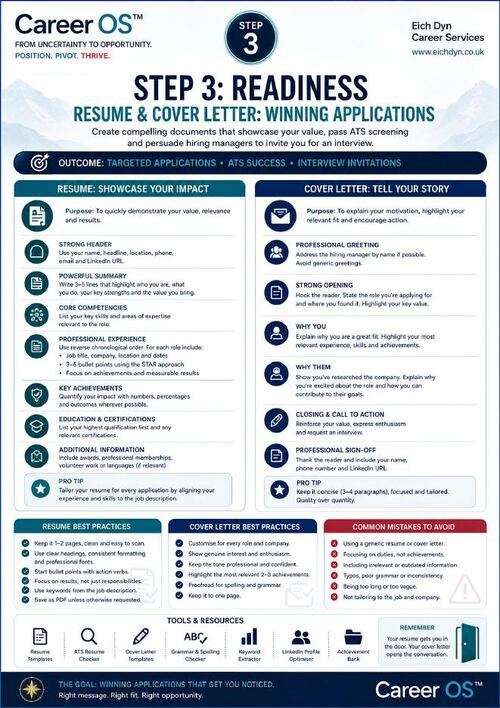
CV and LinkedIn development, achievement evidence, impact-metrics libraries and career narrative.
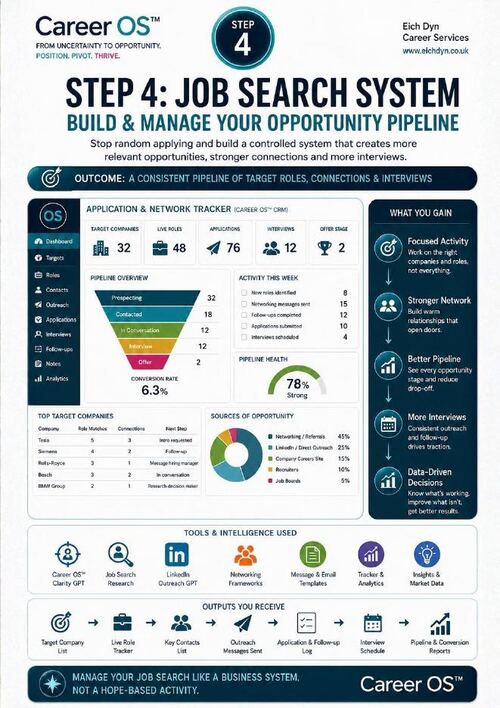
Market and stakeholder mapping, networking discipline, outreach and internal visibility planning.
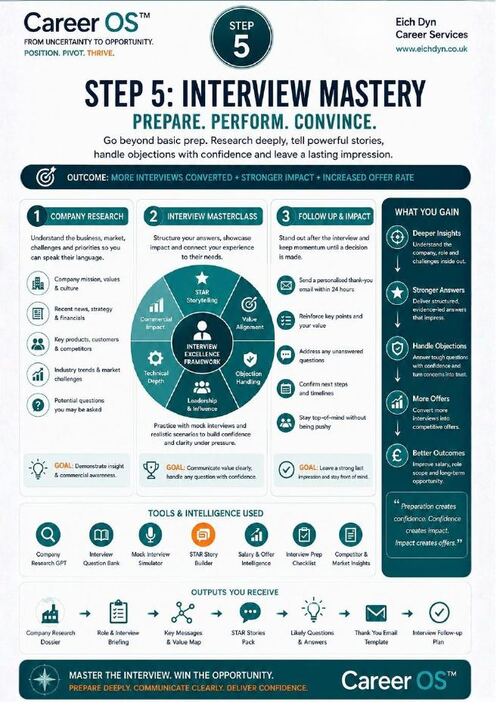
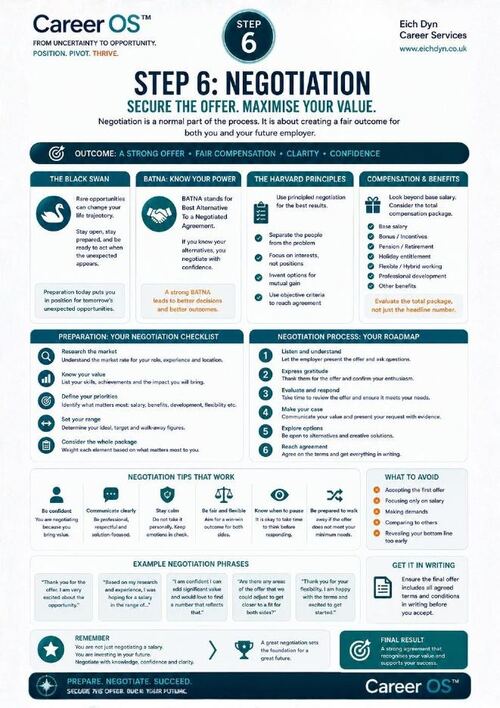
Interview and progression-conversation preparation, plus reward, scope and offer negotiation preparation.
Every tool belongs to a stage, and every stage is executed one of two ways. The full methodology sits on the Career OS™ page; this is the tool layer beneath it.
The stages and tools stay the same. Switch the path to see how they are used.
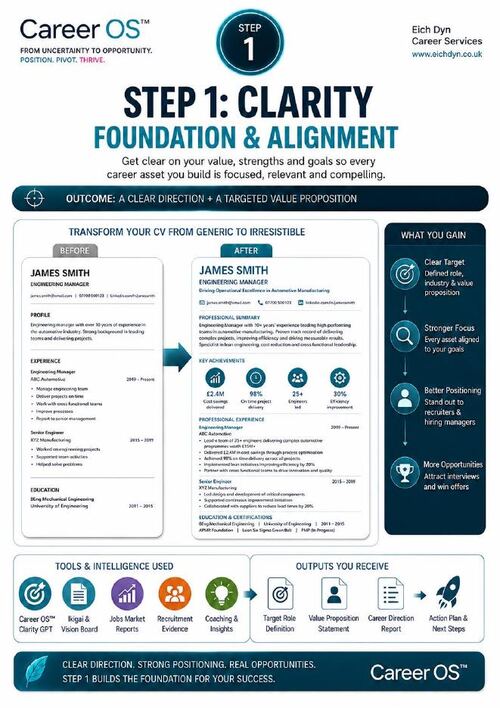
Official stage name: Career Diagnosis
Work out your strengths, ambitions, constraints, realistic options and what progression is actually worth pursuing.
Tool types: Career assessment and readiness diagnostics, weighted decision comparison, strengths analysis and in-role satisfaction scoring.
Test target roles and sectors, transferable strengths, the viability of a change, target reward and your criteria for moving.
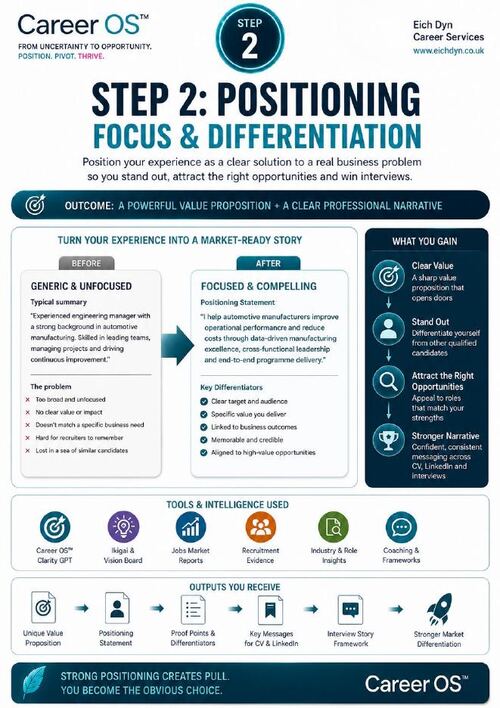
Official stage name: Positioning Strategy
Decide how your experience, expertise and future value should be understood by the people who make decisions about you.
Tool types: Value-proposition and career-branding work, positioning statements, proof points and leadership preference reflection.
External market positioning: relevance to target roles, sector translation and candidate differentiation.
Official stage name: Evidence & Profile
Make your position credible with evidence a decision-maker can act on — not just a better-formatted document.
Tool types: CV development structures, LinkedIn profile guidance, achievement and impact-metrics libraries, career-narrative frameworks and executive profile material.
CV, LinkedIn profile, professional biography, achievement evidence, application material and a transferable-value narrative.
Official stage name: Search & Networking
Create the conditions in which the right opportunities appear.
Tool types: Networking activity tracking, relationship and stakeholder mapping, outreach planning and pipeline discipline.
Target-company mapping, recruiter strategy, networking, direct approaches and tracking live external opportunities.
Official stage name: Interview Mastery
Convert your evidence into decision-maker confidence.
Tool types: Structured interview preparation, STAR answer frameworks, evidence selection and difficult-question practice.
Interview preparation, evidence selection, structured STAR examples, panels, presentations and difficult questions.
Official stage name: Offer Negotiation
Turn progression into the right terms, scope and reward.
Tool types: Negotiation preparation frameworks, reward comparison and value-evidence preparation.
Offer comparison, salary, bonus, benefits, title, scope, flexibility, BATNA thinking and total reward.
Career OS™ HQ is the client environment where the work is held together — diagnostics, evidence, actions and progress against the six stages in one place, rather than scattered across documents and notes.
HQ is the control layer rather than another stage in the sequence. Clarity work, pathway execution, evidence, networking, interviews or progression conversations and the eventual reward outcome all sit against the same six stages.
That is why the tools compound: each output becomes an input to the next stage instead of a standalone document.
The tools are built for technical professionals, scientists, specialists and senior leaders who already have real experience but want a clearer system for converting it into progression — whether that progression is external or internal.
Career planning tools are structured resources that help you make and record a career decision rather than simply think about it. In Career OS™ they cover career assessment and direction, positioning and value, CV and LinkedIn evidence, networking and opportunity creation, interview and progression conversations, and salary or reward negotiation.
The public tools on this page are free to use. Each one asks for a first name and a working email address to unlock it — there is no payment and no card required. The wider Career OS™ Vault of 425 digital assets is available to clients inside the programme.
If you already know your next step, take the path-specific Readiness Assessment: the MOVE Readiness Assessment for external change, or the PROPEL Readiness Assessment for internal progression. If you are unsure, start with the Career Needs Navigator — the overarching Career Positioning Diagnosis. The Navigator is not a MOVE or PROPEL readiness score; it determines which of the two Readiness Assessments applies to you.
Yes. Career OS™ has two execution paths. MOVE supports progression that needs a new role, employer, sector, geography or direction.
PROPEL supports progression from where you are — scope, influence, recognition, responsibility, promotion or reward. The same tools are used differently on each path.
No. Templates change formatting. These tools are designed to produce a decision or a piece of evidence — a weighted comparison of your options, a satisfaction score, a strengths-to-value map, a networking pipeline, a structured interview answer bank or a positioning view.
No. The free tools work on their own and you can use them without a programme, a consultation or a purchase. Career OS™ adds the connected environment, the full resource library and the consulting judgement around them.
Use the free Could You Get Hired Tomorrow? reality check. It asks up to 18 questions about positioning, evidence, market awareness, access and interview readiness, audits the evidence you would actually send, and returns priority actions.
It is a self-assessment rather than a selection assessment, and it is not a prediction of any hiring outcome.
The value of a career tool depends on whether it is being used to solve the right problem.
Use a free Career OS™ tool to explore where you are now, or book a Career Diagnosis to establish the progression problem that needs solving.