Skip to content
The Eich Dyn Career Operating System™

Six Stages. Two Career Paths. One Operating System.

Career OS™ is Eich Dyn's six-stage career operating system for professionals who want to progress, reposition or move.

It connects diagnosis, positioning, evidence, opportunity creation, interview or influence, and negotiation into one deliberate six-stage sequence.

Whether the next step requires a move into a new role or stronger progression from where you are, the system governs the decisions that determine the outcome.

Career OS™ MOVE flywheel — the six stages applied to progression that requires a move to a new role, employer, sector, geography or career direction
Career OS™ MOVEProgression through a new role, employer, sector, geography or direction.
Career OS™ PROPEL flywheel — the six stages applied to progression in scope, influence, recognition, responsibility, promotion and reward within the current organisation
Career OS™ PROPELProgression in scope, influence, recognition, responsibility and reward from where you are.

What is Career OS™?

Career OS™ is Eich Dyn’s structured career operating system for senior professionals, engineers, technical specialists and executives. It helps clients diagnose career blockers, clarify market value, strengthen positioning, prepare for interviews and make better offer decisions through a clear consultation-led methodology.

Where do I start with Career OS™?

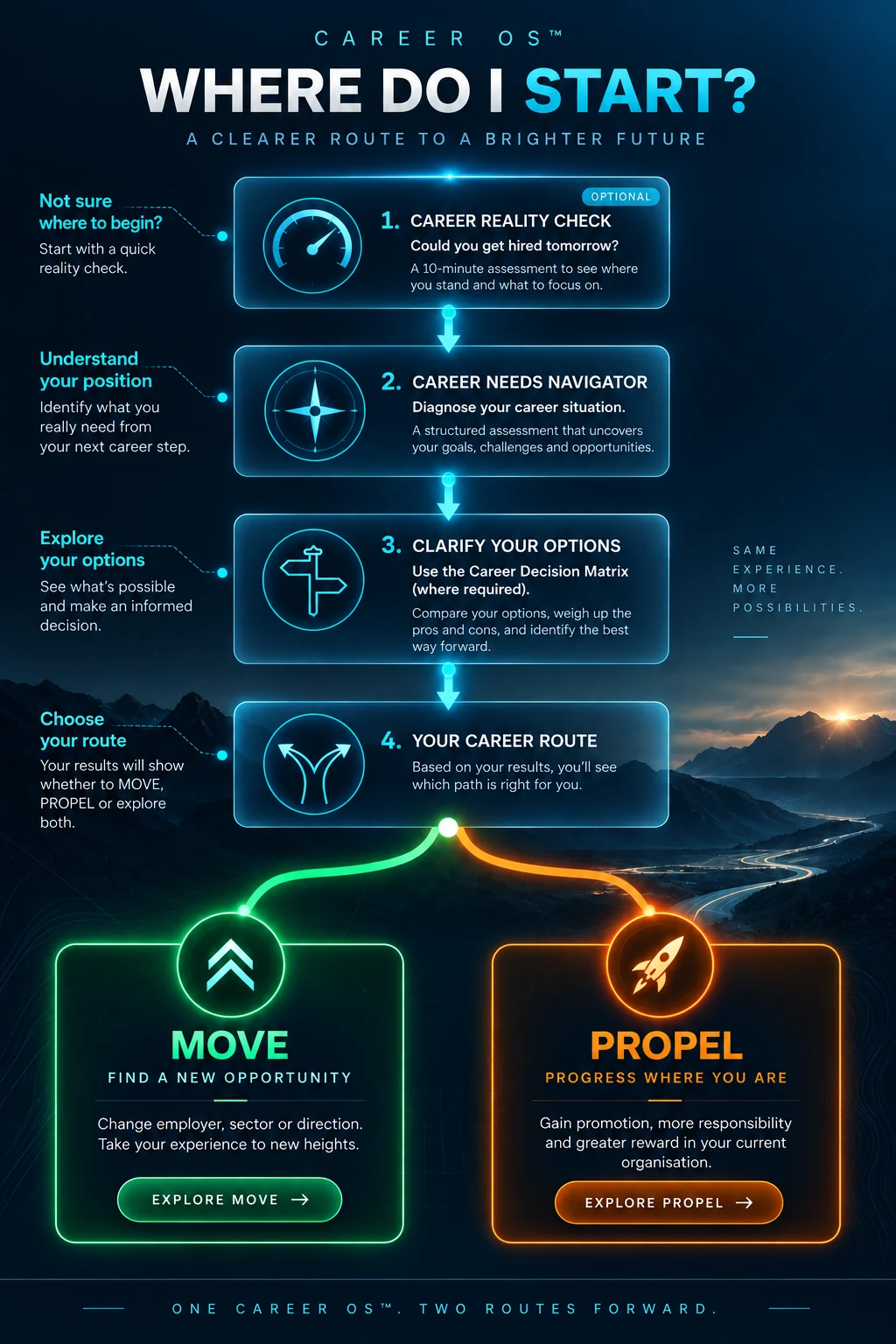
Career OS™ begins with diagnosis, not with a CV rewrite or a job search. A reality check establishes what is actually happening in your career, the Career Needs Navigator clarifies your credible options, and only then are you routed towards one of the two pathways.

One Career OS™. Two governed pathways. MOVE governs progression that requires an external change of role, employer, sector or direction. PROPEL governs progression built from where you already are.

Start with the Career Diagnosis or read how Career OS™ works end to end. You can also explore the Career OS™ tools and assessments for self-guided diagnostics.

Career OS career onboarding flow showing Reality Check, Career Needs Navigator, option clarification and the MOVE or PROPEL route decision.
Career OS™ orientation: reality check, needs navigation, option clarification, then the MOVE or PROPEL decision.

One System. Two Applications.

If you are unsure which application you need, start with the Career Needs Navigator — the overarching Career Positioning Diagnosis. It does not produce a MOVE or PROPEL readiness score; it determines which path-specific Readiness Assessment applies to you.

MOVE — When progression requires a move.

MOVE is the Career OS™ pathway for progression that requires a new role, employer, sector, geography or career direction.

Focus: market positioning, external opportunity creation, interview conversion and offer negotiation. Where those final two stages are the blocker, the work continues as interview consultation for engineering managers or a salary negotiation consultation. Recruiter market access includes the Automotive Transition Recruiter Network → for automotive engineers moving within automotive or into adjacent sectors. For an editorial walk-through, read the guide on structured support for mid-career change.

PROPEL — When progression can happen from where you are.

PROPEL is the Career OS™ pathway for progression through greater scope, influence, responsibility, recognition, promotion or reward from within the current environment.

Focus: internal positioning, stakeholder influence, visible evidence of value, progression opportunities and reward conversations.

The framework

The Six Stages of Career OS™

Six stages, in deliberate order, each with a measurable outcome — executed either as a MOVE or as a PROPEL.

The six stages never change. Switch the path to see how each stage is executed.

STAGE 01

Career Diagnosis

Decide what progression should mean. Clarify strengths, constraints, ambitions, commercial value, timing, risk and realistic options. The right diagnosis is the foundation of specialist engineering career consultancy and every other route.

MOVE

Define external role, level, employer type, sector, geography, reward and direction.

Where should I move, and why?

Outcome: A defined progression target and decision framework.

Read the chapter →
STAGE 02

Positioning Strategy

Decide what decision-makers should understand and remember about your value. Strong positioning is central to career positioning for technical leaders and executive career positioning in the UK.

MOVE

External-market positioning for recruiters, hiring managers and senior decision-makers: differentiation, role relevance, transferable value, executive narrative and sector translation.

Outcome: A differentiated professional position relevant to the decision-makers who matter.

Read the chapter →
STAGE 03

Evidence & Profile

Make the position credible with substantiating evidence.

MOVE

CV, LinkedIn profile, executive biography, achievement evidence, career narrative and application material.

Outcome: Decision-grade evidence aligned to the intended progression route.

Read the chapter →
STAGE 04

Opportunity Creation

Official stage name: Search & Networking

Create the conditions in which the right opportunities emerge.

MOVE

Market mapping, networking, recruiters, direct approaches, target organisations and selective applications.

Outcome: A governed opportunity pipeline relevant to MOVE or PROPEL.

Read the chapter →
STAGE 05

Conversion

Official stage name: Interview Mastery

Convert evidence into decision-maker confidence. Engineering managers can sharpen this stage through interview preparation for engineering managers.

MOVE

Interviews, panels, presentations, assessments, competency evidence and leadership questions — converting opportunity into offer.

Outcome: Stronger decision-maker confidence and improved conversion.

Read the chapter →
STAGE 06

Negotiation & Transition

Official stage name: Offer Negotiation

Convert progression into the right terms and conditions. The final stage is covered in detail by senior salary negotiation support.

MOVE

Salary, bonus, benefits, title, scope, flexibility, notice, long-term progression and role risk — then prepare for entry.

Outcome: A better-defined and better-negotiated progression outcome.

Read the chapter →

The Architecture Stays the Same. The Execution Changes.

MOVE and PROPEL are not separate career theories.

The same fundamental questions apply: What do I want? How should I be positioned? What evidence proves my value? Where will the opportunity come from? How will I influence the decision? What outcome should I negotiate?

What changes is the environment. MOVE is primarily governed by the external market. PROPEL is primarily governed by internal stakeholders, organisational dynamics and progression opportunities.

Career OS™ applies the same operating discipline to both.

Digital ecosystem

The Career OS™ Digital Ecosystem

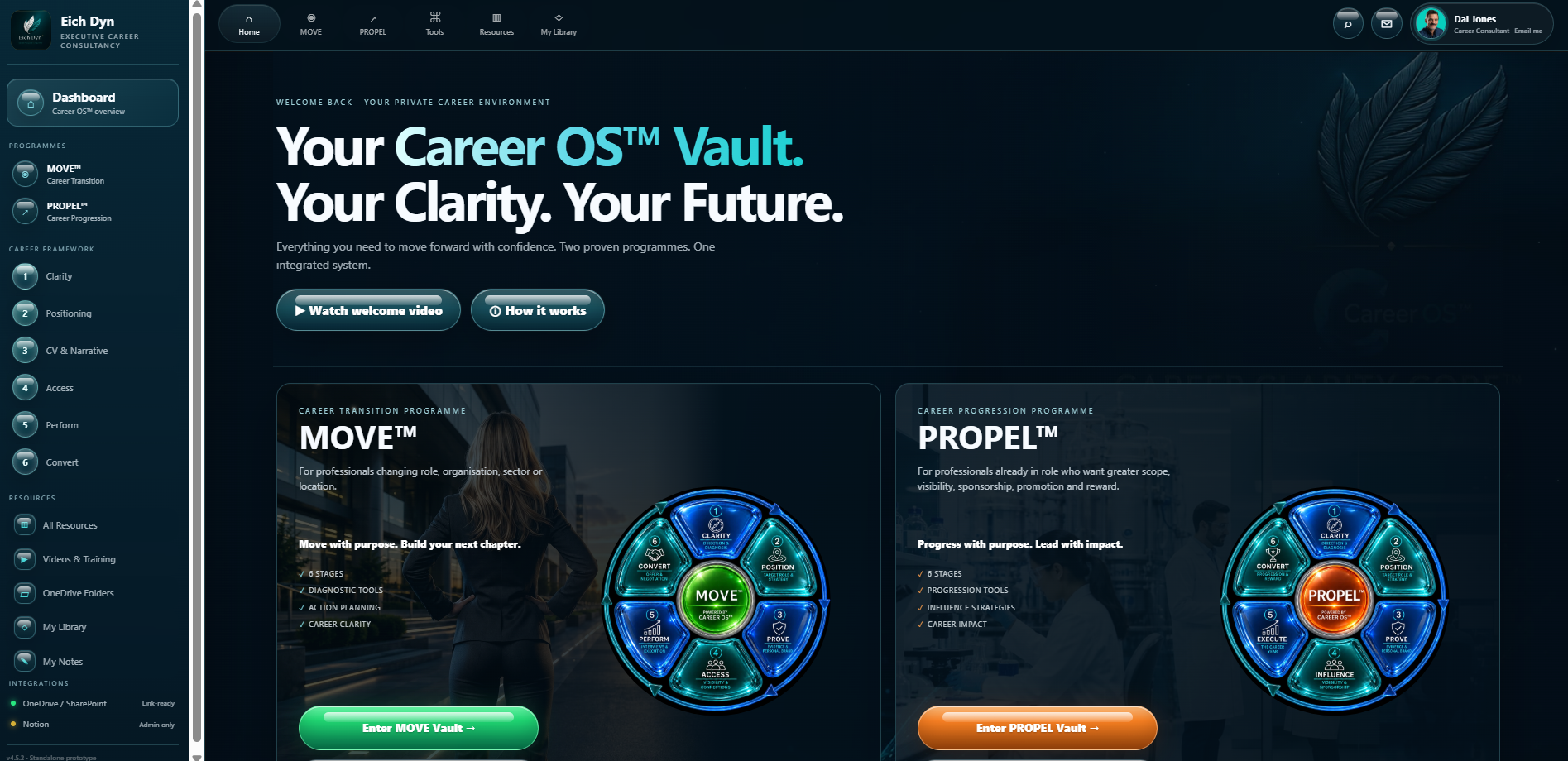
The Career OS™ Platform brings together the Vault, specialist tools, AI assistants and Career OS™ HQ.

The Portal is the client access point, the Vault is the protected asset library, Career OS™ HQ is the premium execution app, and the Knowledge Centre provides editorial and insight content around the methodology.

The Career OS™ Portal showing the MOVE and PROPEL programme wheels, tools, resources and progress tracking in one integrated environment.
The Career OS™ Portal: the client access point for all tools, assessments and resources for MOVE and PROPEL.

Supporting a MOVE

  • Career Decision Matrix for comparing options and directions
  • Interview preparation and the STAR question framework
  • Networking activity tracking
  • Salary and offer negotiation preparation

Supporting a PROPEL

  • Strengths and in-role satisfaction diagnostics
  • Impact-metrics library for evidencing commercial value
  • Stakeholder and network mapping for internal sponsorship
  • Reward and progression conversation preparation

Is Career OS™ the Same as Career Coaching?

No. A great many people arrive here after searching for career coaching, and the underlying problem is usually real: capability that is not converting into progression. Career coaching addresses that by asking questions until you reach your own conclusions, across whatever topic arises in the session.

Career OS™ is a structured career consultancy system instead. A Career Diagnosis establishes where career performance is actually being lost, then the six stages — positioning, evidence, search, interview and offer — are worked in sequence with direct professional judgement and defined outcomes. Coaching technique is used where ownership matters; consultancy judgement is used where objective assessment matters. It is the method behind Eich Dyn’s career consultancy practice, applied through specialist routes for engineers and technical specialists, technical leaders moving into strategic leadership and senior executives making high-stakes career moves.

Career OS™ for Different Career Challenges

The same methodology is applied through different service routes depending on the career problem you are solving.

Three levels. One outcome.

Choose how much human guidance you want.

Every route runs on the same Career OS™ methodology. Start with the £299 Digital Suite, or bring Dai Jones alongside for the Hybrid Programme or 10-Week Guided Intensive.

You remain in control. Across Career OS™, you drive the tools yourself, with immediate closed-loop feedback, clear report-outs and defined next actions.

Full Digital Suite
£299

The complete system, self-paced.

  • 425 digital assets in the Career OS™ Vault
  • Access to 55 AI-powered digital tools
  • Career OS™ Portal access
  • Core walkthroughs across the programme
  • Included 30-minute positioning call
  • 6 months' programme access & updates
  • Digital copy of “7 Highly Effective Hacks for Career Progression”
Apply →
Hybrid Programme
POA

Digital suite + 1:1 consultancy.

  • Everything in Digital Suite
  • 2× 1:1 consultancy sessions
  • Application & interview review
  • Unlimited email & text support
  • 12 months' programme access
  • Career OS™ Portal access
  • 1 month Career OS™ HQ access
  • Physical copy of “7 Highly Effective Hacks for Career Progression” posted to you
Apply →
10-Week Guided Intensive
POA

Structured execution with close 1:1 consultancy support.

  • Everything in Hybrid
  • Up to 10 × 1:1 consultancy sessions
  • Weekly execution, review & accountability
  • Position, evidence, apply, interview & negotiate
  • Lifetime programme access & updates
  • Lifetime Career OS™ HQ access
  • Career OS™ Portal access
  • Additional physical book: The Mindset of Confidence
  • Additional Onboarding module included
  • 10% rebate towards a future PROPEL™ programme
Apply →

See the full breakdown on the Pricing page.

FAQs

Career OS™ Questions

Click any question to expand the answer.

What is Career OS™?

Career OS™ is Eich Dyn's six-stage career operating system for experienced professionals. The six stages are Career Diagnosis, Positioning Strategy, Evidence & Profile, Opportunity Creation (Search & Networking), Conversion (Interview Mastery) and Negotiation & Transition. Career OS™ connects those stages into one sequence so direction, positioning, evidence and execution reinforce each other rather than being handled as separate tasks.

Who is Career OS™ for?

Career OS™ is for mid-career, senior and executive professionals who already have substantial capability but are not converting it into progression. It is used by people seeking promotion, greater scope, a move to a new employer or sector, a return after redundancy, or clearer career direction. It suits professionals who want structure, evidence and candid consultancy rather than encouragement alone.

What is Career OS™ MOVE?

Career OS™ MOVE is the execution path for progression that requires an external move — a different role, employer, sector, geography or career direction. MOVE applies the six stages to the external market: market positioning, CV and LinkedIn evidence, recruiters and direct approaches, interviews and offer negotiation. MOVE is one of two paths, not the whole of Career OS™.

What is Career OS™ PROPEL?

Career OS™ PROPEL is the execution path for progression from inside your current organisation or professional environment. PROPEL applies the same six stages to internal positioning, documented commercial impact, stakeholder and sponsorship mapping, promotion and succession conversations, and reward negotiation — for greater scope, influence, recognition, responsibility, promotion or pay without changing employer.

How is Career OS™ different from career coaching?

Career OS™ is a structured career consultancy system rather than open-ended career coaching. Coaching typically uses questions to help you reach your own conclusions across whatever topic arises. Career OS™ diagnoses where career performance is being lost, then works the six stages in sequence with direct professional judgement, evidence and defined outcomes at each stage.

Coaching techniques are used where ownership matters; consultancy is used where objective assessment matters.

Is Career OS™ only for engineers?

No. Career OS™ is used across engineering, technology, science, manufacturing, programme delivery, operations and wider leadership careers. Its origins in engineering and systems thinking make it especially well suited to technical professionals, but the method addresses career positioning, evidence and decision-making, which are not sector-specific.

What matters is the complexity of the career problem, not the job title.

Can Career OS™ help with internal promotion?

Yes — internal promotion is what the Career OS™ PROPEL path is designed for. PROPEL builds the promotion case through internal positioning, documented commercial impact and leadership evidence, stakeholder sponsorship, succession and progression conversations, and reward negotiation. No external job search is required, and the same six stages apply.

How does the Career OS™ programme work?

Career OS™ is delivered as a structured career-development process rather than a collection of unrelated coaching sessions.

The programme examines the major components of career progress, including clarity, positioning, application assets, job-search execution, interviews and negotiation.

The exact route depends on the client’s current position. Someone considering a career change may require different priorities from someone already attending final interviews.

Career OS™ therefore combines a defined system with individual diagnosis. Clients may use digital tools, written guidance, assessments and one-to-one support depending on the service selected.

The detailed sequence and intervention logic remain part of the programme.

The objective is to identify the right problem, address it in the right order and create a career system the client can continue to use beyond the immediate job search.

What is included in Career OS™?

Career OS™ brings together structured guidance, diagnostic tools, practical career resources and, where selected, individual consulting support, including targeted coaching where appropriate.

The system covers career direction, professional positioning, CV and résumé development, LinkedIn optimisation, job-search strategy, networking, interview preparation and offer negotiation.

The exact inclusions depend on the programme level chosen. Some clients may require self-directed access to tools and frameworks. Others may need direct review, challenge, accountability or specialist support for a complex transition.

Career OS™ is designed to provide an integrated process rather than a series of disconnected documents.

The objective is not to overwhelm clients with content. It is to provide the resources and support required for the specific stage they are facing.

Full details of the current programme options are provided during the appropriate consultation or programme discussion.

Who is the Career OS™ programme suitable for?

Career OS™ is suitable for experienced, mid-career and senior professionals who want a more structured approach to career management.

This includes people seeking promotion, changing sector, recovering from redundancy or a layoff, returning after a career break, improving a prolonged job search or preparing for senior interviews and negotiation.

It is particularly relevant where the career problem is complex and cannot be solved through a single document or generic advice.

Career OS™ is also suited to technical, engineering, scientific, project, programme and leadership professionals who value evidence, structure and disciplined decision-making.

The programme is less suitable for someone seeking only a quick cosmetic rewrite without examining the wider reasons their career campaign may not be working.

The objective is to work with clients who are prepared to engage with the process, provide evidence and implement agreed actions.

Do I need to complete the entire Career OS™ programme?

Not every client needs the same level of support or the same starting point.

Career OS™ covers the complete career journey, but the immediate priority depends on the evidence. A client may need to begin with career clarity, while another may already have a clear direction and require interview or negotiation support.

The value of the full system is that each area can be understood in relation to the others. Career OS™ does not assume that every client needs every intervention at the same depth.

The objective is to avoid both under-treatment and unnecessary work. Where one visible problem is caused by a deeper issue, addressing only the symptom may provide limited value. Where the problem is genuinely contained, a more focused response may be appropriate.

The recommended route is based on the client’s situation, readiness and objectives.

How long does the Career OS™ programme take?

The timescale depends on the programme selected, the complexity of the career problem and the pace at which the client can complete the work.

A focused intervention may be completed relatively quickly. A broader career transition, repositioning or job-search campaign may require a longer period of structured activity.

Career OS™ is not designed to prolong coaching unnecessarily. Equally, complex decisions should not be rushed simply to create the appearance of speed. The client’s availability, urgency and responsiveness also affect progress.

The objective is to move at a pace that supports sound decisions and proper implementation. Programme timescales, session frequency and expected client activity are explained before commencement.

Career progress also continues beyond the formal programme. The purpose is to leave the client with a stronger system, not create permanent dependence on the coach.

Career OS™ is the operating system. Seven Highly Effective Hacks for Career Progression — by Dai Jones — is the published foundation it was built on.