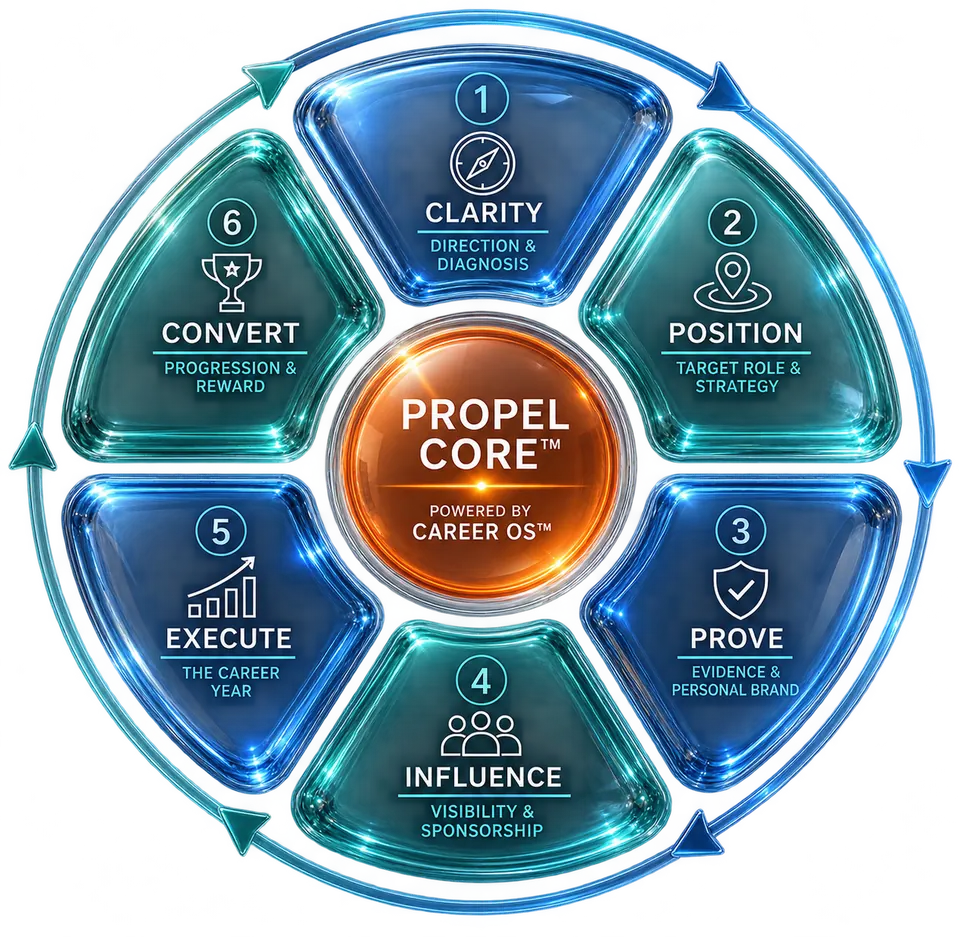
Role PositioningDeciding what decision-makers should understand and remember about your value
Role Positioning is the deliberate management of how internal decision-makers understand, describe and remember the value a professional brings, so that reputation points towards the level they intend to reach next rather than the level they already occupy.
OutcomeA clear, honest internal positioning statement, tested against how managers, functional directors, talent panels and peers currently describe you, with a plan to close the gap between reputation and intended level.
9 min read·
High-level summary
Reputation is a decision shortcut — it tells managers what problems to trust you with before they read your CV or hear you speak.
Role titles routinely lag behind actual scope, so an honest audit of decision rights and scale is essential before repositioning.
Positioning must translate technical work into commercial, strategic, risk, quality, customer or organisational consequence for each audience.
Outputs the client receives
✓A written internal value proposition statement
✓A reputation audit comparing current label to intended next-level position
✓An audience map covering manager, functional director, talent panel, cross-functional executive and specialist community framing
✓A translation bridge connecting technical work to commercial, strategic, risk or customer consequence
✓A consistency check across visible contribution, spoken narrative and written evidence
Career OS™ principle
“Your internal reputation is a decision shortcut; make sure it points to the level you want next.”
Who this stage is for
Technical specialists whose title has not kept pace with their real scope
Managers seen as reliable operators but not yet trusted with strategic or cross-functional problems
Professionals preparing for a promotion panel, talent review or succession conversation
People whose contribution is well regarded but poorly translated into business language
Anyone whose spoken narrative, written evidence and visible work currently tell different stories
Specialists moving from individual delivery into broader organisational influence
Why this stage matters
Most internal decisions about a person's future are not made in a formal review; they are made in corridor conversations, succession discussions and shorthand judgements formed long before a vacancy exists. When someone is asked whether a colleague is ready for more, they reach for the label already in their head. If that label was set two roles ago, it will not update itself, however good the recent work has been.
This is why capable people are repeatedly passed over for opportunities they are genuinely qualified for: not because the work was weak, but because the internal reputation never moved. The engineer known as "good at fixing things" stays the person you call when something breaks, not the person you promote to prevent it breaking. Role Positioning treats this as a solvable problem rather than an injustice to be endured, by deliberately shaping what decision-makers understand and remember.
Career OS™ PROPEL treats positioning as distinct from promotion-seeking self-advertisement. It is about accuracy: describing scale, decision rights and consequence honestly, in language each audience already uses to make decisions, so that reputation and capability finally point the same direction.
Cost of skipping it
Being repeatedly considered for roles below your actual current capability
Managers defending a version of you that no longer matches your scope
Talent panels discounting genuine achievement because it was framed too narrowly
Cross-functional colleagues underestimating your strategic contribution
Slower succession planning because no one can articulate what you would do next
Related Career OS™ tools
Practical resources that turn this PROPEL stage into action inside your current organisation.
Translate work into measurable organisational consequence. Your evidence strengthens Positioning Strategy, and Positioning Strategy shows which evidence still needs work.
Once your internal value proposition is written and tested against how each audience currently describes you, the next question is whether you have the evidence to support it. A positioning statement without proof invites scepticism.
The next stage, Outcomes & Evidence, builds the concrete record that makes your repositioned reputation credible rather than aspirational.
Role Positioning is the discipline of deciding, deliberately, what you want decision-makers to understand and remember about the problems you are trusted to solve. It sits between capability and opportunity: you can be entirely capable of the next level and still be overlooked because the story people tell about you has not caught up.
Positioning is not a slogan or a personal brand exercise. It is a precise statement of the business problems you solve, the scale at which you operate, and the decision rights you actually hold, expressed in language that lets a manager, panel or peer place you correctly without further explanation.
Why capable professionals get stuck here
Technical professionals often assume that strong work speaks for itself. It rarely does, because the people making decisions about your future are usually one or two steps removed from the detail of what you actually did. They rely on summarised impressions, secondhand accounts and whatever label first stuck.
A second reason people get stuck is title lag: promotions in scope frequently outpace promotions in title, particularly in flatter or fast-changing organisations. Someone may be making decisions well above their formal grade while still being introduced by an old job title, which quietly caps how they are considered for future opportunities.
Common mistakes
The most frequent mistake is describing activity rather than consequence: listing what was done instead of explaining what changed as a result. A second is inconsistency — telling one story in a one-to-one, another in a written case for promotion, and letting visible day-to-day work tell a third. Decision-makers notice the mismatch even when they cannot name it.
Over-explaining technical detail to audiences who need business consequence
Waiting to be asked rather than proactively shaping the narrative
Using inflated or hedged language instead of calm, plain statements
Letting one strong project define the whole reputation, positive or negative
Assuming a title change alone will fix a reputation gap
How Career OS™ PROPEL handles this stage
PROPEL treats positioning as a structured translation exercise. It starts with a reputation audit: what is the current label, in the words decision-makers would actually use, and how does it compare with the position the person is aiming for. The gap between the two becomes the brief for the rest of the stage.
From there, the work is to translate technical contribution into commercial, strategic, risk, quality, customer or organisational consequence, and to tailor emphasis for each relevant audience — a line manager cares about different things to a talent panel or a cross-functional executive. The output is a single accurate internal value proposition, expressed with calm authority and no hedging, that can be adapted in emphasis without changing in substance across every audience.
Audience-specific emphasis
The same true story needs different emphasis depending on who is listening. A line manager wants to know the person can be relied on for what is coming next in the immediate team. A functional director wants evidence of judgement across ambiguity and the ability to represent the function elsewhere. A talent panel wants comparability against a defined bar, expressed in language that survives being repeated by someone who was not in the room. A cross-functional executive wants proof of influence outside a direct reporting line. A specialist community wants technical credibility that has not been diluted by translation.
Getting this right means holding one honest position and choosing which parts of it to foreground, never inventing a different story for each room.
Composite example
An engineering manager had built a strong reputation over several years as the person you called when a delivery was in trouble — calm under pressure, technically sharp, always able to get a project back on track. It was a genuine strength, and it had become the entire story colleagues told about him.
The reputation audit showed the gap clearly: senior leaders still described him as "a safe pair of hands for a difficult project", while he was already coordinating three cross-functional workstreams, making resourcing trade-offs across teams, and had shaped decisions that reduced risk before problems ever became visible. None of that was in his prevailing narrative because it was quieter and less dramatic than firefighting.
Working through PROPEL, he rebuilt his internal value proposition around cross-functional delivery leadership: preventing failure through coordination rather than rescuing it after the fact. He adjusted how he spoke in leadership forums, what he wrote in project updates, and which of his contributions he chose to make visible. Within two review cycles, the language used about him by his own director had shifted from "reliable fixer" to "someone we trust to run complex cross-team delivery" — the position he had actually already earned.
A practical exercise
Write down, in one sentence each, how you believe your manager, your functional director and one cross-functional peer would currently describe your value if asked. Then write the sentence you want each of them to be able to say in twelve months. The distance between the two pairs of sentences is your positioning brief.
List the three business problems you are actually trusted to solve today
Note where your title or formal scope understates your real decision rights
Draft one internal value proposition statement in plain, unhedged language
Identify the one audience where your current narrative is weakest
The evidence to collect
Positioning claims need to be anchored in something concrete, even at this early stage. Start gathering examples of decisions you influenced or made, the scale of what you were responsible for, and instances where your input changed a commercial, strategic, risk or customer outcome. This evidence will be formalised properly in the next stage, but collecting it now keeps your positioning statement grounded rather than aspirational.
FAQs · Role Positioning
Questions professionals ask about role positioning
Click any question to expand the answer.
What is the difference between Role Positioning and personal branding?⌄
Personal branding often focuses on external visibility and self-promotion, while Role Positioning is about accurately shaping how internal decision-makers understand the business problems you solve. It is grounded in honest description of scope and consequence, not image management.
How do I know if my job title has fallen behind my real scope?⌄
A useful test is whether your title alone would let a new colleague correctly guess the scale of decisions you make and the people who rely on your judgement. If it would not, there is likely a lag between title and actual responsibility.
Should I raise a reputation gap directly with my manager?⌄
Yes, but frame it around the business problems you are ready to take on rather than a complaint about recognition. Managers respond better to a forward-looking case than to a retrospective grievance.
How do I translate technical work into commercial language without oversimplifying it?⌄
Keep the technical substance intact but lead with the consequence: what risk was reduced, what cost was avoided, what customer outcome improved, or what strategic option was created. The detail can follow once the consequence is understood.
Is it dishonest to emphasise different aspects of my work for different audiences?⌄
No, provided the underlying facts are consistent. Emphasis should change with the audience's priorities, but the substance of the story must remain the same whoever is listening.
What if my visible contribution does not match my spoken narrative?⌄
This is one of the most common causes of stalled positioning, and it usually means either the narrative is exaggerated or the visible work is not being deliberately shaped to reflect your real contribution. Both the story and the visible evidence need to be brought into alignment.
How long does it take for a repositioning to change how people describe you?⌄
It varies by organisation, but most professionals see language shift within one or two review or planning cycles, provided the new position is reinforced consistently in speech, writing and visible work rather than stated once.
Does Role Positioning apply if I am not seeking promotion right now?⌄
Yes. Accurate positioning also protects against being sidelined, deprioritised or excluded from opportunities you are not actively pursuing but would want to be considered for later.
How does a talent panel's view of me differ from my manager's?⌄
A manager typically judges you against immediate team needs and day-to-day reliability, while a talent panel judges you against a broader, more comparative bar for the next level, often based on secondhand summaries rather than direct observation.
What comes after Role Positioning in Career OS™ PROPEL?⌄
The next stage, Outcomes & Evidence, builds the concrete proof that supports the position you have just defined, so that your reputation is backed by demonstrable results rather than assertion alone.
Career OS™ PROPEL
Stop leaving your progression to the appraisal cycle.
A Career Diagnosis establishes what progression should mean in your organisation, what evidence the next level requires, and the route most likely to produce it.