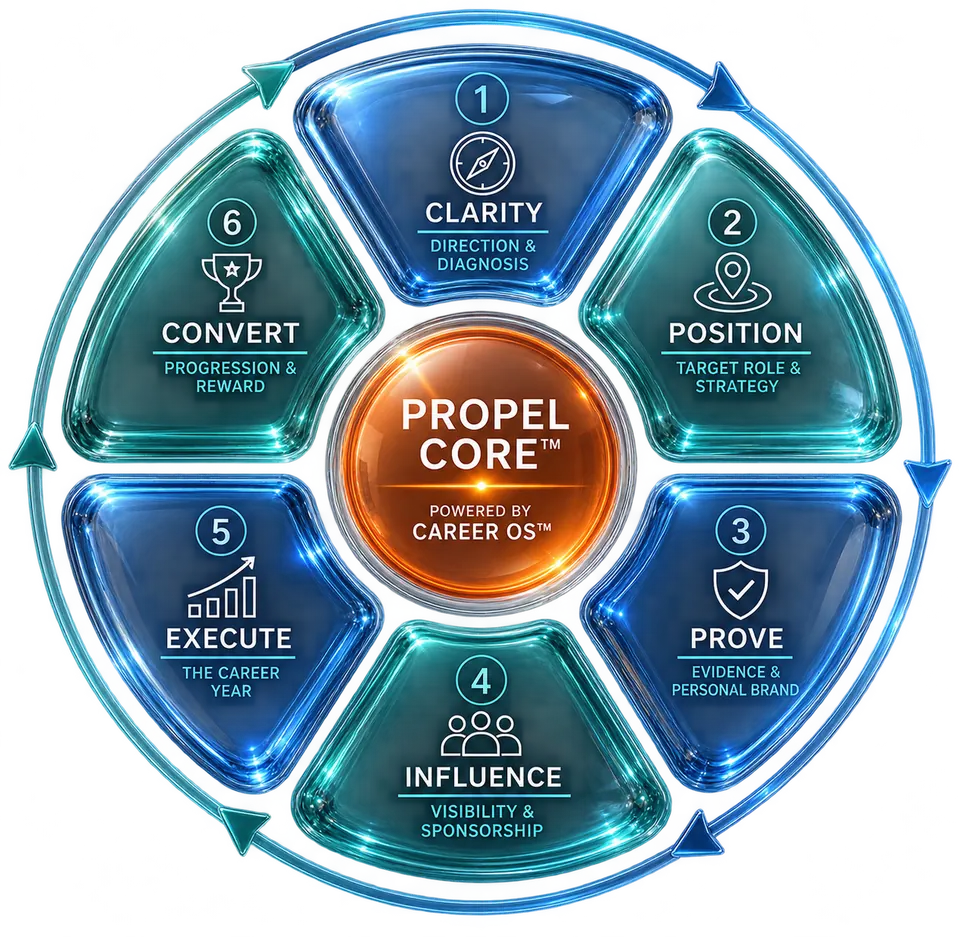
Presence & InfluenceMaking your value visible to the people who allocate opportunity, scope and sponsorship
Presence & Influence is the PROPEL stage in which validated evidence of impact is made legible to the stakeholders who decide on scope, sponsorship and opportunity.
OutcomeYou leave this stage with a working stakeholder map, a defined sponsorship pathway and a communication discipline that makes senior decision-makers understand your contribution without you needing to advertise it.
11 min read·
High-level summary
Reframes visibility as decision-useful information for stakeholders, not personal publicity or self-promotion.
Builds a disciplined stakeholder map across influence, interest, relationship strength and relevance to your direction.
Distinguishes mentors, advocates and sponsors, and treats sponsorship as earned confidence rather than a request.
Outputs the client receives
✓A stakeholder map scored by influence, interest, relationship strength and relevance
✓A managing-upwards brief covering your manager's pressures, preferences and information needs
✓A sponsorship readiness assessment identifying who could sponsor you and what confidence is missing
✓An executive communication template built on conclusion, consequence, decision, evidence
✓A structured internal networking plan with defined reciprocity and introduction actions
Career OS™ principle
“Visibility is not being seen more often; it is being understood by the right people for the right contribution.”
Who this stage is for
Technical specialists whose depth is respected but rarely translated for senior audiences
Professionals whose manager is supportive but has limited influence over the decisions that matter
People who feel exposed by self-promotion and have therefore avoided visibility altogether
Those with strong delivery evidence from Outcomes & Evidence who now need it to reach the right rooms
Professionals who suspect they are respected but not sponsored
Anyone whose good work is known only to the people directly around them
Why this stage matters
Evidence that sits in a personal record achieves nothing until it reaches the people who allocate opportunity. Presence & Influence is the stage where Career OS™ shifts attention outward: from having proof of impact to ensuring the right stakeholders hold an accurate, current understanding of that impact when decisions are made about scope, promotion or sponsorship. This is not about being liked more, or being louder; it is about being legible to people who do not have time to reconstruct your contribution from first principles.
Many capable professionals resist this stage because it feels adjacent to self-promotion, and the discomfort is often well-founded — clumsy visibility damages credibility faster than silence does. Career OS™ treats visibility as an information problem rather than a personality trait: senior stakeholders are managing risk, workload and competing priorities, and they can only act on your behalf if they understand what you have done, what it has enabled and what you are ready for next. Presenting that information clearly is a professional obligation, not vanity.
The cost of skipping this stage is a familiar and quietly corrosive one: strong performers who are trusted for delivery but never considered for the next scope of responsibility, because no one with influence over that decision has ever been given a reason to think of them differently. Sponsorship, in particular, cannot be requested into existence; it has to be built on a foundation of understood, evidenced contribution, which is exactly what this stage constructs.
Cost of skipping it
Strong delivery remains invisible to the people who make allocation and promotion decisions
Managers with limited organisational influence become the sole channel for your visibility
Sponsorship never materialises because no senior stakeholder has enough understanding to advocate confidently
Clumsy self-promotion attempts damage credibility and trigger scepticism instead of confidence
You remain reliably useful at your current level, with no case being built for the next one
Related Career OS™ tools
Practical resources that turn this PROPEL stage into action inside your current organisation.
Practical templates for stakeholder mapping and executive briefs
Next decision
Once your contribution is understood by the right stakeholders, the question becomes whether you can convert that understanding into performance under real conditions — interviews, panels, negotiations and high-stakes conversations where composure and evidence must work together in the moment.
The next stage, Execution, takes the case you have built here and pressure-tests it in exactly those settings.
What Presence & Influence means in Career OS™ PROPEL
Presence & Influence is the deliberate practice of ensuring that the people who allocate opportunity, scope and sponsorship have an accurate, current and decision-useful understanding of your contribution. It sits after Outcomes & Evidence for a reason: you cannot responsibly make yourself visible until you have something substantiated to show, and visibility without substance is precisely the self-promotion that damages credibility.
This stage is not about maximising how often you are seen. It is about ensuring the right handful of people — those with genuine influence over your next opportunity — understand what you have done, what problem it solved and what it signals about your readiness. Everything else is noise.
Why capable professionals get stuck here
Technically strong professionals often assume that good work will be noticed on its own merits, and are then disappointed when it is not. The organisation does not automatically know what you know about your own contribution; senior stakeholders are managing dozens of competing priorities and rarely have time to piece together the significance of someone else's work unless it is presented to them clearly.
A second, equally common block is discomfort with anything that resembles self-promotion, particularly among specialists whose professional identity is built on letting the work speak for itself. This discomfort is not irrational — poorly executed visibility does erode trust — but it leads many capable people to avoid the entire domain rather than learn to do it well.
Assuming strong delivery will be noticed and rewarded without deliberate communication
Treating the direct manager as the only stakeholder who needs to understand their value
Avoiding visibility altogether out of discomfort with self-promotion
Confusing being liked or well-known with being understood for a specific contribution
Common mistakes
The most damaging pattern is transactional sponsorship-seeking: approaching a senior figure and asking directly to be sponsored before any track record of trust or understanding has been established. Sponsorship is a conclusion a senior stakeholder reaches on their own, based on evidence and confidence built over time; it cannot be requested cold without appearing presumptuous.
A second mistake is generic networking — collecting contacts and attending events without a clear sense of which relationships are actually relevant to the direction set at the start of PROPEL. A third is conflating volume of visibility with quality of understanding: being present in every meeting and thread is not the same as being understood for a specific, valuable contribution by the people who matter.
Asking for sponsorship before earning the confidence that makes it credible
Networking broadly without mapping relevance, influence or interest
Mistaking frequency of exposure for depth of understanding
Presenting technical detail to senior audiences instead of conclusions and consequences
Neglecting relationships with peers and adjacent teams who shape reputation informally
Managing upwards and stakeholder mapping
Managing upwards is not deference; it is understanding the pressures, preferences, risks and information needs of the people you report to and work alongside, so that your contribution is framed in terms that matter to them. A manager under budget pressure needs different information from one focused on delivery risk or team development, and Career OS™ treats this as a mapping exercise rather than guesswork.
Stakeholder mapping extends that discipline outward: for each significant stakeholder, PROPEL asks you to assess their influence over your next opportunity, their interest in your work, the current strength of the relationship and its relevance to the direction you set out at the start of the programme. This produces a short, prioritised list rather than an unmanageable network, and it directs your limited time towards the relationships that will actually move your career.
Mentors, advocates and sponsors — and how sponsorship is earned
These three roles are often conflated but function very differently. A mentor offers guidance and perspective, usually without organisational risk on their part. An advocate speaks well of you when your name comes up, which extends your reach modestly. A sponsor uses their own credibility and influence to actively open doors for you — recommending you for opportunities, defending your case in rooms you are not in — and therefore takes on real risk by doing so.
Because sponsorship carries risk for the sponsor, it is earned rather than requested. It accumulates through repeated, observed evidence that you deliver reliably, represent yourself and others accurately, and handle responsibility well beyond your current remit. Career OS™ treats sponsorship readiness as an output of consistent presence and evidence, not a conversation to be engineered.
Senior stakeholders operate under time pressure and need information structured for rapid, confident decision-making. Career OS™ teaches a simple structure for any update, brief or conversation with senior audiences: lead with the conclusion, state the consequence if no action is taken, name the decision being asked for, and support it with evidence — in that order, not the reverse.
This is the opposite of how many technical professionals are trained to communicate, where evidence and method are presented first and the conclusion arrives last. Reordering the sequence does not simplify the thinking behind the work; it simply respects the audience's need to reach the point quickly, and it is one of the highest-leverage habits this stage builds.
Ethical organisational politics
Career OS™ treats organisational politics as a legitimate professional skill when practised ethically: understanding how decisions actually get made, listening before forming a position, disagreeing constructively rather than avoiding conflict, and protecting the trust of colleagues even when interests diverge. This is distinct from manipulation, credit-taking or undermining others, none of which Career OS™ endorses or teaches.
A further discipline covered here is avoiding the trap of becoming indispensable only for current-level delivery. Being the only person who can do a particular job well is often mistaken for career security, but it frequently blocks progression because no one wants to lose you from that seat. Sustainable presence includes visibly developing others and documenting your knowledge, so your value is understood as leadership capability rather than as irreplaceable current-role output.
Composite example: the senior technical specialist building sponsorship
A senior technical specialist, several years into a role where their expertise was well regarded within their immediate function, had never been considered for cross-functional leadership opportunities. Diagnosis found the issue was not capability but reach: their manager had modest influence over senior-level allocation decisions, and no one beyond the immediate team understood the commercial consequences of their technical judgement.
Rather than pursuing generic networking or asking directly for sponsorship, they built a short stakeholder map, identified two senior figures whose priorities intersected with their expertise, and began sharing conclusion-first updates on decisions their work had shaped. Over several months, one of those stakeholders began citing their judgement unprompted in senior discussions — sponsorship earned through demonstrated relevance, not requested through a direct ask.
A practical exercise
List the five to eight stakeholders most relevant to your next opportunity, and score each on influence, interest, relationship strength and relevance to your direction. For the two or three highest-scoring names, identify one piece of decision-useful information about your contribution that they currently do not have, and plan a natural, low-friction way to share it in the coming month.
The evidence to collect
Evidence at this stage is relational and behavioural rather than purely output-based: a completed stakeholder map, a record of managing-upwards briefs delivered, examples of executive-structured communication used in real settings, and any observable signs of advocacy or sponsorship emerging, such as being mentioned in rooms you were not in or being approached for opportunities you did not seek.
FAQs · Presence & Influence
Questions professionals ask about presence & influence
Click any question to expand the answer.
Isn't this stage just self-promotion with better language?⌄
No. Self-promotion focuses on drawing attention to yourself; Presence & Influence focuses on ensuring specific stakeholders have accurate information they need to make good decisions. The distinction is deliberate and shapes everything the stage teaches.
What if my manager has very little organisational influence?⌄
This is common and is exactly why stakeholder mapping looks beyond the direct reporting line. You still manage upwards effectively with your manager, but you also identify other senior stakeholders whose influence is more relevant to your next opportunity.
How is a sponsor different from a mentor?⌄
A mentor offers guidance and perspective without taking on organisational risk. A sponsor actively uses their own credibility to open doors and advocate for you, which is why sponsorship must be earned through demonstrated reliability rather than requested directly.
Can I ask someone senior to be my sponsor?⌄
Asking directly rarely works well, because sponsorship depends on confidence the sponsor has formed through observed evidence. It is more effective to build understanding and trust consistently and allow sponsorship to emerge as a natural conclusion.
I find self-promotion uncomfortable. Does this stage require it?⌄
It does not require self-promotion. It requires clear, honest communication of decision-useful information to the right people, which is a different and more comfortable discipline once separated from the idea of performing for attention.
What is the conclusion, consequence, decision, evidence structure for?⌄
It is a communication structure for senior audiences who need to reach the point quickly. You lead with your conclusion, explain the consequence of inaction, state the decision you are asking for, and then support it with evidence, rather than building up to the conclusion at the end.
How many stakeholders should I focus on?⌄
Most professionals get more value from a short, well-chosen list of five to eight stakeholders scored by influence, interest, relationship strength and relevance than from broad, undirected networking.
Is organisational politics something Career OS™ actually endorses?⌄
Career OS™ treats ethical organisational politics — understanding decision-making, listening first, disagreeing constructively and protecting trust — as a legitimate professional skill, and explicitly rejects manipulation or credit-taking.
What does it mean to become indispensable only for current-level delivery?⌄
It means you become so critical to your present role that no one wants to move you out of it, which quietly blocks progression. This stage encourages visibly developing others and documenting knowledge so your value is read as leadership capability rather than irreplaceability in place.
How does this stage connect to Outcomes & Evidence before it?⌄
Outcomes & Evidence builds the substantiated record of your impact; Presence & Influence ensures that record reaches and is understood by the stakeholders who can act on it. Visibility without prior evidence risks looking like empty self-promotion.
What comes after Presence & Influence?⌄
The next stage, Execution, pressure-tests the case you have built in real, high-stakes settings such as interviews, panels and negotiations, where composure and evidence need to work together under pressure.
Career OS™ PROPEL
Stop leaving your progression to the appraisal cycle.
A Career Diagnosis establishes what progression should mean in your organisation, what evidence the next level requires, and the route most likely to produce it.