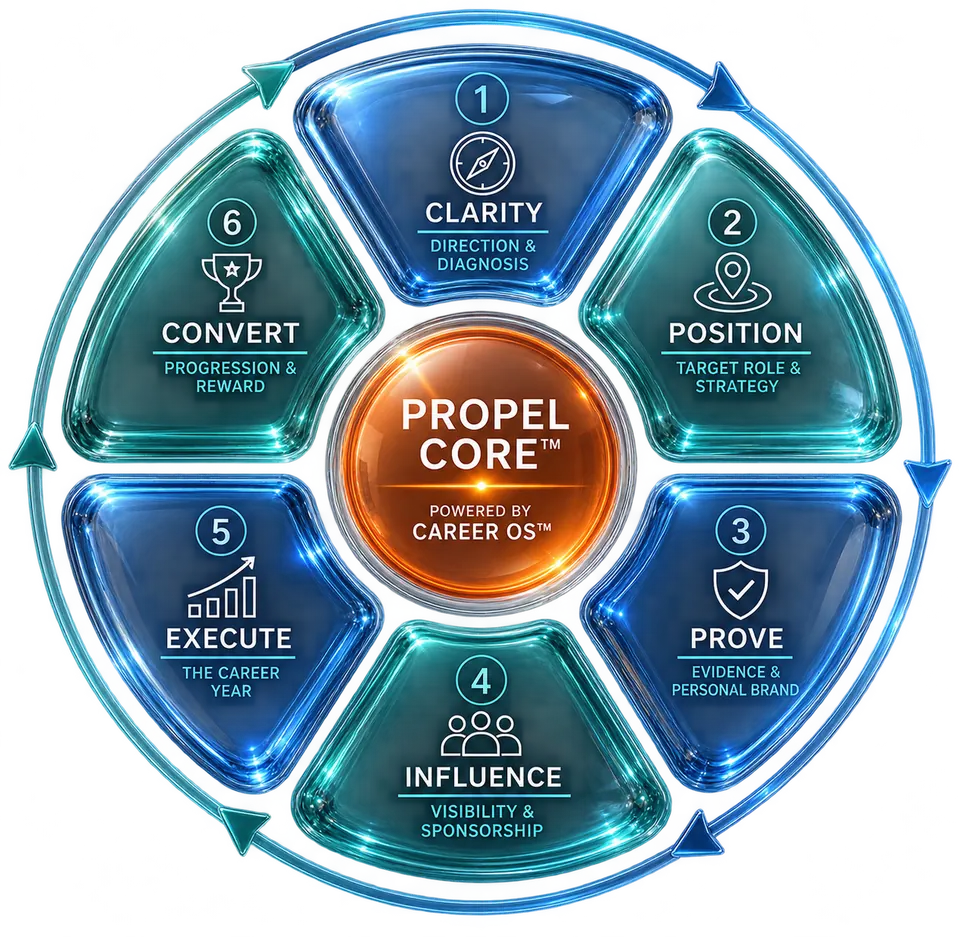
ExecutionDeliberately build the capability, opportunities and evidence the next level requires
Execution is the disciplined stage of Career OS™ PROPEL in which a professional treats progression as a managed campaign, closing capability gaps and generating decision-grade evidence rather than waiting for recognition to arrive unprompted.
OutcomeYou leave this stage with a live 90-day execution plan, a named capability gap being closed, and at least one stretch assignment or scope change that is actively producing evidence for your next level.
11 min read·
High-level summary
Progression stops being hoped for and starts being engineered, milestone by milestone, review by review.
One high-leverage capability gap is closed at a time, using the current role as the proving ground for the next one.
Scope, stakeholder exposure and decision consequence are pursued deliberately — title and reward are treated as lagging, not leading, indicators.
Outputs the client receives
✓A named, prioritised capability gap and a plan to close it within one review cycle
✓A 90-day PROPEL execution plan with milestones and monthly review points
✓One stretch assignment selected for strategic relevance, not extra workload
✓A leading-indicator tracker covering relationships, evidence, scope and feedback
✓A boundary statement for any acting-up or stretch scope, with a defined review date
Career OS™ principle
“Do not simply do more work; choose work that changes what the organisation can credibly trust you to do.”
Who this stage is for
Professionals who are performing strongly but cannot point to evidence of readiness for the next level
Technical leaders being asked to take on more without any accompanying scope, title or reward conversation
People who have identified the right direction and built visibility, but now need a deliberate plan of action
Those offered a stretch assignment and unsure whether it will build their case or simply absorb their time
Professionals wary of open-ended acting-up arrangements that never convert into a substantive role
Anyone who suspects their current organisation may not be able to supply the opportunity they need
Why this stage matters
Most careers stall not from a lack of effort but from a lack of aim. Capable people take on more work, absorb more pressure and deliver more output, yet none of it changes what the organisation is willing to trust them with. Execution is the stage where that pattern is broken: effort is redirected from volume to leverage, and every stretch of work is chosen because it closes a specific, named gap between current standing and the next level.
This requires treating progression as a campaign rather than a hope. A campaign has milestones, review dates and a defined target state. It distinguishes between doing the current job well — which protects standing — and generating evidence of the next job, which builds a case. The two are related but not the same, and conflating them is one of the most common reasons strong performers plateau despite good appraisals.
The cost of skipping this stage is not dramatic failure; it is quiet stagnation. Years pass, competence deepens, but the organisation's mental model of what a person can be trusted with never moves. Deliberate execution is what converts capability that already exists into a credible, evidenced case for what comes next.
Cost of skipping it
Years of strong delivery that never translate into expanded scope or title
Stretch assignments accepted indiscriminately, diluting focus and evidence quality
Indefinite acting-up arrangements with no review date and no formal recognition
Capability gaps left unaddressed until they surface publicly, at cost to reputation
Reliance on an annual appraisal cycle to surface progress that should be self-tracked monthly
Related Career OS™ tools
Practical resources that turn this PROPEL stage into action inside your current organisation.
Once a capability gap is being closed and a piece of evidence-generating work is underway, the question shifts from 'what should I do' to 'how do I make sure this converts'. That is the leverage and progression stage: turning demonstrated readiness into an actual decision — promotion, move, or negotiated change in standing.
If the 90-day plan surfaces a structural block — no available scope, no sponsor willing to test you, a stalled talent cycle — that finding belongs here too. Execution includes recognising early when the internal path cannot supply what is needed, and preserving the option to look outward without abandoning the internal effort prematurely.
Execution is the point in Career OS™ PROPEL where direction, positioning and visibility are converted into action. By this stage a professional should already know where they are heading and how they are perceived; execution is the deliberate work of closing the gap between that positioning and what the organisation currently trusts them to do.
The defining discipline is selectivity. Rather than accepting every piece of extra work as evidence of commitment, execution asks a sharper question of each opportunity: does this close a specific capability gap, expose me to the right stakeholders, or attach me to a decision with real consequence? Work that fails all three tests is simply more work, however well it is performed.
Why capable professionals get stuck here
The most common trap is confusing busyness with progress. Strong performers are, almost by definition, given more to do — and they tend to accept it, because saying yes is easier and feels like the responsible choice. Over several years this produces a heavier workload but not a materially different case for advancement, because the additional work was never chosen for its evidential value.
A second trap is waiting for permission. Many professionals hold back from stretch work, cross-functional exposure or scope expansion until someone formally offers it, rather than proposing it themselves with a clear rationale. Opportunities of real consequence are rarely advertised; they are shaped, negotiated and, in many cases, requested.
Accepting additional workload without asking what capability or evidence it builds
Waiting to be offered stretch opportunities rather than proposing them
Allowing acting-up arrangements to run indefinitely without a review point
Treating the current role's success as automatically evidencing next-level readiness
Under-investing in the relationships that will ultimately sponsor the decision
Common mistakes in execution
Beyond indiscriminate workload, the second cluster of mistakes concerns pacing and focus. Some professionals try to close every perceived gap simultaneously — technical depth, commercial fluency, stakeholder management, delivery track record — and end up making shallow progress on all fronts rather than decisive progress on one. Career OS™ PROPEL treats this as a sequencing error: one high-leverage gap, closed convincingly, does more for a case than five gaps addressed superficially.
A related mistake is accepting acting-up or interim scope without agreeing what happens next. Deputising, covering a vacancy or absorbing a departed colleague's responsibilities can be a legitimate route to evidence, but only if it is bounded: a review date, an explicit understanding of what success looks like, and a fallback if the arrangement is not formalised. Left open-ended, it becomes unpaid extra work with no natural end point.
How Career OS™ PROPEL handles execution
PROPEL treats execution as a managed campaign with three moving parts: a single prioritised capability gap, a portfolio of evidence-generating activity, and a review rhythm that keeps both honest. The capability gap is identified in earlier PROPEL stages and is deliberately narrowed to one item at a time — the skill, exposure or track record most likely to unlock the next credible decision about the professional's standing.
Evidence-generating activity is then selected against three tests: strategic relevance to the organisation's priorities, exposure to the stakeholders who influence the next decision, and proximity to a decision of real consequence. Internal mobility, secondments, cross-functional projects and shaped roles are all legitimate routes, but each is assessed against those tests rather than accepted by default. Monthly reviews check progress against the 90-day plan and adjust course before drift sets in.
Scope before title, and leading before the title
A recurring PROPEL principle is that scope is easier to obtain than title, and scope well used is what eventually makes the title case for itself. Rather than lobbying for a new job title, the more productive move is often to negotiate an expansion of decision-making scope within the current role — a budget line, a team, a client relationship, a delivery stream — and then to lead it with the judgement expected at the next level.
This means making sound decisions within that bounded scope, communicating them clearly, and being accountable for the outcomes, well before any formal promotion. It is a deliberate act of demonstration, not self-promotion: the organisation is shown, through real decisions, what it can trust the person to own. The boundary that protects this approach is a clear limit on how long expanded scope can run without formal recognition or reward being discussed.
Timing, succession cycles and preserving optionality
Execution also requires reading the organisation's own rhythm. Most employers run informal or formal succession and talent cycles — moments when scope is reallocated, roles are reshaped or vacancies are planned for. Positioning evidence and capability development to be visible just ahead of those cycles, rather than immediately after, materially improves the odds that effort converts into a decision rather than sitting unconsidered for another year.
At the same time, PROPEL is candid that not every organisation can supply the opportunity a professional needs, regardless of how well execution is run internally. Part of disciplined execution is monitoring, honestly, whether the internal path is producing real movement within a reasonable timeframe. Where it consistently is not, preserving external optionality — a live market view, an updated case, selective conversations — is not disloyalty; it is a rational hedge against a structural constraint the individual cannot solve alone.
A composite example: the recovery assignment
A senior data engineering lead, strong technically but not yet trusted with cross-functional accountability, was offered a struggling platform-migration programme that others had avoided. Rather than treating it as unwelcome extra work, they reframed it through the PROPEL execution lens: it offered senior stakeholder exposure, a genuine decision of consequence — whether the migration would proceed, pause or be re-scoped — and a direct test of the judgement expected at the next level.
They negotiated explicit scope (decision rights over the recovery plan, not just delivery of tasks already agreed), set a review date three months out, and tracked leading indicators monthly: which stakeholders now sought their view unprompted, what decisions they had been allowed to make unsupervised, and what language sponsors used to describe them. By the review point, the recovery had stabilised and, more importantly, the organisation's language about the individual had shifted from 'strong engineer' to someone capable of running ambiguous, high-stakes work — the precise evidence their case had been missing.
A practical exercise: build the 90-day plan
Name the single highest-leverage capability gap standing between the current role and the next level, and write one sentence describing what closing it would let others credibly say about you. Then identify one live or obtainable piece of work that would close that gap while meeting the strategic-relevance, stakeholder-exposure and decision-consequence tests.
Set three monthly checkpoints. At each, record what evidence was created, which relationships were strengthened, what scope was gained or lost, what feedback was received, and whether any decision milestone was reached. Where the plan reveals no available route internally, note the date by which an external option should be reconsidered.
One named capability gap and the sentence that defines it as closed
One selected piece of evidence-generating work, tested against relevance, exposure and consequence
Three monthly review dates with defined leading indicators
A boundary and review date for any acting-up or stretch scope
A trigger point for reconsidering external optionality
The evidence to collect
Execution succeeds when it leaves behind a specific, verifiable record: instances of independent decision-making within expanded scope, unprompted recognition from senior stakeholders, measurable outcomes from the stretch assignment, and any shift in the language used about the individual by those who influence the next decision. This evidence is what feeds directly into leverage and progression, where it is converted into a formal case.
Equally important is evidence of what did not work — capability gaps that proved harder to close than expected, or opportunities that failed to materialise despite good positioning. Recorded honestly, this becomes the input for recalibrating the plan rather than repeating the same approach without adjustment.
FAQs · Execution
Questions professionals ask about execution
Click any question to expand the answer.
How is execution different from simply working hard in my current role?⌄
Working hard protects your standing in the current role, but it does not automatically produce evidence for the next one. Execution is the deliberate selection of work chosen for its capability-building, stakeholder-exposure and decision-consequence value, rather than for volume alone.
How many capability gaps should I try to close at once?⌄
One. Career OS™ PROPEL treats sequencing as central: closing a single high-leverage gap convincingly produces a stronger case than making shallow progress across several gaps simultaneously.
Should I accept every stretch assignment I am offered?⌄
No. A stretch assignment is worth accepting when it offers strategic relevance, exposure to the stakeholders who influence your next decision, and proximity to a consequential outcome; assignments that offer only extra workload should generally be declined or renegotiated.
What if I am asked to act up without a formal offer or timeline?⌄
Set a boundary before you agree: a defined review date, an explicit description of what success looks like, and a clear understanding of what happens if the role is not formalised by then. Indefinite, unreviewed acting-up rarely converts into a substantive decision on its own.
How do I lead before I have the title?⌄
Negotiate bounded scope within your current role — a budget, a team, a client relationship — and exercise the judgement expected at the next level within that scope, communicating decisions and outcomes clearly so the organisation can observe your readiness directly.
What is a 90-day PROPEL execution plan?⌄
It is a short, structured plan naming one capability gap, one piece of evidence-generating work, and three monthly review points at which relationships, evidence, scope and feedback are checked against progress toward the next decision.
What are leading indicators of progression, and why track them?⌄
Leading indicators are early signals — stronger stakeholder relationships, new evidence created, expanded scope, direct feedback and decision milestones reached — that a case is strengthening well before any formal promotion or move occurs, allowing you to adjust course early.
How does succession or talent-cycle timing affect execution?⌄
Most organisations reshape roles and reallocate scope around informal or formal succession cycles, so positioning your evidence and readiness just ahead of those cycles improves the likelihood that your effort is considered rather than overlooked for another year.
What if my organisation cannot offer the opportunity I need?⌄
Continue executing internally, but monitor progress honestly against your plan, and preserve external optionality — a current market view and an updated case — as a rational hedge if the internal path consistently fails to produce movement.
Does execution guarantee promotion or a pay rise?⌄
No. Execution improves your readiness and strengthens the evidential case for the next level, but decisions on promotion, pay or selection remain the organisation's to make and depend on factors beyond any individual's control.
How does execution differ from the presence and influence stage before it?⌄
Presence and influence builds visibility and the trust needed for others to sponsor you; execution converts that foundation into concrete capability, scope and evidence, which leverage and progression then uses to secure an actual decision.
Career OS™ PROPEL
Stop leaving your progression to the appraisal cycle.
A Career Diagnosis establishes what progression should mean in your organisation, what evidence the next level requires, and the route most likely to produce it.