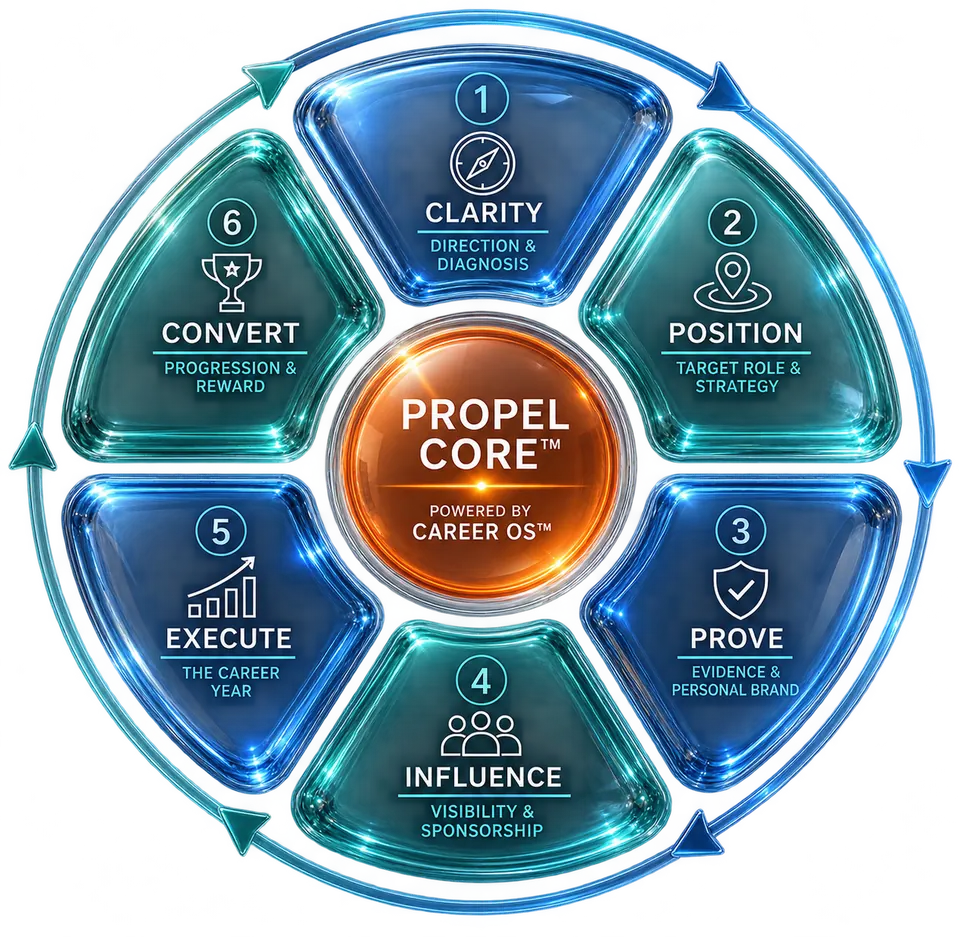
Outcomes & EvidenceTurn a busy year into a defensible, decision-grade case for the next level.
Outcomes & Evidence is the discipline of converting day-to-day delivery into a retrievable, attributable record of impact that a promotion panel or hiring manager can trust without you in the room.
OutcomeYou leave this stage with a live impact and evidence bank, a next-level decision portfolio, and a promotion case built on verifiable results rather than remembered effort.
10 min read·
High-level summary
Most capable professionals can describe what they did; far fewer can prove what changed because of it, with numbers, decisions and witnesses that hold up under scrutiny.
A monthly evidence bank, built around baseline, action, outcome and attribution, converts scattered wins into a coherent, retrievable case.
The strongest cases pair past achievement with a forward-looking decision portfolio that shows readiness for scope you have not yet held.
Outputs the client receives
✓A structured monthly impact and evidence bank template, populated with your current cycle's material
✓A results library organised by baseline, action, outcome and attribution across relevant business measures
✓A next-level decision portfolio evidencing scope, judgement under ambiguity and stakeholder consequence
✓A short stakeholder feedback and recognition file, verified and honestly attributed
✓An evidence-gap map with named stretch work designed to close each gap before your next review point
Career OS™ principle
“Hard work becomes promotion evidence only when its consequence can be retrieved, explained and trusted.”
Who this stage is for
Professionals with a strong year who cannot yet summarise its impact in two credible sentences
Technical and delivery leads whose contribution is embedded in team results and hard to separate out
Anyone preparing a promotion, VP or partner case in the next one to three review cycles
People who feel their manager's account of their year is thinner than the actual work
Those moving from individual delivery into scope where influence and judgement matter as much as output
Professionals who suspect their achievements are real but currently unprovable
Why this stage matters
A year of good work leaves a trace, but the trace decays fast. Numbers get folded into team totals, decisions are forgotten by the people who benefited from them, and by the time a promotion conversation arrives, what remains is a vague sense of having been busy and useful. Panels and sponsors do not promote on vague impressions; they promote on evidence they can retrieve, explain to someone else, and stand behind. Without a disciplined evidence bank, even strong performers end up reconstructing their case from memory under time pressure, which produces thin, generic claims that undersell what actually happened.
The deeper problem is that task lists and evidence of readiness are not the same thing. Describing what you did tells a panel you were occupied; describing what changed, at what scale, and because of which decision you made, tells them you are ready for more accountability. This distinction matters most for measures that sit outside an individual's job title, such as risk reduced, cash released, quality improved or capacity created, and for evidence of leadership through others where no formal authority existed. Capturing this in the moment, with honest attribution rather than convenient rounding, is what separates a credible case from an inflated one.
The cost of skipping this stage is not a single missed promotion; it compounds. Each cycle without a retrievable record makes the next case harder to build, because the underlying material has aged out of memory and the professional starts again from nothing. Over several years this produces a familiar pattern: strong contributors who are consistently rated well but rarely selected, because their case, however real, was never made in a form a decision-maker could act on.
Cost of skipping it
Promotion cases rebuilt from memory months after the work, losing detail, scale and attribution
Genuine impact folded invisibly into team or manager totals with no individual trace
Stakeholder recognition given verbally and never captured, so it cannot be cited later
Evidence gaps only discovered during a promotion cycle, too late to close them
A case built entirely on the past, with nothing to show readiness for scope not yet held
Related Career OS™ tools
Practical resources that turn this PROPEL stage into action inside your current organisation.
Supporting templates for stakeholder mapping and decision logging.
Next decision
With a working evidence bank in place, the next question is not what you have already proved but how visibly it travels. Strong evidence that only you can see still leaves your case dependent on other people remembering to speak for you.
Stage four turns retrievable proof into deliberate presence: making sure the right people encounter your judgement and impact before the decision that matters is made, not only during it.
Outcomes & Evidence is the practice of recording, at the time it happens, what changed as a result of your work, at what scale, and how that change can be verified by someone who was not directly involved. It sits deliberately after Role Positioning, because evidence only becomes strategically useful once you know which next-level scope you are gathering proof for.
The stage produces two connected assets. The first is an evidence bank: a monthly record of results structured around baseline, action, outcome and attribution, covering financial, operational and behavioural measures. The second is a next-level decision portfolio: a smaller, curated set of moments where you exercised judgement, handled ambiguity, or influenced a stakeholder group without formal authority, each one strong enough to carry a promotion conversation on its own.
Why capable professionals get stuck here
The most common failure is treating achievement as self-evident. Professionals assume that because a result happened on their watch, it will be attributed to them by default. In reality, results get attributed to the loudest voice in the room, the most senior name on the slide, or the team as an undifferentiated whole, unless someone deliberately and honestly claims their share of it.
A second, quieter failure is confusing effort with evidence. Long hours, visible activity and a full calendar feel like proof of contribution, but a panel cannot evaluate effort; it can only evaluate consequence. Professionals who have not separated the two often produce cases that are detailed about process and silent about outcome, which reads as busy rather than ready.
Common mistakes
Most evidence problems are habits rather than gaps in capability. They are corrected by changing what gets recorded, and when, rather than by working harder.
Recording only what was delivered, not what changed as a result and for whom
Letting real numbers dissolve into team-level totals with no individual attribution
Waiting until a review cycle to reconstruct the year, rather than capturing evidence monthly
Treating soft, relational impact, such as influence without authority, as unprovable and leaving it out entirely
Rounding or inflating figures under pressure, which damages credibility the moment it is checked
Building a case entirely from the past, with nothing that signals readiness for future scope
Measures that make a case credible
A defensible outcomes case rarely rests on one measure. It draws on whichever combination of revenue, margin, cost, cash, risk, quality, delivery, customer, capacity and strategic measures genuinely applied to the work, stated at the scale they actually occurred rather than rounded upward. The discipline is choosing measures the work actually affected, not reaching for whichever number sounds most impressive.
Equally important is the qualitative layer beneath the numbers: the scope you were operating in, the decisions you made, the ambiguity you resolved without a clear playbook, the stakeholders involved, and the consequences that would have followed had you chosen differently. This is what shows judgement, not just outcome, and judgement is what most next-level roles are actually testing for.
How Career OS™ PROPEL handles this stage
PROPEL treats evidence-gathering as a running discipline rather than a pre-promotion scramble. The monthly evidence bank is built into the platform so that baseline, action, outcome and attribution are captured close to the event, while detail is still accurate and stakeholders still remember their part in it.
Alongside the evidence bank, PROPEL builds a next-level decision portfolio and a short stakeholder feedback file, both reviewed for honest attribution before they are used. Where a genuine gap exists between what a role requires and what the evidence currently shows, PROPEL names it directly and identifies stretch work capable of closing it, so the eventual case is built on real, verifiable material rather than presentation alone.
Composite example: the programme manager's promotion case
A composite programme manager, several years into consistently strong delivery ratings, had never been shortlisted for the senior programme director role two people ahead of her had reached. Her actual year included resolving a supplier dispute that protected a significant margin position, restructuring a delivery plan under a compressed deadline, and quietly holding together stakeholder confidence across three departments during a difficult quarter. None of it appeared anywhere in a form her sponsor could cite.
Working through the evidence bank, she reconstructed each episode against baseline, action, outcome and attribution, established the financial scale of the supplier outcome with her finance business partner, and gathered two short pieces of stakeholder feedback that verified her role in the quarter's recovery. The resulting case was not a longer list of tasks; it was three well-evidenced decisions, each with a number, a consequence and a named witness, framed against the scope of the role she was seeking rather than the one she already held.
Practical exercise: building your first evidence entry
Choose one piece of work from the last eight weeks that you believe mattered. Write four short statements against it: the baseline before you acted, the specific action you took, the measurable outcome that followed, and an honest note on attribution, naming anyone else who contributed and what you specifically added.
Then ask who could verify the outcome if asked, and note their name against the entry. If no one could verify it, that is itself useful information: it marks an evidence gap worth closing through better documentation or a short piece of stretch work, rather than a claim you would struggle to defend under questioning.
The evidence to collect and how to protect it
Beyond the entries themselves, collect the artefacts that make them checkable: dashboards, financial summaries, meeting notes, and short written or verbal feedback from stakeholders who observed the outcome directly. Where information is commercially sensitive, describe scale and consequence in terms your organisation would be comfortable seeing repeated externally, rather than omitting the achievement altogether.
Confidentiality and verification are not obstacles to a strong case; they are part of what makes it trustworthy. A case that is precise about what can and cannot be disclosed, and consistently accurate rather than flattering, reads as more credible to a panel than one that overstates with no caveats at all.
FAQs · Outcomes & Evidence
Questions professionals ask about outcomes & evidence
Click any question to expand the answer.
What is the difference between an achievement and evidence of readiness?⌄
An achievement describes what happened; evidence of readiness explains what it shows about your judgement, scope and decision-making at the next level. The same episode can be written as either, and only the second version strengthens a promotion case.
How often should I update my evidence bank?⌄
Monthly is the practical minimum, because detail, scale and stakeholder memory all decay quickly. Waiting for an annual review cycle means reconstructing the year from memory, which produces thinner and less accurate entries.
What if my results are genuinely a team effort?⌄
Most meaningful results are team efforts, and that is not a problem provided attribution is handled honestly. State clearly what the team achieved and what you specifically contributed, decided or unblocked within it.
How do I evidence leadership if I don't manage anyone?⌄
Focus on influence without authority: moments where you shaped a decision, changed a stakeholder's position, or coordinated people outside your reporting line toward an outcome. These are usually stronger next-level signals than formal management alone.
Is it acceptable to round numbers to make an impact sound clearer?⌄
No. Rounding or inflating figures damages credibility the moment anyone checks, and a single doubted figure can undermine an otherwise strong case. State figures precisely and be ready to explain how they were calculated.
What if my work is confidential and I can't disclose specifics?⌄
Describe scale and consequence in terms that respect confidentiality, such as relative change or proportional impact, rather than omitting the achievement entirely. A well-handled confidential example still demonstrates judgement.
What is a next-level decision portfolio?⌄
It is a curated set of moments where you exercised judgement under ambiguity, managed stakeholder consequence, or made a call outside your formal remit, selected specifically because each one demonstrates readiness for the scope you are seeking.
How many evidence entries do I actually need for a strong case?⌄
Quality matters more than volume; three to five well-evidenced, verifiable episodes usually carry more weight than a long list of minor tasks. The aim is depth and attribution, not exhaustive coverage.
How do I close an evidence gap I've identified?⌄
Name the specific capability or measure the gap relates to, then seek deliberate stretch work, a project, a stakeholder relationship, or a decision opportunity, designed to generate genuine evidence against it before your next review point.
Should my promotion case only cover past achievements?⌄
No. The strongest cases pair verified past achievement with a credible account of future business need and your readiness to meet it, since panels are ultimately deciding on capacity for what comes next, not only recognition for what has already happened.
Career OS™ PROPEL
Stop leaving your progression to the appraisal cycle.
A Career Diagnosis establishes what progression should mean in your organisation, what evidence the next level requires, and the route most likely to produce it.