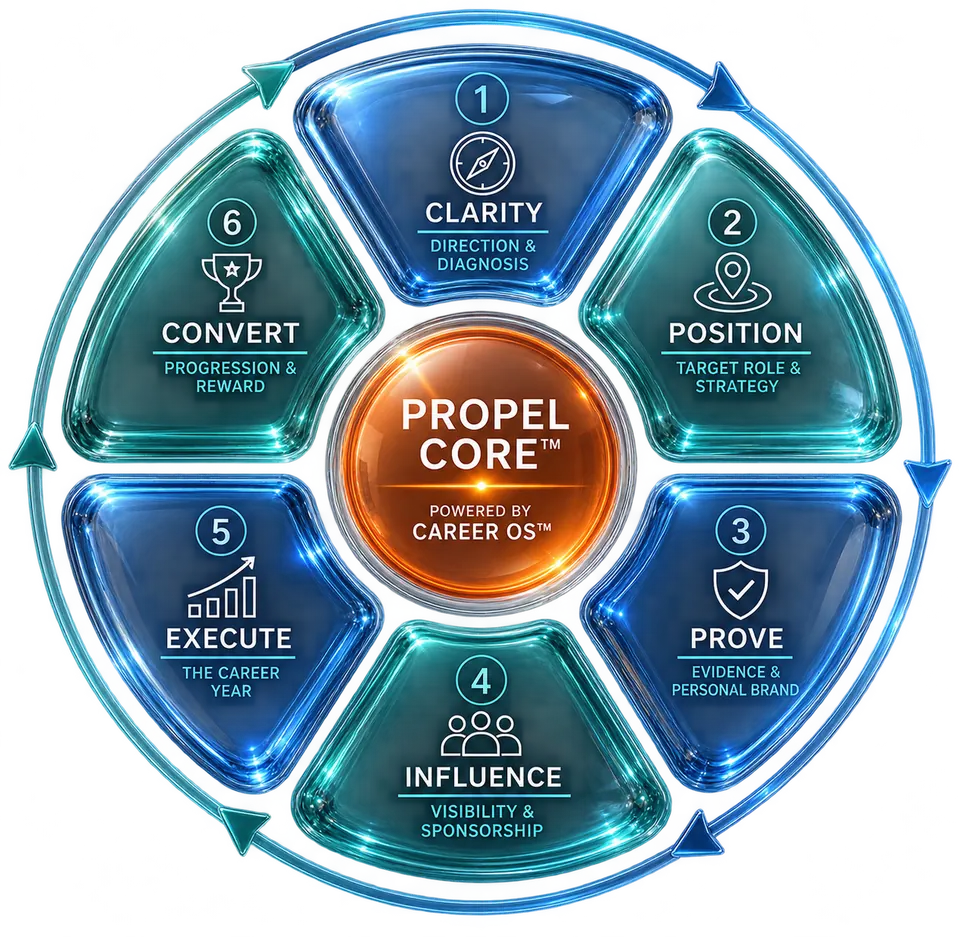
Purpose & DirectionDefine what progression should mean before you pursue it
Purpose & Direction is the stage of Career OS™ PROPEL in which an ambitious, capable professional decides — deliberately and in writing — what progression actually means for them before any plan, conversation or campaign is built to pursue it.
OutcomeYou leave this stage with a defined target level, a named route, a tested internal-versus-move gate, and a 90-day hypothesis you can act on immediately.
11 min read·
High-level summary
Progression is broader than promotion — it includes specialist advance, scope growth, visibility, influence, development and reward, and each demands a different plan.
Most stalled careers are not short of effort; they are short of a defined destination, so development activity accumulates without moving anyone closer to anything specific.
This stage produces a tested direction, not a guess: formal and informal promotion criteria are mapped, true capability gaps are classified, and a route is chosen before a single action is taken.
Outputs the client receives
✓A defined target grade or role, with the specialist and leadership routes to it named separately
✓A capability map that separates genuine next-level gaps from unproven or misdiagnosed ones
✓A short list of direct, bridge and development routes to the target, with the trade-offs of each made explicit
✓A 6–24 month direction statement paired with a specific, testable 90-day hypothesis
✓An internal-versus-move decision gate with the conditions that would trigger each path
Career OS™ principle
“Do not ask your development plan to solve a destination you have not defined.”
Who this stage is for
Senior technical professionals weighing a principal specialist route against a move into management
Engineers, scientists and technical leads who feel capable but cannot articulate what "next" should look like
Professionals who have been told to "build a development plan" with no clarity on what it is meant to achieve
Anyone comparing promotion, scope growth, reward and optionality as competing, not identical, goals
Professionals who suspect their current organisation may not offer the route they actually want
STEM leaders returning to their career direction after a period of being absorbed by delivery
Why this stage matters
Most career development activity in STEM organisations is generated before the destination is agreed. Professionals accept stretch projects, sign up for courses, and rehearse conversations with their manager, all without a settled answer to a prior question: progression towards what, specifically, and by when. The result is visible effort that does not compound, because each activity is aimed at a slightly different, unstated target.
This matters more, not less, the more capable someone is. Strong technical performers are often given latitude precisely because they are trusted to fill ambiguity with good judgement. But good judgement applied to an undefined destination still produces drift — competent, well-regarded, and stationary. The professional weighing principal engineer authority against an engineering management track is a common case: both routes reward the same strong current performance, yet require almost entirely different evidence, sponsors and language to pursue.
Purpose & Direction exists to interrupt that drift deliberately, before it costs another appraisal cycle. Skipping it does not remove the need for a decision; it simply defers the decision to whichever opportunity, manager or vacancy happens to appear next, which rarely produces the outcome a deliberate choice would.
Cost of skipping it
Months spent building evidence for a level or route that was never actually the right target
Development conversations with a manager that go in circles because neither party has a fixed destination to test against
Genuine capability gaps left unaddressed while energy goes into gaps that were never real
A slow drift into an internal path that was never compared honestly against external options
Confidence erosion from repeated stretch efforts that do not translate into progression of any kind
Related Career OS™ tools
Practical resources that turn this PROPEL stage into action inside your current organisation.
Supporting exercises for capability mapping and route planning
Next decision
Once direction is defined, the next question is how the market and your organisation currently perceive you against that target — which is rarely identical to how you perceive yourself.
Stage 2, Role & Positioning, takes the destination fixed here and tests it against your current visibility, reputation and framing, so that the plan you build next is aimed at closing a real gap rather than an assumed one.
Purpose & Direction is the deliberate act of specifying what progression means for you before you invest in pursuing it. Concretely, that means naming a target grade or role, distinguishing whether the route to it runs through deepening specialist authority or taking on people and budget leadership, and being honest about the reward and time horizon you are actually optimising for.
It is not a values exercise or a vague statement of ambition. It produces a specific target that can be tested: a grade, a scope, a route, and a window of six to twenty-four months within which progress should be visible. Anything vaguer than that is not yet direction — it is preference.
Why capable professionals get stuck here
Capable professionals get stuck at this stage precisely because they are capable elsewhere. Strong delivery performance generates positive feedback that feels like progress, even when it says nothing about readiness for the next level. It is easy to mistake being consistently relied upon for being positioned to advance, and organisations rarely correct that impression because reliable performers are useful to keep exactly where they are.
A second, quieter cause is the difficulty of choosing between genuinely different goods. Promotion, specialist progression, broader scope, greater visibility, increased influence, deliberate development and better reward are not the same objective wearing different names — pursuing one can actively work against another. A professional who wants scope growth without a title change needs a different conversation, different sponsors and different proof than one who wants a formal band increase, and trying to pursue both simultaneously without acknowledging the difference tends to produce a plan that satisfies neither.
Common mistakes at this stage
The most consistent mistake is treating "progression" as self-evidently meaning promotion, without checking whether promotion is actually what would solve the underlying dissatisfaction. A professional who is frustrated by lack of influence over technical direction may not need a new title; they may need a defined route to greater decision authority within their current grade.
Assuming the organisation's formal promotion criteria are the only criteria that matter, ignoring the informal ones that actually decide outcomes
Building a development plan before defining what it is meant to make you ready for
Treating specialist and leadership routes as a single track with a shared set of evidence requirements
Comparing an internal opportunity to an imagined external one instead of a researched one
Accepting organisational constraints as immovable facts rather than testing which are genuine and which are habit
Setting a target so broad ('senior role', 'more responsibility') that no evidence could ever confirm or disconfirm progress towards it
How Career OS™ PROPEL handles this stage
PROPEL treats direction-setting as a structured discovery exercise rather than a single decision made in isolation. The first task is to surface both the formal promotion criteria your organisation publishes and the informal criteria that actually govern outcomes — the sponsors, track record and visibility patterns that rarely appear in a competency framework but consistently determine who advances.
Against those criteria, next-level capabilities are mapped and classified. Some apparent gaps are real and require deliberate development; others are simply unproven, meaning the capability exists but has not yet been demonstrated in a form the organisation recognises; a third category is misdiagnosed, where what looks like a skills gap is actually a visibility or sponsorship gap. Conflating these three categories is one of the most expensive errors in career planning, because it sends people to build skills they already have while leaving genuine gaps and structural blockers unaddressed.
From that classification, PROPEL designs three types of route to the target: a direct route where the gap is genuinely capability and can be closed through deliberate practice and evidence-building; a bridge route where a lateral or interim step is required to access the next-level evidence at all; and a development route where the timeline is genuinely longer and the plan should say so honestly. The result is a 6–24 month direction, sharpened into a 90-day hypothesis — the smallest concrete test of that direction you can run immediately, with a defined internal-versus-move decision gate that specifies what would confirm the current organisation is the right vehicle and what would indicate it is not.
Composite example: the principal engineer decision
A senior systems engineer, ten years into a strong technical career, is weighing two routes: principal engineer authority, deepening technical scope and influence without direct people management, or a move into engineering management, taking on a team and budget. Both are labelled "progression" internally, and both are plausible for someone with her track record — which is exactly the problem, because pursuing both at once produces a diluted case for either.
Working through Purpose & Direction, she maps the formal criteria for each route and finds the principal track requires demonstrated cross-team technical authority and a recognised body of design decisions, while the management track requires people-leadership evidence she has had few opportunities to build. She also uncovers an informal pattern: her organisation has promoted no one to principal engineer in three years, despite the level existing on paper, while management promotions have been comparatively frequent. That single piece of informal evidence reframes her decision — not because it dictates her choice, but because it changes what she needs to test before committing eighteen months to either route.
Her 90-day hypothesis becomes concrete: seek one clearly scoped cross-team technical decision to lead, while requesting a direct conversation with a recent principal-engineer hire about how their case was actually built. The decision gate she sets is equally specific — if no realistic principal case emerges within a year, she will treat an external principal-track move as the live alternative rather than defaulting into management by attrition.
A practical exercise: draft your own decision gate
Before any development plan is built, write down the specific target grade or role you are aiming at, the route you believe leads there, and the evidence that would tell you within twelve months whether that route is realistic inside your current organisation. Then write the conditions under which you would treat an external move as the better path, in concrete terms rather than a vague sense of frustration.
Name the target: grade, title or scope, as specifically as your organisation's structure allows
Name the route: direct, bridge or development, and why
List three formal criteria and three informal ones that govern this route in your organisation
Write your 90-day hypothesis as a single testable action
Write the specific evidence that would trigger an internal-versus-move decision
Organisational constraints and boundaries
A credible direction has to account for real constraints — budget freezes, flat structures, a genuine absence of vacancies at the target level, or a manager who is unlikely to sponsor internal moves. Ignoring these produces a plan built on hope rather than evidence, and it tends to collapse at the first structural obstacle.
The discipline here is distinguishing a genuine constraint from a convenient excuse. A frozen headcount is a real constraint; a vague sense that "now isn't the right time" usually is not, and deserves to be tested rather than accepted. PROPEL treats constraints as inputs to route design, not as reasons to abandon a target: a genuine structural limitation typically points towards a bridge or development route, or towards the internal-versus-move gate being tested earlier than originally planned.
The evidence to collect
By the end of this stage you should be able to point to a written target, a named route, a classified list of capability gaps, and a 90-day hypothesis with a clear owner and deadline — you. The evidence that this stage has actually worked is not a feeling of clarity; it is the existence of a document specific enough that another person could read it and know exactly what you are testing over the next quarter and why.
FAQs · Purpose & Direction
Questions professionals ask about purpose & direction
Click any question to expand the answer.
Is Purpose & Direction only relevant if I want a promotion?⌄
No. This stage covers promotion, specialist progression, scope growth, visibility, influence, development and reward as distinct and sometimes competing goals. It is designed to help you choose deliberately among them, not to assume promotion is always the target.
How is this different from a standard personal development plan?⌄
A development plan usually assumes the destination is already known and focuses on closing skills gaps. Purpose & Direction works one step earlier, defining the destination itself and classifying which apparent gaps are real, unproven or actually about visibility and sponsorship.
What if my organisation doesn't have a formal promotion framework?⌄
The absence of a formal framework makes the informal criteria more important, not less. This stage places extra weight on mapping how promotions have actually happened in practice, through observation and direct conversation, rather than relying on a published competency document.
How do I choose between a specialist route and a leadership route?⌄
Start by mapping the distinct evidence each route requires and the criteria — formal and informal — your organisation actually applies to each. The right choice usually becomes clearer once you see how differently the two routes are evidenced, rather than assuming your current strengths transfer equally to both.
What is a 90-day hypothesis and why does it matter?⌄
It is the smallest concrete, testable action that would tell you whether your chosen direction is realistic. It matters because a 6–24 month direction is too long to wait on before getting any real-world signal, so the hypothesis converts intention into an early, checkable test.
How do I know if a capability gap is real or just unproven?⌄
A real gap means the capability genuinely does not yet exist and needs deliberate development. An unproven gap means the capability exists but has not been demonstrated in a form your organisation recognises, which calls for evidence-building and visibility rather than new skills training.
When should I treat organisational constraints as a reason to consider leaving?⌄
When the constraint is structural and verifiable, such as a genuinely frozen level or a confirmed absence of vacancies over a sustained period, rather than a vague sense that timing is wrong. This stage asks you to set that threshold explicitly, in advance, as part of your internal-versus-move decision gate.
Can I work on Purpose & Direction if I am not actively unhappy in my current role?⌄
Yes, and doing so before dissatisfaction sets in is usually more effective. Defining direction while you still have goodwill and energy produces a clearer, less reactive plan than doing it under pressure after frustration has already built.
Does this stage assume I will stay with my current employer?⌄
No. It builds an honest internal-versus-move decision gate precisely because staying is not always the right answer. The aim is to reach that conclusion through evidence rather than either loyalty or impatience.
How long should this stage take to complete properly?⌄
Most professionals can produce a credible first version of their direction, route and 90-day hypothesis within two to three focused working sessions, though testing the hypothesis itself naturally takes the full 90 days.
Career OS™ PROPEL
Stop leaving your progression to the appraisal cycle.
A Career Diagnosis establishes what progression should mean in your organisation, what evidence the next level requires, and the route most likely to produce it.