
High-level summary
- Builds an answer library that maps to the actual interview questions decision-makers ask.
- Drills senior-level structure into every answer: situation, impact, leverage.
Prepare evidence, stories and interview performance with confidence — including the 30 STAR questions framework.
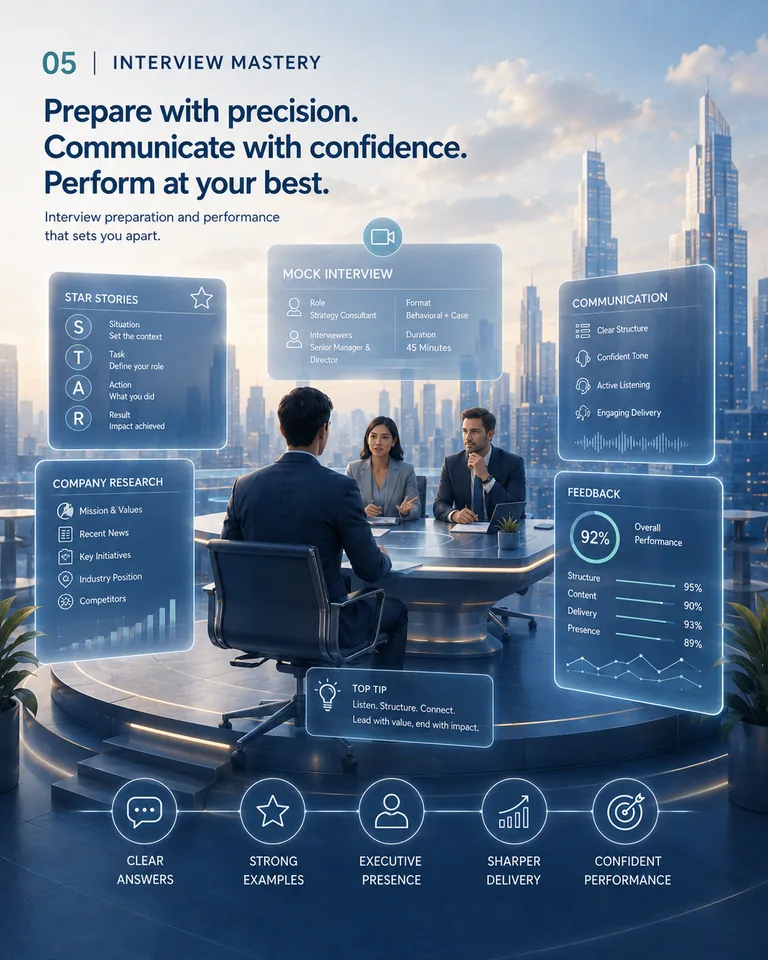
“Interviews are not a memory test. They are a confidence and structure test — and structure is trainable.”
Interviews are decision-risk assessments, not memory tests. Without structure and evidence, strong candidates lose to weaker ones with better-rehearsed stories.
Cost of skipping it
Practical resources that turn this stage into action. Free tools open after a short email unlock.
6 resources shown
Build your senior-level answer library.
Compile company, role and stakeholder research before the interview.
Predict the questions you're most likely to face.
Generate intelligent questions that show senior judgement.
Practice a complete verbal mock interview with feedback.
Reinforce fit and urgency after every interview round.
Confirm whether Interview Mastery is your most urgent constraint. If it is, book a Career Diagnosis or step into the relevant Career OS™ programme.
Company Research and Interview Mastery is the stage where Career OS™ prepares you to perform with clarity, evidence and commercial relevance. Senior interview success depends on judgement, leadership, communication and the ability to connect your experience to the company's priorities — not just technical competence.
It is the discipline of turning your experience into structured, evidence-led answers that map to the company's actual problem — backed by deep research, rehearsed stories and intelligent questions that demonstrate senior judgement.
Many strong technical candidates underperform because they answer from their own history rather than the employer's problem. They explain what they did, but not why it matters to this company, in this role, at this moment.
Senior interviews are not technical memory tests. They are decision-risk assessments: can this person solve our problem, lead at the required level, influence stakeholders, handle ambiguity and trade-offs, and be trusted with this responsibility?
Interviews are prepared through a structured system:
Asked: "Tell us about a time you recovered a difficult programme."
A weak answer gives a chronological story. A stronger Career OS™ answer covers context, technical and commercial risk, stakeholders involved, decisions made, trade-offs managed, measurable outcome, leadership lesson — and how that experience applies to the target company's current challenges.
This shifts the candidate from "experienced engineer" to "credible senior leader."
For one target role, answer:
Build a reusable interview evidence bank:
Click any question to expand the answer.
If you are getting interviews but not receiving offers, the problem is unlikely to be your CV alone. You have already demonstrated enough relevance to enter the selection process. The difficulty usually lies in how your evidence is selected, structured and connected to the employer’s decision criteria.
Candidates may answer the question asked but fail to address the risk behind it. Others provide detailed examples without making their personal contribution, judgement or outcome sufficiently clear. There may also be a mismatch between interview performance and the seniority of the role.
Strong technical answers do not always demonstrate leadership, commercial awareness or organisational influence. Career OS™ examines where interview conversion is being lost rather than assuming the problem is confidence. The objective is to identify whether the issue concerns evidence, relevance, structure, delivery, executive presence, role fit or final-stage differentiation.
Senior-level interview preparation should begin with the organisation, the role and the problems the successful candidate will be expected to solve. Reviewing common interview questions is not enough. You need to understand the commercial context, leadership expectations, operational risks and stakeholder environment surrounding the appointment.
Your examples should then be selected to demonstrate relevant judgement, scale, complexity and outcomes. At senior levels, interviewers are often assessing how you think, influence and make decisions under uncertainty—not simply whether you have completed similar tasks before. Career OS™ structures preparation around the employer’s likely decision criteria and the evidence required to reduce perceived hiring risk.
The detailed preparation framework remains part of the programme. The objective is not to memorise polished answers. It is to build a disciplined evidence base that allows you to respond naturally, credibly and at the correct level of seniority.
Executive interview coaching is specialist preparation for director, vice-president, C-suite and senior leadership selection processes. These interviews typically assess more than technical competence. They may examine strategic judgement, leadership maturity, organisational influence, commercial awareness, governance, transformation and the ability to operate with incomplete information.
Executive coaching should therefore go beyond practising standard questions. It should test whether the candidate communicates at the required altitude, selects appropriate evidence and understands the concerns of boards, investors, senior stakeholders or executive search consultants. Career OS™ combines role analysis, evidence selection, challenge and simulated interview practice.
The objective is not to create scripted perfection. It is to ensure that the candidate can explain complex experience with clarity, authority and relevance. A successful executive interview should make it easier for the panel to imagine the candidate operating in the role—not simply recognise that they have held senior titles before.
Behavioural interview questions ask for evidence of how you acted in a real situation. A strong answer should establish the context, explain the challenge, identify your personal responsibility, describe the actions you took and show the result. The emphasis should remain on your decisions and contribution rather than the team in general.
The most common mistake is providing too much background and too little evidence. Candidates may spend several minutes describing the project before reaching the part that demonstrates capability. Career OS™ helps clients build a structured evidence bank so that examples can be selected according to the competency and risk being tested.
The detailed mapping process remains part of the programme. The objective is not to memorise one answer for each question. It is to understand which examples demonstrate leadership, judgement, conflict management, delivery, failure, resilience or change— and how to adapt them without losing authenticity.
The STAR method structures an interview example into Situation, Task, Action and Result. The Situation should provide only enough context for the interviewer to understand the challenge. The Task should clarify what you were responsible for.
The Action should explain what you personally decided and did. The Result should show the outcome and, where possible, the measurable effect. The Action section should normally receive the greatest attention.
It is where the interviewer assesses judgement, skill and behaviour. A common weakness is treating STAR as a rigid script. This can make answers sound rehearsed or cause candidates to force complex leadership examples into an oversimplified structure.
Career OS™ uses structured evidence methods while allowing for the depth required by senior roles. The objective is clarity, not mechanical delivery. STAR is useful when it helps the interviewer follow the evidence.
It becomes less useful when the framework is more visible than the substance of the answer.
“Tell me about yourself” is usually an invitation to explain your professional relevance, not to provide a complete autobiography. A strong answer should summarise your current professional identity, the most relevant parts of your background, the value you have created and why the opportunity represents a logical next step. The answer should be tailored to the role.
A general career history may contain accurate information but still fail to establish why the interviewer should continue with interest. Career OS™ develops this answer from the wider positioning strategy so that it aligns with the CV, LinkedIn profile and target role. The detailed structure varies according to career level, sector and transition.
The objective is to give the interview a clear direction from the beginning. The interviewer should quickly understand who you are professionally, what you bring and why your experience matters to the organisation.
Leadership is demonstrated through evidence of judgement, influence, accountability and the conditions you created for others to perform. Simply stating that you managed a large team is not enough. Interviewers need to understand what was difficult, what decisions you made, how you aligned stakeholders and what changed because of your leadership.
Strong examples may involve setting direction, resolving conflict, managing uncertainty, developing capability, protecting delivery or making an unpopular but necessary decision. Career OS™ helps distinguish leadership evidence from general management activity. The detailed leadership diagnostic and evidence selection process remain within the programme.
The objective is not to present yourself as the hero of every story. Credible senior leadership includes listening, delegation, challenge, governance and the ability to create results through others. The strongest answers show both personal accountability and organisational impact.
Panel interview preparation should account for the fact that different interviewers may be assessing different risks. A line manager may focus on delivery, a technical leader on competence, HR on behaviour and a senior sponsor on strategic fit. The same answer may therefore be interpreted from several perspectives.
Preparation should include research into the panel members, their functions and the likely concerns each person brings to the decision. During the interview, answer the person who asked the question while maintaining appropriate engagement with the rest of the panel. Career OS™ helps candidates map evidence against the probable interests of the full decision group.
The objective is not to deliver separate performances for each interviewer. It is to present a consistent professional proposition that remains relevant across technical, behavioural and commercial criteria. A panel interview becomes more manageable when the candidate understands that it is one decision viewed through several lenses.
A technical leadership interview requires evidence of both technical credibility and leadership beyond the technical detail. Interviewers may test whether you can make informed decisions, challenge specialists, manage technical risk and connect engineering or scientific issues to cost, timing, safety, customer value and organisational priorities. The common mistake is to answer at too much technical depth.
Detailed knowledge may demonstrate competence but obscure the leadership judgement being assessed. Career OS™ helps candidates identify where the answer should move from technical context to decision-making, influence and outcome. The specific balance depends on the level of the role.
The objective is not to prove that you remain the best technical specialist in the room. It is to show that you can lead technical work, create conditions for expert performance and make responsible decisions when evidence, risk and stakeholder priorities conflict.
Explain the redundancy or layoff briefly, factually and without defensiveness. Make clear that the role ended because of restructuring, cost reduction, closure, acquisition or another business decision where that is accurate. Avoid criticising the former employer or providing unnecessary detail.
Then move the conversation towards what you learned, how you responded and why you are now interested in the current opportunity. Career OS™ ensures that the explanation remains consistent across the CV, LinkedIn profile and interview. The objective is not to persuade the interviewer that redundancy never affected you.
It is to show professional maturity, readiness and a coherent next direction. Employment loss is common and is not automatically a negative indicator. Concern usually increases when the explanation is unclear, emotional or inconsistent.
A calm, proportionate answer allows the interview to return quickly to your capability and future contribution.
A career gap should be explained honestly, concisely and in a way that is proportionate to its relevance. State the reason clearly, whether it involved caring responsibilities, health, study, travel, relocation, redundancy or a planned break. Then explain any useful activity completed during the period and confirm your current readiness to return.
Do not over-explain. Lengthy justification can create concern where little existed. Career OS™ helps clients prepare a consistent narrative so that the gap is neither hidden nor allowed to dominate the interview.
Career OS™ Dedicated FAQ • 37 The objective is to remove ambiguity and return attention to the role. Interviewers are usually assessing whether the period creates any current risk concerning capability, motivation, reliability or availability. A clear answer should address those issues directly.
The gap is part of the career history. It does not need to become the defining feature of the application.
Ask questions that help you understand the role, the organisation’s priorities and how success will be judged. Strong questions may explore the most important outcomes in the first year, the challenges inherited by the successful candidate, the decision-making environment or the relationships critical to success. Avoid asking questions that are answered clearly on the website or that focus only on benefits before mutual interest has been established.
Career OS™ helps candidates develop questions from the research and risk analysis completed before the interview. The objective is not to impress the panel with complexity. It is to demonstrate judgement and gather information that supports your own decision.
An interview is a two-way assessment. The questions you ask should help determine whether the role is genuinely viable, not merely prolong the conversation. At senior levels, thoughtful questions can also reveal how you would approach the role if appointed.
Interview confidence usually improves through evidence, preparation and familiarity rather than encouragement alone. Candidates often feel anxious because they do not know which examples to use, how to structure them or what the panel is really assessing. This uncertainty increases cognitive load and makes delivery less controlled.
A structured evidence bank, role analysis and realistic practice can reduce that uncertainty. Career OS™ treats confidence as an outcome of preparation, not a personality trait that must be acquired first. The objective is not to remove every sign of nervousness.
Some anxiety is normal and may reflect the importance of the opportunity. The aim is to ensure that nerves do not prevent you from accessing your evidence, listening to the question or communicating at the required level. Confidence becomes more reliable when it is based on preparation you can explain, test and repeat.
No. You should prepare your evidence thoroughly, but avoid memorising complete scripts. Memorised answers can sound unnatural and may fail when the question is phrased differently.
They also reduce listening because the candidate becomes focused on delivering the prepared wording rather than responding to the interviewer. A better approach is to understand the structure, key facts, decisions and outcome of each example. Career OS™ helps clients build adaptable evidence rather than fixed speeches.
The detailed preparation method remains part of the programme. The objective is to sound prepared without sounding programmed. You should know your examples well enough to shorten, expand or redirect them according to the question.
This is particularly important in senior interviews, where follow-up questions may test judgement, alternatives and consequences. Preparation should increase flexibility, not remove it.
Most interview answers should be long enough to provide clear evidence but short enough to maintain focus. A straightforward question may require one or two minutes. A complex leadership or behavioural example may require several minutes, particularly at senior level.
The correct length depends on the question and the amount of context needed. The common problem is not always excessive length. Some answers are too brief to prove the claim being made.
Career OS™ helps clients distinguish between context, evidence and unnecessary detail. The objective is to give the interviewer enough information to assess capability without forcing them to search for the point. A useful answer normally signals where it is going, provides relevant evidence and concludes with the outcome or learning.
If the interviewer wants greater depth, they can ask a follow-up question. Strong candidates create space for that conversation rather than attempting to include their entire career in one response.
A mock interview is a realistic simulation used to test preparation, evidence selection, communication and response under pressure. It should reflect the level, role and likely structure of the actual interview rather than rely only on generic questions. A strong mock interview identifies where answers are unclear, overlong, unsupported or pitched at the wrong level.
It can also reveal habits that are difficult to recognise alone, such as avoiding the question, overusing “we” or failing to state the outcome. Career OS™ uses mock interviews as a diagnostic and development tool. The objective is not to rehearse a perfect performance.
It is to expose weaknesses while there is still time to correct them. Useful feedback should be specific and connected to the decision criteria of the role. A mock interview has value when it changes preparation and performance—not merely when it provides reassurance.
The number depends on the complexity of the role, the candidate’s experience and the quality of the first performance. Some professionals need one focused simulation to test strong preparation. Others benefit from several rounds, particularly when they are changing sector, returning after a long absence or targeting a substantially more senior position.
The purpose should determine the number. A mock interview may be used to diagnose weaknesses, practise revised answers, test a presentation or prepare for a final-stage panel. Career OS™ does not recommend repetition without clear learning objectives.
The objective is not to make the interview feel familiar through volume alone. It is to improve specific areas of performance. A second mock interview should not simply repeat the first.
It should test whether the candidate has absorbed the feedback, strengthened the evidence and improved control. Quality of iteration matters more than the raw number of sessions.
An executive search interview is typically conducted by a retained search consultant assessing suitability for a senior appointment. The consultant is evaluating whether your background matches the client’s brief, whether your motivations are credible and whether you can be presented confidently to the hiring organisation. These interviews may feel conversational, but they are still selective.
Search consultants assess track record, leadership level, compensation, mobility, reputation and potential concerns. Career OS™ helps candidates understand the difference between speaking with an executive search consultant and meeting the employer directly. The objective is not to deliver a formal board presentation unless requested.
It is to communicate your career history, impact and direction with enough clarity that the consultant can advocate for you. Your answers should be concise, consistent and commercially relevant. Search consultants need to understand both why you fit and where the client may challenge your candidacy.
Final interview preparation should focus on the remaining decision risks. By this stage, the employer usually accepts that you are broadly capable. The final discussion may therefore concentrate on leadership fit, stakeholder confidence, commercial judgement, motivation, compensation or the differences between the strongest candidates.
Review earlier interviews and identify which concerns remain unresolved. Do not assume the final stage will simply repeat previous questions. Career OS™ helps candidates analyse the probable decision dynamics and strengthen the evidence most likely to matter at the final stage.
The detailed preparation depends on who will attend and what has already been discussed. The objective is not to introduce an entirely different version of yourself. It is to provide consistency while addressing the final uncertainties.
Final interviews are often won through confidence in the hiring decision, not through one dramatic answer.
Standing out does not require theatrical delivery or exaggerated claims. At the final stage, differentiation usually comes from clarity, judgement, evidence and the quality of the connection between your experience and the organisation’s priorities. You should understand the role well enough to discuss likely challenges, trade-offs and early priorities without pretending to possess information you have not been given.
Career OS™ helps candidates identify their most credible points of differentiation and present them without forcing comparison with other applicants. The objective is to make the appointment feel lower risk and higher value. This may involve demonstrating unusual breadth, relevant transformation experience, stronger stakeholder capability or a more credible first-year contribution.
The strongest final-stage candidates do not merely repeat that they want the role. They help the decision-makers understand what choosing them would enable.
Record the questions, your answers, the panel’s reactions and any concerns raised while the details are still fresh. Send a brief professional thank-you message where appropriate. It should confirm interest and may reference a relevant point from the discussion, but it should not become a second application.
Then review the interview objectively. Identify which answers were strong, where evidence was weak and what may require clarification at a later stage. Career OS™ treats the post-interview review as part of the wider evidence and conversion process.
The objective is not to replay every moment emotionally. It is to capture useful information and prepare for the next decision point. Continue progressing other opportunities until an offer is formally confirmed.
A positive interview is encouraging, but it is not yet an employment outcome.
A concise thank-you email is usually appropriate, particularly in senior or relationship-led recruitment processes. The message should thank the interviewer for their time, confirm your interest and refer briefly to a meaningful aspect of the conversation. Avoid sending a long summary of your qualifications or attempting to correct every answer.
If an important factual clarification is genuinely required, it should be handled carefully and proportionately. Career OS™ considers the follow-up in the context of the role, culture and recruitment process. The objective is to reinforce professionalism and interest without applying pressure.
A thank-you message is unlikely to rescue a poor interview, but it can support a positive impression and maintain continuity. The strongest follow-up sounds like a professional continuation of the conversation, not a template distributed automatically after every meeting.
The appropriate waiting period depends on the timetable given by the employer. If the panel stated when a decision would be made, wait until that point has passed before following up. Where no timetable was provided, a concise message after several business days may be reasonable.
Senior recruitment processes often take longer because several stakeholders must align, references may be checked or another candidate may still be interviewed. Career OS™ encourages candidates to distinguish between ordinary delay and a pattern of poor communication. The objective is to remain professional without allowing one process to control the entire job search.
Follow up once with a clear and courteous message. If no response follows, continue with other opportunities while leaving the relationship intact. Silence is frustrating, but repeated contact rarely accelerates an internal decision.
A reference request usually indicates serious interest, but it should not be treated as a guaranteed offer. Employers may check references before making a final decision, after a conditional offer or as part of comparing shortlisted candidates. You should confirm who will be contacted, what stage the process has reached and whether you are comfortable with the timing—particularly if a current employer is involved.
Career OS™ helps clients prepare referees so they understand the target role and can provide relevant, accurate evidence. The objective is not to script the reference. It is to avoid surprises and ensure that the referee can speak knowledgeably about your work.
Select people who have directly observed your performance and can comment credibly on the areas most relevant to the appointment. A prestigious name is less useful than a well-informed referee who can provide specific evidence.
Positive signs may include detailed follow-up questions, discussion of future priorities, introductions to additional stakeholders or practical questions about notice period and availability. However, none of these signals guarantees an offer. Interviewers may remain engaged with several candidates or follow a consistent process.
A better assessment considers whether you answered the key questions, demonstrated relevant evidence and addressed any concerns raised. Career OS™ encourages candidates to evaluate controllable performance rather than rely entirely on body language or informal comments. The objective is to learn from the interview without creating false certainty.
A warm conversation can still lead to rejection. A challenging interview can still result in progression.
Final-stage rejection can result from a narrow difference between strong candidates rather than a fundamental weakness. The employer may have selected someone with more direct sector experience, a different leadership profile, stronger internal sponsorship or lower perceived transition risk. Organisational priorities may also have changed.
Where feedback is available, assess it carefully. Some feedback is specific and useful; some is deliberately general. Career OS™ examines the full interview pattern rather than accepting or dismissing feedback automatically.
The objective is to identify whether the rejection reveals a repeatable issue concerning evidence, seniority, motivation, fit or differentiation. One final-stage rejection should not trigger a complete reinvention. Repeated rejection at the same stage requires deeper analysis.
The fact that you reached the final interview confirms that substantial parts of the campaign are working. The task is to determine what prevented conversion at the last decision point.
A verbal offer is encouraging, but you should wait for the complete written offer before resigning or making irreversible commitments. The written document should confirm the role, salary or compensation, benefits, location, reporting line, start date, probation terms and any conditions such as references or background checks. Use the period between verbal and written offer to maintain professional communication and clarify any outstanding points.
Career OS™ treats offer evaluation as a separate decision stage rather than the automatic conclusion of the interview process. The objective is to understand what has actually been offered before accepting. A positive conversation may not include every contractual detail, and assumptions can create difficulty later.
Continue to act professionally and avoid using the delay to apply unnecessary pressure. However, do not treat an informal statement as equivalent to a final, documented agreement.
Review the complete opportunity, not only the base salary. Consider responsibilities, decision authority, reporting line, success measures, location, flexibility, benefits, bonus, pension or retirement provision, probation, notice terms and future progression. Also examine what you learned during the interview process.
Leadership behaviour, communication quality and unresolved ambiguity can provide important evidence about the working environment. Career OS™ uses structured offer evaluation to compare the role with the client’s actual career criteria. The detailed decision process remains part of the programme.
The objective is to avoid accepting an attractive title or salary while overlooking conditions that may recreate the problem you intended to leave. A job offer is both an achievement and a decision. The relief of receiving it should not replace proper assessment.
Not automatically. The first offer may be excellent, but its timing does not make it the right decision. Evaluate it against your career direction, financial needs, working preferences and the evidence gathered during the recruitment process.
If other credible opportunities are active, consider whether their likely timelines can be managed professionally. Do not create artificial competition or misrepresent your position. Career OS™ helps clients compare offers and active opportunities using consistent criteria.
The objective is not to delay for the sake of negotiation or to pursue an imaginary perfect role. It is to avoid allowing urgency, relief or fear to make the decision alone. A prolonged job search can create strong pressure to accept quickly.
That pressure is understandable, but it does not remove the need to examine the role carefully. The right offer should support both immediate stability and longer-term career value.
Yes. It is reasonable to request a defined period to review a formal job offer. The amount of time depends on the seniority of the role, complexity of the package and employer’s timetable.
The request should be clear, appreciative and proportionate. Use the time to review the contract, clarify outstanding terms and assess the opportunity against your career criteria. Career OS™ helps clients distinguish between legitimate evaluation and delay without purpose.
The objective is not to signal a lack of interest. It is to make an informed professional decision. Where a decision deadline is unusually short, ask whether a brief extension is possible and explain that you want to review the complete offer responsibly.
A credible employer should normally understand that a significant career decision requires proper consideration, although business constraints may limit the flexibility available.
If you are a STEM professional with strong experience but inconsistent interviews, unclear positioning or stalled progression, Career OS™ gives you a structured way to diagnose the issue and rebuild your route to better roles. Book a Career OS™ Diagnosis Call — understand where your career system is leaking value, and what to fix first.