
High-level summary
- Translates a long career into a single defensible specialism.
- Gives recruiters and hiring managers a reason to fight for you internally.
Convert broad experience into a sharp market-ready story. Easier to understand, easier to remember, easier to recommend.
“The market does not buy a career history. It buys relevance, evidence and confidence in the problem you can solve.”
Without sharp positioning, every downstream asset is forced to do positioning's job badly. Recruiters and hiring managers fill the gap with their own assumptions — usually a smaller role than you deserve.
Cost of skipping it
Practical resources that turn this stage into action. Free tools open after a short email unlock.
7 resources shown
Define your target role, market position and transferable value before any CV, LinkedIn or application work begins.
Readiness diagnostic for the MOVE path within Career OS™, reached via the Career Needs Navigator.
Pressure-test whether to move, reshape or stay.
Map your career direction using the Ikigai framework.
Assess your current career clarity and next priorities.
Structure your career discovery with targeted questions.
Learn the foundational principles for lasting career growth.
Confirm whether Positioning Strategy is your most urgent constraint. If it is, book a Career Diagnosis or step into the relevant Career OS™ programme.
Positioning Strategy defines how the market should understand your value. Senior STEM professionals are rarely rejected because they lack experience — they are rejected because their value is not positioned clearly enough.
It turns your background, experience and capability into a clear professional proposition that answers one central question: why should this employer choose you for this level of role, now?
Technical careers are built through competence and delivery. That works inside organisations where people see the work. It does not automatically work in the external market — recruiters, hiring managers and AI screening systems only see the message you present.
Many technical professionals describe what they were responsible for, but not what they are known for, what value they create, or what senior problem they solve.
The most common mistakes include:
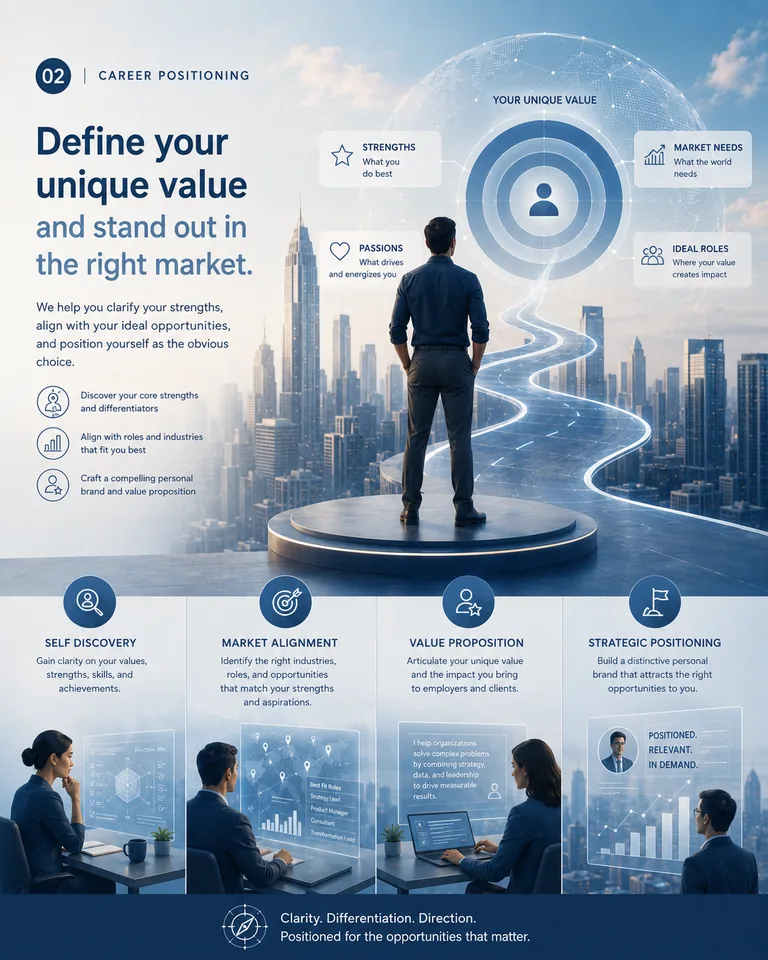
Positioning is built around four questions:
Initial: "I am an experienced engineering manager with strong technical and people management skills."
Repositioned: "Engineering delivery leader with experience leading cross-functional teams, supplier networks and complex technical programmes from concept through launch, with a track record of improving delivery confidence, reducing risk and aligning engineering execution with business outcomes."
The second version gives the market a clearer reason to care.
Write a one-sentence positioning statement: "I help [type of organisation] solve [type of problem] by applying [capability] to deliver [measurable or strategic outcome]."
If the sentence feels vague, your positioning needs more work.
Positioning is only convincing when backed by proof:
Click any question to expand the answer.
Eich Dyn is positioned as a premium career consultancy rather than a career coaching service, although many people searching for career coaching are looking for exactly this type of support. The difference is structure: engagements begin with a Career Diagnosis with Dai Jones, and the work then follows the Career OS™ methodology — positioning, evidence, opportunity strategy, interview preparation and offer decision support. You receive direct professional judgement and recommendations, not only reflective questions.
Career coaching helps you think and decide; career consulting assesses, advises and structures. In practice a consultant will tell you when your positioning is weak, your evidence is unconvincing or your target roles are wrong, and then set out what to change and in what order. Career consulting is more strategy-led and sequenced, which is why Career OS™ is delivered as six connected stages rather than standalone sessions.
Engineers and technical specialists are a core audience, and many arrive after searching for a career coach for engineers. The support is consultancy-led: translating technical depth into commercial value a hiring panel can price, positioning for the senior market you should be competing in, building leadership evidence that withstands scrutiny, and preparing interviews around decisions rather than descriptions.
Yes. Senior professionals searching for executive career coaching often need structured career strategy. Eich Dyn provides executive career consulting for experienced professionals making high-stakes career moves, covering direction, positioning, evidence, opportunity strategy, interview preparation and offer decisions.
Career OS™ is Eich Dyn's six-stage career operating system for professionals who want to progress, reposition or move. It is designed for experienced professionals who want greater control over their career direction, market positioning and next move. It brings together the areas that are too often treated separately: career clarity, professional positioning, CV and LinkedIn development, job-search strategy, interview preparation and offer negotiation.
Rather than addressing one visible symptom in isolation, Career OS™ examines how the different parts of a career campaign work together. This matters because a weak result is not always caused by the most obvious problem. A poor response rate may appear to be a CV issue when the deeper problem is unclear positioning, unsuitable role targeting or insufficient evidence.
Career OS™ provides a disciplined way to diagnose those issues, prioritise the right interventions and build a more coherent career strategy. The detailed diagnostic process and tools remain part of the programme itself.
Career OS™ is designed primarily for mid-career, senior and experienced professionals who have accumulated substantial capability but are finding that experience alone is no longer enough to create career momentum. This includes professionals seeking promotion, changing organisation, moving into leadership, returning after redundancy, repositioning into a new sector or trying to regain control after a prolonged and frustrating job search. It is particularly relevant to people whose careers have become more complex.
At this stage, the challenge is rarely a lack of experience. More often, the difficulty lies in making that experience clear, relevant and commercially compelling to a new audience. Career OS™ is not restricted to one profession, although it is especially well suited to technical, engineering, scientific, programme, project and leadership backgrounds where careers involve multiple disciplines, long timelines and complex evidence.
The programme is built for people who need more than generic encouragement. They need structure, challenge and informed decision-making.
A career coach helps a client examine their direction, decisions, positioning and behaviour more objectively than they may be able to do alone. The work can include clarifying goals, identifying barriers, evaluating options, improving professional communication and strengthening the way a person approaches the employment market. At its best, career coaching is not simply motivational.
It should help the client think more clearly, identify what is not working and act with greater discipline. However, not all career coaching is the same. Some approaches are primarily reflective and conversational.
Others are more tactical, focusing on CVs, interviews or job applications. Career OS™ combines coaching with structured diagnosis, strategy and practical implementation. The aim is not to tell a client what to do, nor to provide a collection of generic answers.
It is to help them understand the system surrounding their career, identify the highest-value issues and make better decisions using evidence rather than assumption.
Career coaching generally helps a client think, decide and act more effectively. Career consultancy places greater emphasis on analysis, expert interpretation and practical recommendations. In coaching, the practitioner may use questions to help the client reach their own conclusions.
In consultancy, the practitioner is more likely to assess the situation directly, identify weaknesses and advise on what needs to change. Experienced professionals often need both. There are moments when reflection is appropriate, particularly when values, confidence or career direction are unclear.
There are also moments when direct professional judgement is required. A client may not need another open question. They may need to know that their positioning is weak, their evidence is unconvincing or their job-search strategy is inefficient.
Career OS™ combines the two disciplines. It uses coaching where insight and ownership matter, and consultancy where objective assessment, market knowledge and direct challenge are more useful. The balance depends on the client, the problem and the stage of the career process.
Career OS™ treats a career as an interconnected system rather than a series of isolated tasks. Traditional career coaching may concentrate on confidence, motivation, reflection or general career goals. Those areas can be valuable, but they may not resolve the practical reasons a professional is failing to progress.
A candidate can feel more confident and still have weak positioning. They can improve their CV and continue targeting unsuitable roles. They can perform well in interviews but fail to present evidence that addresses the employer’s actual concerns.
Career OS™ therefore looks at the relationship between direction, positioning, market evidence, applications, networking, interviews and negotiation. The purpose is to locate where performance is being lost and address the right problem in the right sequence. The detailed scoring models, diagnostic questions and intervention logic are not published openly.
They form part of the Career OS™ process. What clients receive is not simply advice, but a structured way of understanding and managing their career.
Yes. Career OS™ was developed specifically with experienced professionals in mind. At mid-career and senior levels, career decisions become more complicated.
There may be greater financial responsibility, stronger expectations around salary, a narrower selection of suitable roles and more at stake if a move goes wrong. Professional identity can also become tightly connected to title, sector, expertise or organisational status. These individuals may have decades of experience but still struggle to explain their value outside the context in which that experience was gained.
They may also find that earlier job-search methods no longer work at the level they are now targeting. Career OS™ helps separate experience from relevance. It examines how capability is interpreted by employers, how professional value is communicated and where a candidate may be relying too heavily on reputation, job titles or technical history.
It is not designed to diminish experience. It is designed to make that experience usable, visible and credible in a changing employment market.
No. Career OS™ is applicable across a wide range of professional, technical, operational and leadership careers. Its origins are strongly influenced by systems thinking, engineering discipline, programme delivery and evidence-based decision-making.
That makes it especially relevant to engineers, scientists, technical leaders, project managers, programme directors and other STEM professionals. However, the underlying career problems are not limited to STEM. Professionals in operations, consulting, transformation, finance, commercial leadership, higher education and other sectors often face similar challenges.
They may be highly capable but poorly positioned, uncertain about their next move or unable to translate their experience into a proposition the market understands. The important factor is not the job title. It is the complexity of the career problem and the willingness of the client to examine it properly.
Career OS™ is most useful for people who value structure, evidence and strategic clarity. It is less suited to someone seeking a quick cosmetic rewrite without addressing the wider causes of weak career performance.
Yes. In many cases, the best time to improve a career system is before an urgent job search begins. Professionals often wait until redundancy, burnout, organisational conflict or stalled progression forces them to act.
By that point, time pressure can reduce the quality of decision-making. They may accept the first plausible role, rush their applications or discover that their professional network has been neglected. Career OS™ can be used proactively to evaluate career direction, strengthen positioning, clarify future options and identify gaps before they become urgent.
It can also help a professional decide whether the right move is to leave, remain, negotiate, reposition internally or prepare for a later transition. Not every career problem requires an immediate resignation or job search. Sometimes the first requirement is to understand what is actually wrong.
The programme does not begin with the assumption that a client must leave their role. It begins by examining the evidence, the available options and the consequences of each possible direction.
Online career coaching can be highly effective when the process is structured, the objectives are clear and both parties are prepared to work with evidence rather than general impressions. Career decisions do not normally depend on being in the same physical room. They depend on the quality of the analysis, the relevance of the questions, the strength of the supporting material and the client’s willingness to implement what is agreed.
An online format can also offer practical advantages. Documents, assessments, job descriptions, interview evidence and action plans can be reviewed directly during the process. Sessions can be integrated with digital tools, written outputs and structured follow-up activity.
The limitation is not usually the technology. It is the quality of the method. A poorly defined coaching conversation remains poorly defined whether it takes place online or face to face.
Career OS™ uses online delivery as part of a wider working system, combining structured sessions with diagnostic tools, written guidance and practical career assets. The effectiveness comes from the discipline of the process, not the location of the conversation.
AI can support career development, but it cannot reliably replace informed human judgement. It can help generate ideas, analyse job descriptions, improve wording, organise information and accelerate repetitive tasks. Used properly, it is a valuable productivity tool.
Used carelessly, it can produce generic, inflated or inaccurate material that sounds polished but does not reflect the individual. The central career decisions still require context. An AI tool does not fully understand a person’s history, risk tolerance, family pressures, political environment, reputation, confidence or the consequences of making the wrong move.
It may also reinforce the assumptions contained in the prompt rather than challenge them. Career OS™ uses AI where it adds speed, structure or analytical support. It does not treat AI output as professional judgement.
The important question is not whether AI should be used. It is where it should be used, what evidence it should be given and when human interpretation is necessary. That boundary is a significant part of using career technology responsibly.
No responsible career coach can guarantee that a client will secure a specific role, salary or job offer. Employment decisions are made by third parties and are influenced by market conditions, competition, timing, organisational priorities and factors outside the control of either the client or the coach. What a structured career programme can do is improve the quality of the client’s decisions, materials, positioning and execution.
It can identify avoidable weaknesses, strengthen evidence, improve interview performance and reduce the amount of effort being spent on ineffective activity. Career OS™ focuses on improving the conditions under which better outcomes become more likely. It does not make artificial promises about outcomes that no coach controls.
Clients should therefore be cautious of anyone offering certainty in an uncertain market. A credible service should explain what it can influence, what remains outside its control and what the client must contribute. The objective is not false reassurance.
It is to build a stronger, more disciplined and more competitive career campaign.
The process begins by understanding the client’s current position, intended direction and the evidence surrounding the problem. This is important because the first issue presented is not always the issue that needs to be solved. A client may request a new CV when the real difficulty is unclear role targeting.
They may believe they need interview coaching when their examples lack relevance. They may assume they need to leave their employer when the underlying problem could be role design, leadership conflict or stalled progression. The opening stage therefore focuses on diagnosis rather than immediate prescription.
Career OS™ examines the available information, identifies the most significant gaps and determines which areas require attention first. The exact tools and assessment sequence depend on the client’s circumstances and level of support. The process is deliberately structured, but not rigid.
Every client enters with a different career history, level of readiness and degree of urgency. The system provides the framework; the evidence determines the route.
If you are a STEM professional with strong experience but inconsistent interviews, unclear positioning or stalled progression, Career OS™ gives you a structured way to diagnose the issue and rebuild your route to better roles. Book a Career OS™ Diagnosis Call — understand where your career system is leaking value, and what to fix first.