
Director of Engineering Interview Questions: Frameworks, Sample Answers and Executive Preparation
Director interviews are not larger EM interviews. They test organisational scaling, long-term technical strategy, senior stakeholder credibility and commercial judgement. This guide gives you the questions, the SCOPE answer framework, sample answers and a 14-day preparation plan to walk in at executive level.

Director of Engineering interviews are not larger versions of engineering manager interviews. They test a different layer of leadership.
An engineering manager interview asks whether you can run a team. A director interview asks whether you can run an organisation — multiple teams, a multi-quarter technical strategy, a senior stakeholder map, a headcount plan, and the operating system that holds it all together.
If you walk into a director interview with manager-level stories, you will sound like a strong EM applying for a stretch role. If you walk in with director-level evidence — scaling, strategy, executive influence, organisational design — you sound like the person they have been looking for.
This guide gives you the director of engineering interview questions you are most likely to face, what the panel is actually scoring, the frameworks you can use, sample answers, and a preparation plan that gets you ready for an executive conversation.
What Director of Engineering Interviews Actually Test
At director level the panel is usually a mix of CTO or VP Engineering, a peer director, a senior product or commercial leader, and often a board observer or non-executive. They are scoring six things:
- Organisational scaling — can you grow, restructure and operate 30 to 150+ engineers without the org collapsing?
- Long-term technical strategy — can you set a 12 to 36 month technical direction that survives contact with the market?
- Senior stakeholder management — can you operate credibly with CEO, CFO, CPO, board and customers?
- Talent system ownership — can you build the hiring, performance, succession and leadership pipeline?
- Commercial and financial judgement — do you understand unit economics, cost of delivery, build vs buy, vendor risk and capex versus opex?
- Executive presence under pressure — can you hold a room, deliver hard news, and stay clear when the strategy is contested?
Director interviews are won on judgement and evidence, not on enthusiasm.
Director of Engineering Interview Questions by Category
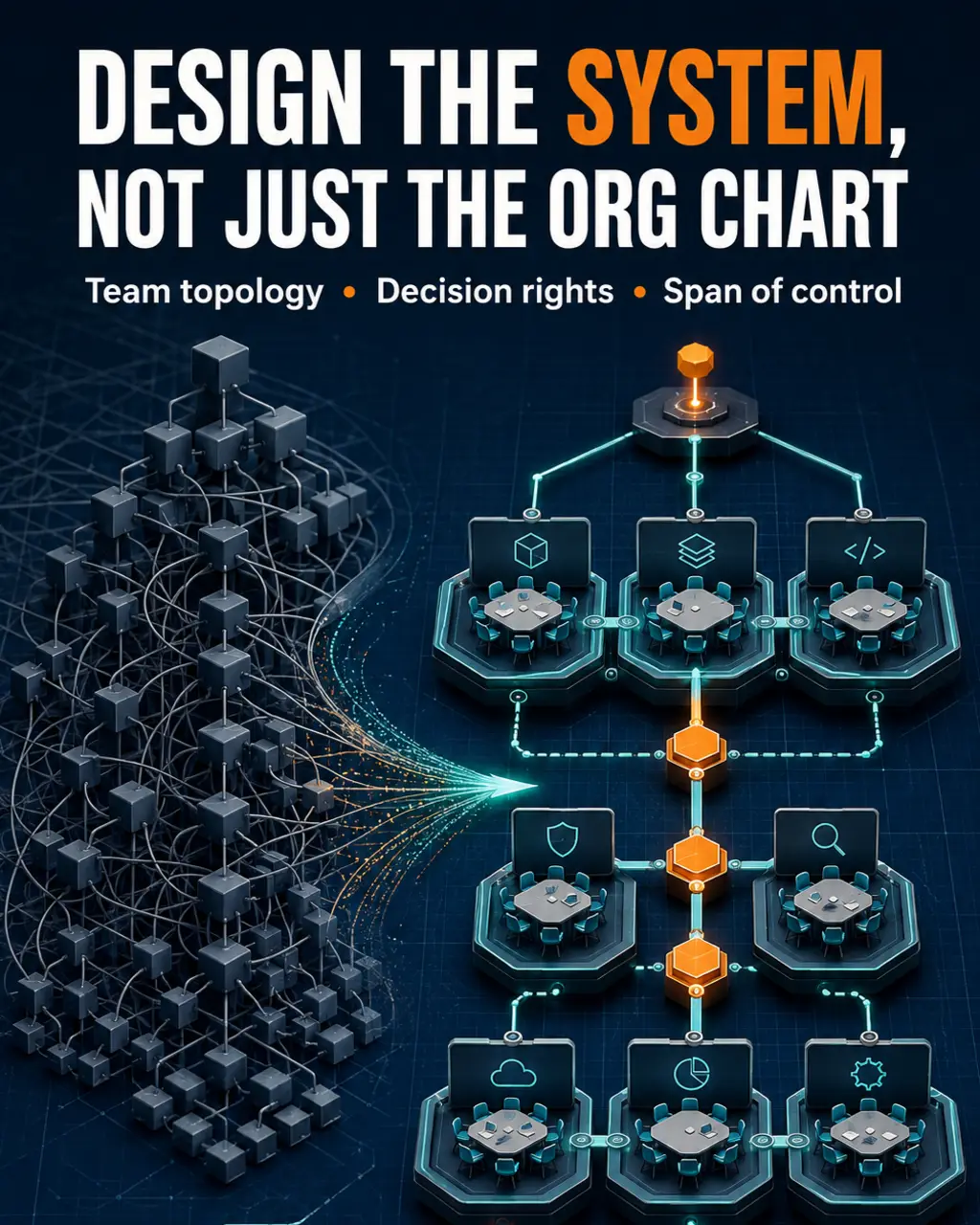
Organisational Scaling and Design
- How have you structured an engineering organisation as it grew from one stage to the next?
- Walk me through a re-org you led. What was the trigger, the design choice and the outcome?
- How do you decide between functional teams, stream-aligned teams and platform teams?
- How do you manage span of control as the org grows?
- How do you protect throughput when you double headcount in 12 months?
- Tell me about a time you removed a layer of management. Why, and what did you learn?
Long-Term Technical Strategy
- What is your approach to setting a 12 to 36 month engineering strategy?
- Tell me about a strategic technical bet you placed. What was the thesis, the evidence and the outcome?
- How do you balance platform investment against feature delivery?
- How do you decide when to migrate, rewrite or retire a system?
- How have you handled a strategy that turned out to be wrong?
- How do you ensure your strategy is understood and owned by every team in the org?
Senior Stakeholder Management
- Describe how you partner with a CEO or CPO when priorities are contested.
- Tell me about a board or executive update you delivered on a high-risk programme.
- How do you say no to a CEO without damaging the relationship?
- Walk me through a time you had to defend an unpopular engineering decision to the executive team.
- How do you operate when product and engineering are misaligned?
- How do you build credibility with finance and commercial leaders?
Talent System and People Leadership
- How have you built a hiring engine that sustained growth without dropping bar?
- Walk me through how you develop engineering managers and senior managers under you.
- How do you handle a senior leader who is underperforming?
- How do you build a succession plan for your own role?
- How have you improved retention of senior engineers and managers?
- What is your philosophy on performance management at director level?
Commercial and Financial Judgement
- How do you build and defend an engineering budget?
- Tell me about a build versus buy decision you led. What changed your mind?
- How do you manage cloud and vendor cost at scale?
- How do you tie engineering investment to commercial outcomes?
- Walk me through how you would diagnose a delivery problem that has a commercial root cause.
- How do you justify platform investment to a CFO?
Crisis, Risk and Judgement
- Tell me about the hardest decision you made as a leader. What did it cost you?
- Walk me through an incident or outage that exposed a structural weakness. What did you change?
- How have you handled a senior departure that destabilised the org?
- Tell me about a time you had to deliver very bad news to the executive team.
- How do you make decisions when the data is incomplete and time is against you?
What Director-Level Answers Should Sound Like
Director answers share five qualities. If your stories miss any of them, the panel will quietly downgrade you to a senior EM.
- Scope — the answer involves multiple teams, multiple quarters, and meaningful headcount or budget.
- System — you describe the operating system you built, not just the action you took.
- Stakeholders — you name the senior people you influenced and how.
- Trade-off — you make the trade-off explicit, including what you chose not to do.
- Outcome — you tie the outcome to commercial, organisational or strategic impact, not just delivery.
A common failure mode is telling a story that proves you are a strong manager. The panel needs to hear stories that prove you can hold the org.
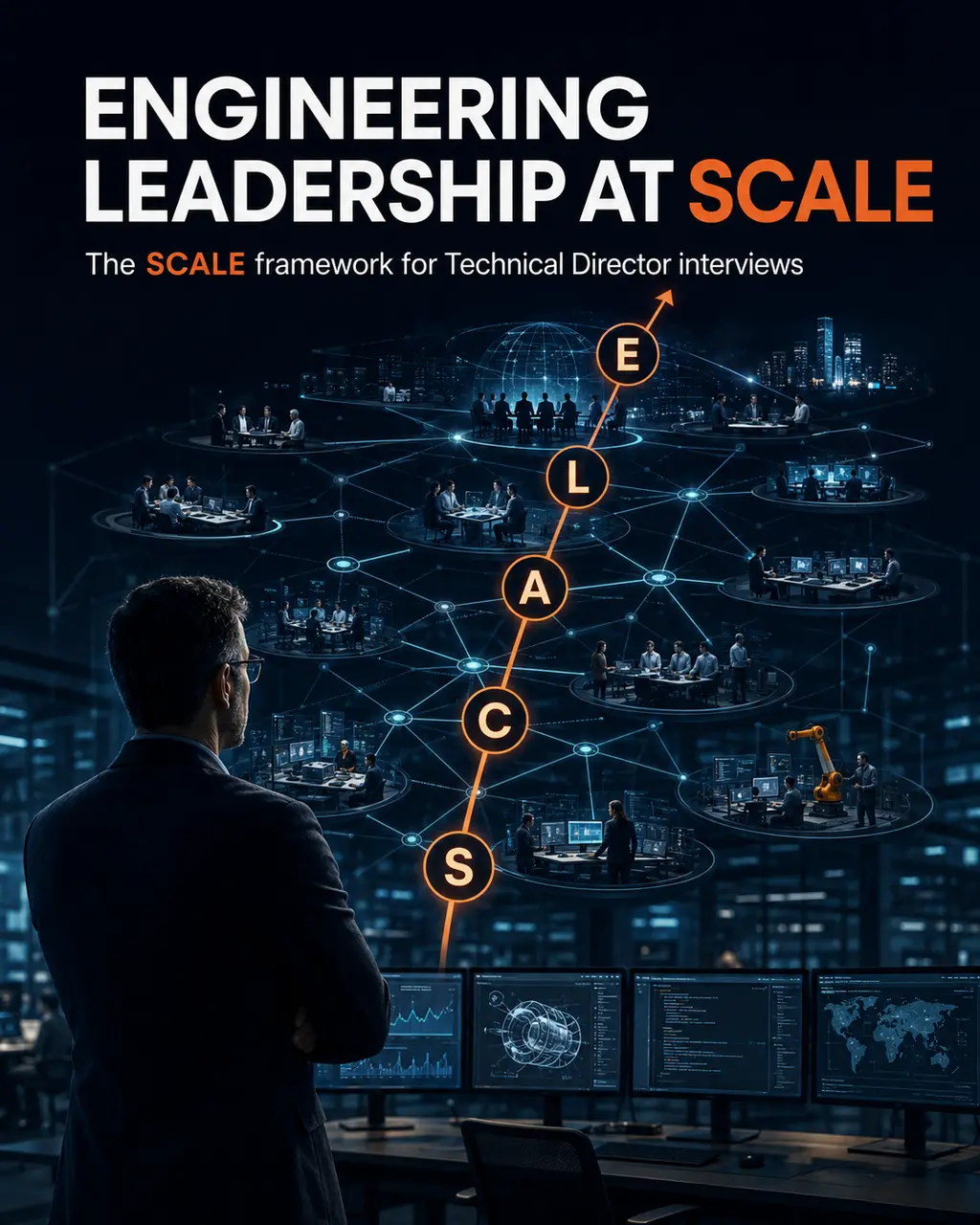
A Framework for Director Interview Answers: SCOPE
Use SCOPE when an EM-style STAR answer is not big enough.
- Situation — the organisational, commercial or strategic context. Not just the team.
- Constraint — the real constraint: budget, talent, regulation, board pressure, market window.
- Option set — the options you considered, and why you ruled out the others.
- Play — the play you ran. What you decided, who you aligned, and what you sequenced.
- Effect — the multi-quarter effect on the org, the strategy and the business.
SCOPE forces you out of single-team thinking. It is the structure that signals director-level judgement.
Turn organisational experience into director-level evidence.
Career OS™ helps you build a SCOPE story bank tied to the six signals director panels actually score on — scaling, strategy, stakeholders, talent, commercials and crisis. Backed by 300+ implementation resources and 49 precision AI tools.
Sample Director of Engineering Interview Answers
"Walk me through a re-org you led."
When I joined, engineering was 60 people in nine teams, organised by feature area. The constraint was speed: we were losing two enterprise deals a quarter on roadmap timelines. I considered three options — keep structure and add a delivery PMO, move to stream-aligned teams around customer journeys, or split into a platform and product org. I ruled out the PMO because the bottleneck was architectural ownership, not coordination. I chose stream-aligned teams with a thin platform group, sequenced over two quarters with the CTO and CPO. I personally owned the manager moves and the architectural seam between platform and streams. Within nine months, cycle time on the top three customer journeys dropped by 40 percent, we closed both enterprise deals we had been losing, and attrition in the senior engineer band dropped from 18 to 7 percent. The lesson I took was that I should have moved the platform leader appointment two months earlier.
"How do you say no to a CEO?"
I assume the CEO is usually right about the destination and often wrong about the route — and my job is to make the route visible. When our CEO pushed to ship an AI feature in six weeks to match a competitor, I did not say no in the room. I asked for 48 hours, came back with three options costed against revenue risk, talent risk and platform risk, and showed which one I would defend to the board. The CEO chose the middle option, which was a 10-week shippable beta with an explicit platform investment baked in. We shipped, the platform investment paid back inside two quarters, and the CEO trusted my next "not yet" because I had earned it.
"Tell me about a strategic technical bet you placed."
Two years in, we were paying a vendor 1.4 million a year for a search and ranking layer we used across every product. The bet was to bring it in-house over four quarters using a small platform squad. The thesis was that search quality was becoming a competitive moat and we could not iterate at the speed we needed on a vendor stack. The evidence was three failed vendor change requests and a churn analysis tying search relevance to renewal rate. I sized the squad, sequenced the migration to start with the highest-value surface, and negotiated a 12-month exit with the vendor as cover. The bet worked: vendor cost gone, relevance up 22 percent on the top three surfaces, and the squad became the seed of our ML platform. The honest reflection is that I underestimated the change management cost on the product teams consuming the new platform.
Senior Stakeholder Mapping: The Exercise to Do Before the Interview
Before any director interview, draw the stakeholder map for your most recent role on a single page.
- Name the CEO, CFO, CPO, CRO, board members and largest customer contacts you operated with.
- For each, write the outcome you owned with them, the disagreement you navigated, and the trust signal you built.
- Now connect each name to a story in your bank.
If you cannot fill in the disagreement column for at least four senior stakeholders, your evidence is at EM level, not director level. Spend prep time generating those stories before you spend more time polishing answers.
The 14-Day Director Interview Preparation Plan
Days 1 to 3 — evidence audit. List every team, programme, re-org, hiring plan, strategy doc, board paper and incident you have owned. Cluster them by the six categories above. Be honest about which clusters are thin.
Days 4 to 6 — story bank. Write 10 to 12 stories using the SCOPE framework. At least two stories per category. At least three that involve a senior stakeholder disagreement.
Days 7 to 9 — strategy narrative. Write a one-page version of your most recent engineering strategy. Be ready to defend the thesis, the trade-offs and the things you got wrong.
Days 10 to 11 — commercial fluency. Refresh on engineering cost lines, cloud unit economics, build vs buy framing, and how engineering investment shows up on a P&L. You do not need to be a CFO; you need to be fluent.
Days 12 to 13 — rehearsal. Run answers out loud with a peer at director level or above. Cut the answer if it goes over 2 minutes. Add scope and commercial framing if the panel would still hear "senior EM".
Day 14 — questions for the panel. Prepare 6 to 8 questions covering org health, exec-team trust, succession risk, board pressure, technical debt posture and how success is measured at 6 and 12 months. The questions you ask are part of the interview.
Questions to Ask in a Director of Engineering Interview
- What is the executive team's biggest unspoken concern about engineering right now?
- How is engineering performance measured at the board level?
- Where is the org most fragile if a senior leader left tomorrow?
- What is the strategy that the previous director did not finish?
- How is technical debt represented in commercial planning?
- What does success look like for this role at 6, 12 and 24 months?
- How are platform and product investment balanced today, and who owns that balance?
- What is the relationship between engineering and the CFO like in practice?
Final Word
Director of Engineering interviews are won by candidates who can speak the language of the executive team without losing the language of engineering.
If your answers show organisational scope, strategic judgement, senior stakeholder credibility and commercial fluency — backed by stories that name the trade-off you made — you will stand out from candidates who are still pitching at manager level.
Career OS™ is built to take that evidence out of your head and onto the page, so you walk into the room with conviction and the panel walks out remembering you. If you want senior-level support sharpening that narrative, executive career consulting is built for exactly this level of interview.
Walk into your director interview at executive level.
Book a Career OS™ Diagnosis to map your evidence, sharpen your strategy narrative and rehearse the senior stakeholder answers that convert director interviews into offers — with 300+ stage-by-stage resources and 49 AI tools built for technical leaders.
Go deeper on the next decision.
Supporting Career OS™ guides for engineers and technical leaders moving into management.

Engineering Management — full guide
Roles, skills and career options at a glance

Engineering Manager Career Path
Progression from engineer to director and VP
Software Engineer to Engineering Manager
Making the IC-to-leadership transition into a first EM role

How to Become an Engineering Manager
Preparing for your first EM role
Tech Lead to Engineering Manager
Moving from technical leadership into formal people management
Staff Engineer vs Engineering Manager
Deciding between the senior technical track and people management
First-Time Engineering Manager Guide
Leading your first engineering team with confidence

Engineering Manager 30-60-90 Day Plan
Executing a credible first ninety days in a new EM role

Engineering Manager CV & Resume Guide
Repositioning a technical CV around leadership evidence

Engineering Manager Interview Questions
Interview and promotion panels