
UK, Germany and US Job Market 2026: Skills Are in Demand — But Competition Remains
August 2026 employment market update for experienced professionals, engineers and STEM leaders — what current UK, German and US data says about skills demand, candidate competition and how to compete for the right roles.
Dai Jones · Eich Dyn Career Services ·
August 2026 Employment Market Update for Experienced Professionals, Engineers and STEM Leaders
If you are an experienced engineer, technical specialist, programme leader, scientist or senior professional looking at the employment market in 2026, you could be forgiven for thinking that the available evidence contradicts itself.
Employers tell us that skills are difficult to find. Governments publish lists of shortage occupations. There remain hundreds of thousands, and in some markets millions, of vacancies. Engineering, healthcare, digital, technology, energy and specialist technical capabilities continue to feature prominently in areas of demand.
Yet good people are still struggling to secure good roles.
Both things can be true.
The latest employment evidence from the United Kingdom, Germany and the United States points towards a labour market that still contains considerable opportunity, but which has become more selective, more fragmented and less forgiving of a poorly targeted job search.
For experienced STEM professionals in particular, the question is therefore no longer simply: "Are there jobs?"
There are.
The better question is: "How effectively am I positioned to compete for the right ones?"
What is happening in the UK job market in 2026?
The UK labour market has clearly cooled, but it has not stopped hiring.
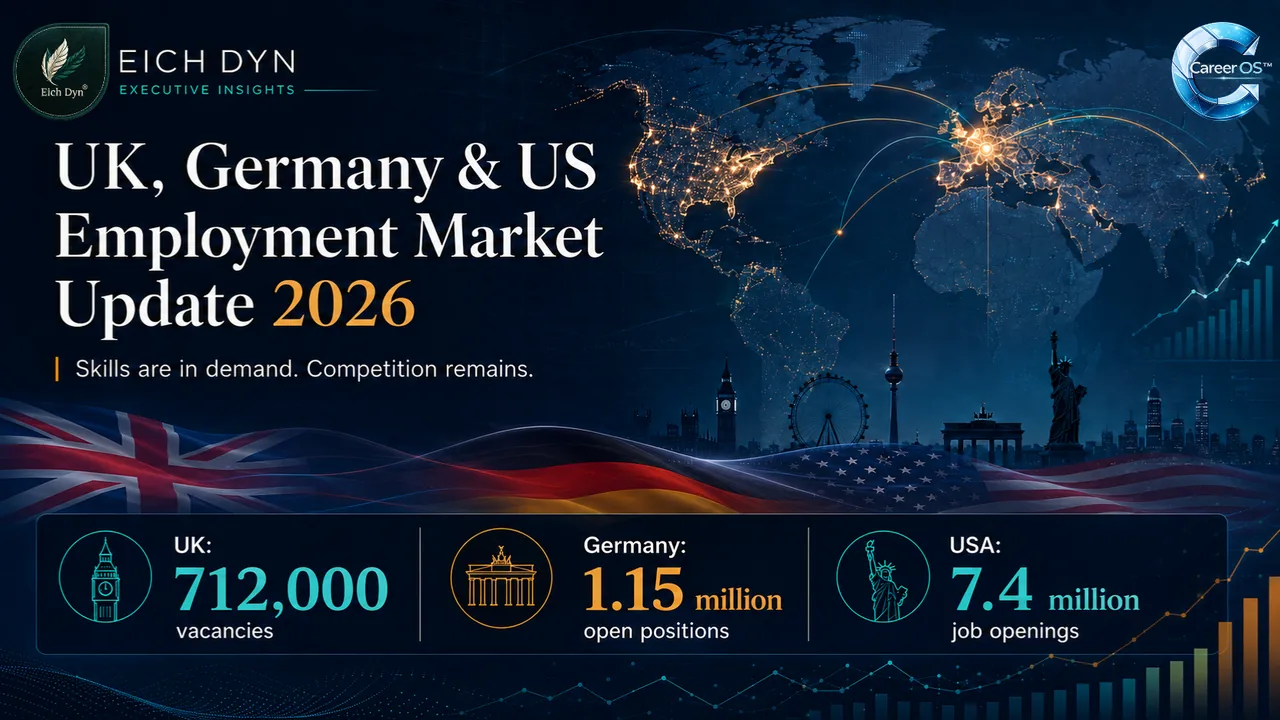
The Office for National Statistics reported an estimated 712,000 UK vacancies during April to June 2026. That was 7,000 lower than the previous quarter and 18,000 lower than a year earlier. There were also 2.5 unemployed people for every vacancy during March to May 2026, a useful indication that candidates now face considerably more competition than in an exceptionally tight labour market.
That headline alone, however, does not describe the skills market.
Skills England's 2025 Occupations in Demand analysis identified 62 occupations in critical demand, employing approximately 5.1 million people, and another 125 occupations in elevated demand, covering around 10.9 million workers. Health, care, digital, engineering and other specialist occupations feature strongly within this picture.
That is precisely why I would resist describing the UK employment market simply as either "good" or "bad".
It is selective.
There may be fewer vacancies overall and more people competing for them, while employers simultaneously struggle to recruit people with the precise technical knowledge, experience, leadership capability or domain expertise they require.
For a senior engineer or technical leader, that distinction matters enormously. A general vacancy statistic tells you remarkably little about the demand for a particular combination of systems engineering, programme delivery, manufacturing, digital, AI, energy, regulatory knowledge or leadership experience in a particular location and salary band.
What is happening in the German job market?
Germany tells a remarkably similar story.
The IAB's employer survey recorded approximately 1.15 million open positions in the first quarter of 2026. That remains a substantial volume of employment demand, but it was around 8% lower than the previous quarter and approximately 2% below the same quarter a year earlier. IAB itself described labour demand as continuing at a relatively low level.
At exactly the same time, Germany continues to experience structural skills shortages.
The Bundesagentur für Arbeit's 2025 skills-shortage analysis identified 157 shortage occupations, demonstrating that a cooling labour market does not remove the underlying difficulty employers experience when recruiting particular capabilities.
Healthcare and care professions remain important, alongside IT, engineering, construction, transport and other specialist occupational groups.
German automotive is the clearest example of demand moving rather than disappearing, and the structural reset now running through German automotive shows why large-scale restructuring and specialist shortages are appearing side by side.
Again, both things can be true.
A German employer can struggle for months to recruit one highly specialised engineer while another experienced engineer sends application after application without reaching interview.
That is not necessarily a contradiction. It is often a matching problem.
The employer needs a particular combination of skills, evidence, sector knowledge, location, language capability, seniority and commercial experience. The professional may possess much of that value, but if it is presented too broadly, targeted at the wrong role family, or poorly translated into the language of the employer's problem, the two sides can pass each other in the market.
Is the US job market still strong in 2026?
The United States provides perhaps the clearest example of why headline numbers require interpretation.
The US Bureau of Labor Statistics reported 7.4 million job openings in June 2026 through its Job Openings and Labor Turnover Survey. That remains an enormous number of available positions.
Yet the market has cooled.
By July, US unemployment stood at 4.1%, with approximately 6.9 million people unemployed, while total non-farm payroll employment changed little, falling by 23,000 during the month. Hiring therefore continues, but employers have become more selective and the balance of power is very different from the extraordinary post-pandemic recruitment environment.
For STEM professionals, however, the longer-term structural picture remains significant.
BLS projections suggest employment across STEM occupations will grow by 8.1% between 2024 and 2034, compared with 2.7% for non-STEM occupations. The 2024 median annual wage for STEM occupations was $103,580, more than twice the corresponding median for non-STEM occupations.
So America does not have a simple shortage of jobs, nor a simple shortage of candidates. It has millions of both.
The real issue is increasingly the quality of the match.
Why can skills shortages and difficult job searches exist at the same time?
Because labour-market demand is not the same thing as demand for every candidate.
This distinction gets lost remarkably quickly when employment statistics are reduced to headlines.
A national shortage of engineers does not mean every engineer can submit the same generic CV to fifty advertised vacancies and expect results. A shortage of digital skills does not mean every experienced technology professional is equally suited to every technology role. Equally, rising candidate competition does not mean organisations have suddenly stopped needing difficult-to-find specialists.
Vacancies exist at the intersection of occupation, capability, seniority, industry, geography, remuneration and timing.
Having spent much of my career around engineering, programme leadership and complex technical organisations, and now working with experienced professionals on their own careers, I see the same mistake repeatedly from both sides of the employment equation.
People describe themselves by what they have done.
Employers recruit against what they need solved next.
Those are not automatically the same proposition.
A technically excellent professional can therefore become almost invisible if their CV, LinkedIn profile and recruiter narrative describe twenty years of history rather than making their future value immediately obvious.
What should experienced STEM professionals do differently?
The evidence across all three markets leads me towards one conclusion: this is not the environment for an indiscriminate, high-volume job search.
It is an environment for precision.
The starting point should be clarity around the role family you are targeting and the problems organisations will pay you to solve. From there comes positioning: defining the combination of technical credibility, leadership capability, commercial impact and transferable value that differentiates you from other credible candidates.
Your CV and LinkedIn profile then become evidence systems rather than biographies. Your achievements need to demonstrate scale, complexity, decisions, outcomes and impact.
Your search strategy also needs to extend beyond repeatedly pressing "Apply".
Job boards matter, but they are only one access route. Recruiters, former colleagues, professional networks, direct approaches, target-company research, internal referrals and conversations around emerging requirements can expose opportunities before they become crowded advertised competitions.
This becomes particularly important at senior level, where the best opportunity may begin as a business problem long before somebody writes a formal job description.
Is 2026 a bad time to change jobs?
Not necessarily.
It is a less forgiving time to conduct a weak job search.
That is different.
Across the UK, Germany and the United States, employers continue to recruit substantial numbers of people. Specialist shortages continue to exist. STEM, healthcare, digital, engineering, technology and energy-related capabilities remain strategically important.
But experienced professionals should not confuse market demand with entitlement to attention.
The candidate who can articulate a precise target, demonstrate relevant evidence, communicate a compelling professional narrative and reach decision-makers through several channels has a very different proposition from somebody whose strategy consists primarily of uploading a generic CV to another vacancy.
That distinction becomes more important as competition increases.
The real employment-market lesson from the UK, Germany and US
The most useful conclusion from the 2026 data is not that there are too few jobs.
Nor is it that there are too few skilled people.
It is that skills demand and candidate competition are now operating simultaneously.
For employers, this produces hard-to-fill specialist positions.
For candidates, it produces crowded competitions for attractive roles.
And somewhere between those two groups sits the problem of alignment.
That is why I increasingly view career development as an operating system rather than a collection of isolated activities — the thinking behind Career OS™. Career clarity affects positioning. Positioning affects the CV and LinkedIn narrative. That narrative affects search and networking. Search determines which interviews you reach. Interview performance influences the offer, and the quality of the offer determines what you ultimately have available to negotiate.
Fixing one document while ignoring that system can improve presentation without solving the underlying problem.
The professionals most likely to navigate a selective market effectively will therefore be those who understand where they create value, where that value is currently demanded, how to evidence it, and how to reach the organisations that need it.
Because the opportunity has not disappeared.
The route to it has simply become more demanding.
Frequently asked questions
Are engineering and STEM skills still in demand in 2026?
Yes. Current UK and German evidence continues to identify significant occupational shortages, while US Bureau of Labor Statistics projections expect STEM employment to grow faster than non-STEM employment through 2034. Demand, however, varies materially by discipline, industry, seniority and geography.
Why am I struggling to find a job if employers say there is a skills shortage?
Because a skills shortage describes an imbalance in particular parts of the labour market; it does not mean every candidate matches every vacancy. Role targeting, positioning, achievement evidence, salary expectations, geography, visibility and access to decision-makers all influence whether your skills translate into interviews.
Should experienced professionals rely on online job boards?
No single channel should carry an experienced professional's entire search strategy. Advertised vacancies remain important, but recruiter relationships, professional networking, referrals, target-company research and direct conversations can considerably broaden access to the market. For senior and specialist roles, the objective should be to understand both the visible and less-visible employment market, rather than treating online applications as the complete job search.
Source Market Reports
The underlying market updates behind this analysis. Each report opens only when you choose to view or download it.
Unlock the market reports
Enter your name and email once to open the UK, Germany and US market updates. One set of details unlocks every free Eich Dyn resource on this browser.
The Career OS™ next step
If your experience is genuinely valuable but your job search is not converting, the problem is usually target, positioning, evidence or market access — not effort. A Career Diagnosis establishes which of those is holding you back before you send another application.
Book a Career Diagnosis← Back to Career Strategy Insights