
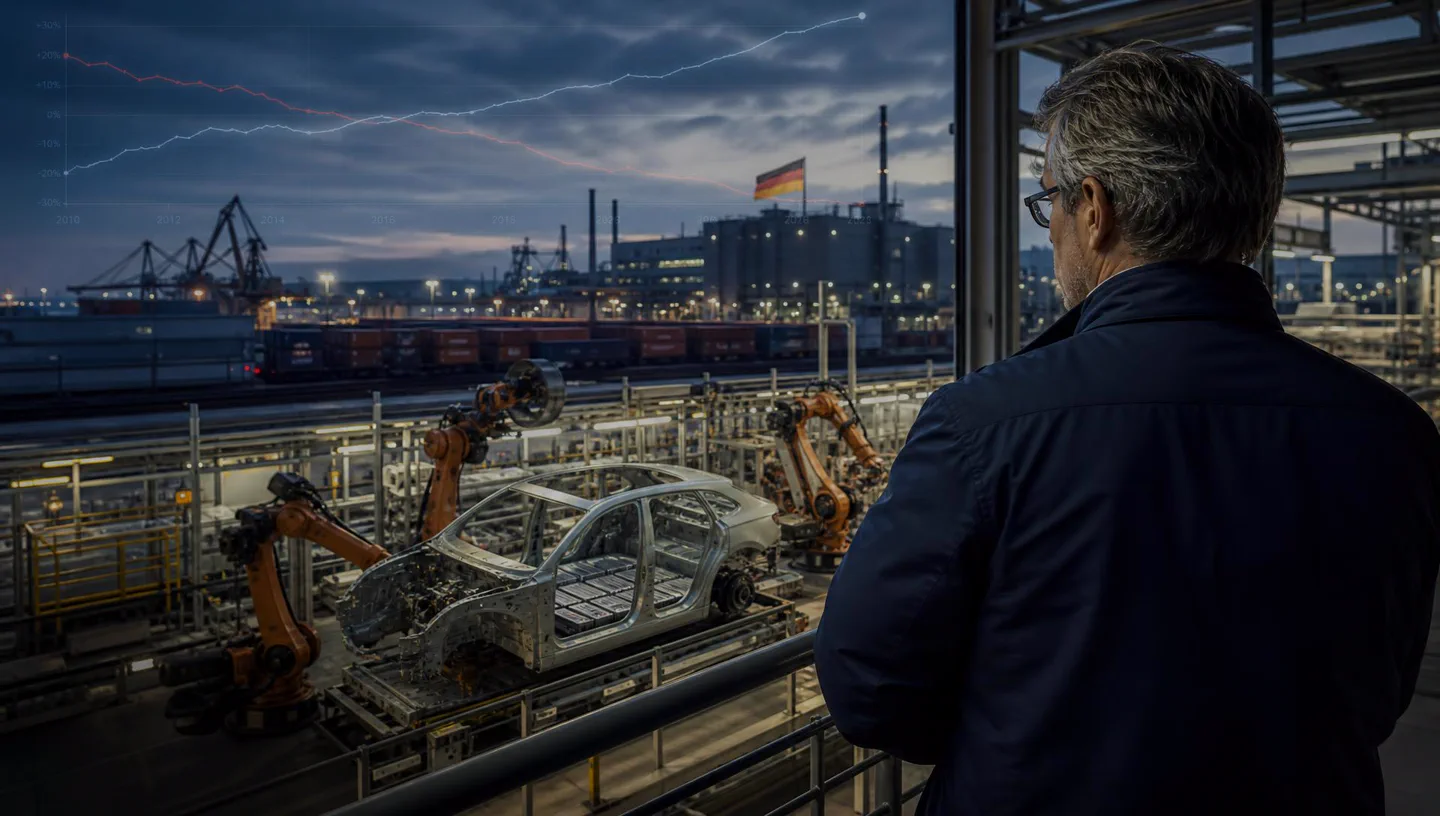
Germany’s Automotive Reset
How EV transition, China exposure, workforce restructuring and government intervention are reshaping Europe’s industrial powerhouse.
By Dai Jones, Founder & Lead Consultant, Eich Dyn Career Services Ltd · · Market Intelligence
Introduction
Germany has spent decades building one of the most formidable automotive industries in the world. Not simply factories, but an engineering ecosystem: manufacturers, suppliers, research centres, production specialists, technology businesses and a workforce whose capability has been developed over generations.
That is why what is happening now matters. This is not simply another difficult automotive cycle. The source report describes a much deeper structural transition, with electrification, software, automation, China exposure, energy costs, regulation, workforce restructuring and government intervention all acting at the same time.
Germany still has enormous strengths. Automotive remains at the centre of its innovation model, accounting for approximately 34% of German corporate R&D spending according to the report. International investment is increasingly concentrating on digitalisation, electronics and automation rather than straightforward assembly. That is important because it tells us something fundamental: Germany’s problem is not a lack of engineering capability. The challenge is whether that capability can be redirected quickly enough into the technologies and operating models that will define the next phase of the industry.
My reading of the evidence is therefore not that German automotive is disappearing. It is that the industry is being forced to reinvent itself while still carrying the cost, infrastructure and workforce assumptions of the model that made it successful in the first place. That is a much harder problem.
The issue is not whether Germany still knows how to engineer cars. It does. The issue is whether the industrial system around that capability can change at the same speed as the market around it.
1. Germany still has an extraordinary engineering advantage
The report’s opening data matters because it challenges the easy narrative that Germany has somehow stopped being competitive. Foreign direct investment projects implemented in Germany declined in 2025, but the fall was smaller than the broader European decline shown in the report. Germany recorded 1,564 implemented FDI projects, down 9.3% year on year, compared with a reported 18.1% decline across the EU-27.
More interesting is where that investment is going. The report states that 20% of international firms choosing Germany are doing so for R&D and production. In other words, capital is still attracted to German technical capability, but increasingly to its intellectual and digital core rather than to traditional assembly capacity.
That is a critical distinction. Mature industrial economies rarely lose competitiveness because every part of the system fails at once. They lose it when the centre of value moves and the rest of the system cannot reconfigure fast enough. In automotive, that centre of value is shifting towards software, electronics, battery systems, automation and data-rich product development.
Germany therefore starts this transition from a position of real strength, but also with a considerable amount of legacy infrastructure to carry. Its success will depend on protecting the R&D concentration that has historically underpinned its industrial leadership while redirecting investment into the areas where future value is being created.
2. The China problem is bigger than Chinese cars
One of the most significant findings in the report is the change in foreign investment dynamics. China is shown as having overtaken the United States as the leading source of FDI projects into Germany, with 228 projects compared with 206 from the US.
It would be easy to read that simply as a change in the nationality of investors. I think it is more important than that. The report describes a growing relationship between German industrial growth and Chinese technology partnerships in mobility and automation. At the same time, German manufacturers face rising competitive pressure from Chinese vehicle makers in export markets.
That creates a complicated dependency. China is simultaneously a market, an investment source, a competitor and a critical part of the battery and raw-material supply chain. Those roles do not sit neatly alongside one another.
The practical issue for German manufacturers is therefore not just market share. It is strategic freedom. The more the industry depends on one geography for critical processing, technology partnerships or key materials, the less room it has to respond independently when trade relationships deteriorate or regulation changes.
3. The domestic EV push cannot hide the export challenge
The report describes what it calls a dual-market paradox. Domestically, the German government is attempting to stimulate battery-electric vehicle adoption through purchase support and corporate tax measures. For 2027, the report identifies €803 million of support through the Climate and Transformation Fund, alongside changes to company-car taxation and degressive depreciation intended to improve the financial case for electric fleets.
That support matters, but it does not remove the bigger export problem. German brands are facing stronger competition in China and additional pressure from US tariffs and wider European trade tensions.
The report’s export ratios are particularly interesting. It gives a net export surplus ratio of 3.8 for BEVs compared with 2.4 for gasoline vehicles. The implication is not that the transition is already complete. It is that Germany’s ability to protect its long-term automotive trade position increasingly depends on scaling competitive electric products fast enough to replace the economic contribution of the legacy ICE portfolio.
And this is where timing becomes critical. If the old export model weakens faster than the new one scales, there is a gap. That gap is measured not just in vehicle volumes, but in factory utilisation, supplier revenues, engineering work, investment capacity and employment.
4. Why the workforce reset is structural, not cyclical
The most uncomfortable part of the report is the workforce analysis. It points to more than 50,000 planned job reductions sector-wide and describes Volkswagen’s restructuring as potentially affecting up to 100,000 positions.
The report is explicit that this should not be treated as a normal downturn. Its argument is structural. Battery-electric vehicle production requires fewer assembly hours than internal-combustion production; German labour costs remain above the Eurozone average; industrial energy costs are high; and manufacturers continue to carry underutilised legacy ICE capacity.
The value chain itself is also moving. Competitive advantage is migrating towards software and battery chemistry, while greater automation reduces the amount of direct labour required in some manufacturing processes.
That does not mean every traditional engineering role disappears. It means the mix changes. Organisations need fewer people in some activities and more capability in others. The difficult part is that the people released by one side of the system are not automatically qualified for the shortage areas on the other side.
The report captures this contradiction well: large-scale reductions in legacy roles can exist at the same time as a wider specialist workforce gap. That is not inconsistent. It is exactly what structural transformation looks like. For individuals caught in it, the practical work is set out in the guide to career change after automotive redundancy.
5. The paradox: redundancies and skills shortages at the same time
According to the report, the broader economy could face a specialised workforce gap of 723,000 vacancies by 2029. Set against large automotive headcount reductions, that number is striking.
But we should be careful with the conclusion. A redundant powertrain engineer does not become a battery chemist or software specialist simply because funding exists for training. Skills are not interchangeable at the press of a button. Technical depth takes time to build.
The more realistic opportunity sits in the transfer zone between old and new capability. Experienced engineers may be able to reposition into systems engineering, integration, validation, industrialisation, programme leadership, manufacturing engineering, requirements, quality, thermal management or adjacent technical disciplines where a large proportion of their existing judgement remains valuable.
That distinction matters for employers and for individuals. The question is not simply, ‘What new skill should I learn?’ It is, ‘Which parts of my existing experience remain commercially valuable, where is demand moving, and what is the smallest credible gap I need to close to become relevant to that demand?’
That is a much more practical way to think about reskilling than asking experienced professionals to discard decades of expertise and start again from zero.
6. Energy and raw materials are now part of the engineering problem
German manufacturers are also dealing with pressure beyond the vehicle itself. The report highlights EU CO2 fleet-emission limits, slower infrastructure rollout, high energy prices and dependence on imported battery materials.
Lithium and manganese processing are described as heavily dominated by China, while graphite supply is presented as being close to totally dependent on Chinese exports for anode material. The report characterises this as a single-point-failure risk.
That is a useful way of looking at it. Automotive programmes have always been sensitive to supply-chain disruption, but electrification moves a greater proportion of strategic dependency into a relatively small set of materials, processing locations and technologies.
At the same time, manufacturers are being pushed by regulation to move faster. That creates a difficult equation: accelerate the product transition while parts of the infrastructure and supply base needed to support that transition remain externally constrained.
The result is that energy policy, grid capacity, mineral processing and industrial sovereignty are no longer peripheral policy subjects. They are becoming product and programme risks.
7. Can government funding buy enough time?
The German government is clearly attempting to cushion the transition. The report identifies substantial interventions for 2027: €13.3 billion for energy-cost relief and grid-fee support, €500 million for battery-cell manufacturing, €1.6 billion for charging infrastructure and €307 million for battery research.
Alongside this sits the Federal Employment Agency’s €4.12 billion upskilling initiative using Qualifizierungsgeld. The logic is understandable: reduce the cost of the transition, protect industrial capability and help workers move towards shortage areas rather than simply leaving the labour market.
The hard question is whether funding can change the underlying economics quickly enough. Subsidies can reduce friction. They can buy time. They can encourage investment. What they cannot do indefinitely is compensate for an industrial model that remains structurally uncompetitive.
The report becomes particularly sceptical here because the state itself is under fiscal pressure. It cites debt-service and administration expenditure rising from €97.2 billion in 2026 to €129.1 billion in 2027, a 32.8% increase, and projects national debt reaching €3 trillion by 2030.
That matters because an industrial strategy that depends permanently on large public intervention eventually meets the limits of public finances. The real test is whether the support creates a stronger, more productive industrial base before those limits tighten.
8. What this means for automotive professionals
For people working inside the industry, this is where the strategic analysis becomes personal.
The uncomfortable truth is that being highly experienced does not automatically make somebody highly employable in the next version of the industry. Experience has value only when an employer can see how that experience solves the problems it now needs solved.
That does not devalue a long career in mechanical engineering, manufacturing, quality, product development or programme delivery. Quite the opposite. Deep experience contains judgement, systems understanding, risk awareness, supplier knowledge and programme discipline that cannot be recreated quickly.
But professionals may need to reposition that value. A CV built around components, processes or technologies that an organisation is actively shrinking will struggle, even when the individual behind it is excellent. The same person may become highly attractive when their experience is translated into integration, leadership, industrialisation, systems thinking, validation, transformation or delivery capability that transfers directly into the new environment. That translation is the practical work behind career consultancy for experienced engineers.
The task is therefore not to panic and attempt to become something completely different overnight. It is to understand where the market is moving, identify which of your capabilities still carry value, recognise the gaps that genuinely matter and close them deliberately.
That is career management in a structural transition. Waiting for the organisation to decide what happens to you is not a strategy.
9. The 2027–2030 window
The report concludes that the 2027–2030 planning cycle will be one of the most consequential periods in modern German industrial policy. I think that is a fair reading of the evidence presented.
Germany is not starting from weakness. It still has world-class engineering capability, a deep manufacturing base, substantial R&D concentration and significant international investment interest.
But those strengths now have to be converted into a different industrial model: more electric, more software-led, more automated, less dependent on high-cost legacy capacity and more resilient to geopolitical disruption.
That is the reset.
The winners will not necessarily be the organisations with the longest history or the individuals with the longest CVs. They will be those that recognise early where value is moving and reposition before the transition is forced upon them.
One thing to do today
Start with the market problem, not the course.
Write down the three capabilities you have today that will still be valuable in the next version of your industry — then identify the single gap that could stop an employer seeing that value.
Do not begin with the course you think you should take. Begin with the market problem you want to remain capable of solving. That is the difference between collecting skills and building career resilience.
Source note
This article is drawn from the Eich Dyn Career OS Whitepaper — September 2026 edition, which synthesises detailed research on the German market. The quantitative claims here reflect the underlying source material, including federal fiscal and budgetary documents, industrial policy papers, foreign direct investment reports, labour-market and upskilling legislation, and the master analytical synthesis that informed the whitepaper.
The full bibliography contains 46 foundational sources spanning federal fiscal data, Bundeshaushalt and Sondervermögen infrastructure planning, macroeconomic and industrial policy research, FDI and cross-border capital flow analysis, active workforce and social legislation, and the original strategic synthesis on German industrial transformation. The career implications and practitioner interpretation are Eich Dyn commentary, written to make the analysis actionable for senior engineers, technical leaders and executives.
Before the whitepaper or any derivative article is published externally, the underlying statistics should be linked to their original external sources in the website version.
Continue reading
German Industrial Transformation & STEM Labor Outlook (2027–2030)
The wider public-investment, FDI, upskilling and industrial-growth picture beyond automotive.
Read →Career Change After Automotive Redundancy
Translating automotive experience into adjacent sectors after a restructuring announcement.
Read →UK, Germany and US Job Market 2026
The wider employment-market picture across the three markets most relevant to senior STEM professionals.
Read →Career Impact Metrics
Fifty ways to convert engineering and programme responsibility into evidence an employer can assess.
Read →Redundancy Runway Calculator
Model how long a redundancy settlement realistically funds a considered search.
Read →
Reposition before the transition decides for you.
A Career Diagnosis establishes which parts of your experience still carry market value, where demand is moving, and the smallest credible gap to close first.