
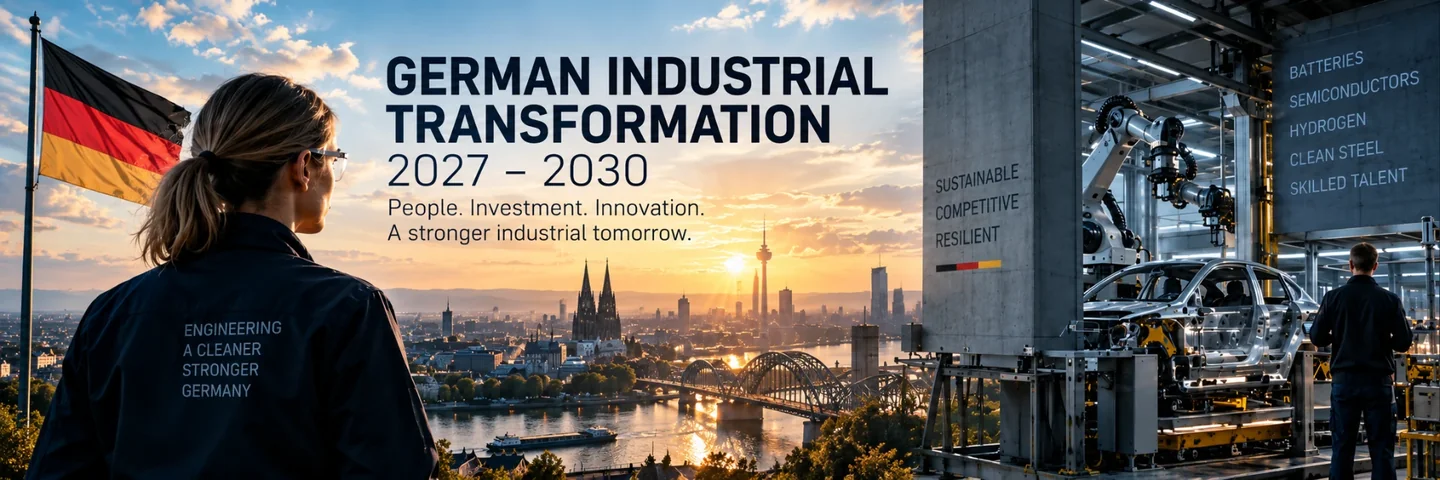
German Industrial Transformation & STEM Labor Outlook (2027–2030)
A Macro-Fiscal Analysis of Public Capital Allocation, Foreign Inward Investment, Industrial Realignment, and Strategic Upskilling Pathways for Mid-Career STEM Professionals.
By Dai Jones, Founder & Lead Consultant, Eich Dyn Career Services Ltd ·
German industrial transformation outlook
Germany is entering a four-year industrial reallocation cycle where public capital, foreign investment, technical labour and industrial policy are all moving at the same time. The opportunity is real, but so is the fiscal and skills pressure.
The underlying signals are unusually concentrated. Germany plans €124.0 billion of consolidated public investment in 2027, or €117.7 billion net. Inward foreign direct investment recovered to €9.6 billion in 2025 from €4.3 billion in 2024, across 1,564 greenfield and expansion projects. At the same time, the Federal Employment Agency’s upskilling budget reaches €4.12 billion, an increase of 20%, or €690 million.
Those figures do not guarantee employment growth, nor do they remove the risk from industrial restructuring. They show capital being redirected while the capabilities needed to absorb it are changing. The centre of demand is moving away from routine-heavy legacy work and towards high-complexity, cross-disciplinary domains where physical engineering meets software, data, controls and regulation.
Why I wrote this
I have friends in Munich from years spent working alongside BMW teams. I also have former colleagues and contacts from AMG and Mercedes programmes. Earlier in my career, I supplied and supported high-end carbon-fibre-reinforced polymer component work associated with the AMG GT Black Series programme.
The point is not nostalgia. These are engineering communities and people I know, and I can see how quickly the technical landscape around them is changing. German industrial change is no longer an abstract policy story. It affects engineers, programme leaders, technical specialists, suppliers and researchers I know personally. That is why I wrote this report: to turn a large macro-fiscal shift into something a technically experienced person can examine and act upon.
The 2027–2030 inflection point
Four forces are arriving together. Decarbonisation is changing products, processes and energy inputs. Digital sovereignty is increasing the strategic value of semiconductors, software, industrial data and control systems. Demographic contraction is tightening parts of the technical labour market. Public and private capital are being deployed to reshape infrastructure and industrial capacity.
The investment signal is substantial. The 2027 consolidated public-investment figure is €124.0 billion gross and €117.7 billion net. Inward FDI more than doubled from €4.3 billion in 2024 to €9.6 billion in 2025, with 1,564 greenfield and expansion projects. China accounted for 228 investment projects in 2025, ahead of the United States on 206. Germany remains investable, but the composition and strategic dependencies of that investment matter as much as the total.
The fiscal counterweight is debt servicing. Federal interest costs are projected at €20.95 billion in 2026, €41.90 billion in 2027, €55.20 billion in 2028, €68.10 billion in 2029 and €80.70 billion in 2030. Public capital can accelerate change, but a rising interest bill progressively narrows the room for delay, duplication and poor execution.
€124 billion in 2027 — building the next industrial era
Federal debt servicing / interest, 2026–2030 (€bn)
- 2027 investment
- €124.0bn
- gross · €117.7bn net
- Interest-cost change
- Nearly 4×
- 2026 to 2030
- 2030 debt servicing
- €80.7bn
- projected annual cost
This is the central macro-fiscal tension. Germany is attempting to sustain a high investment baseline while the cost of financing the state rises rapidly. Industrial policy therefore has to do more than announce programmes. It has to create productive capability, crowd in private investment and help people move into work that the future industrial system can use.
Five industrial growth vectors
The whitepaper identifies five practical domains where investment, industrial policy and technical labour are likely to converge. They are not isolated sectors. Each is a system of hardware, software, energy, supply chains, standards and delivery capability.
Where investment, innovation and STEM talent will drive growth (2027–2030)
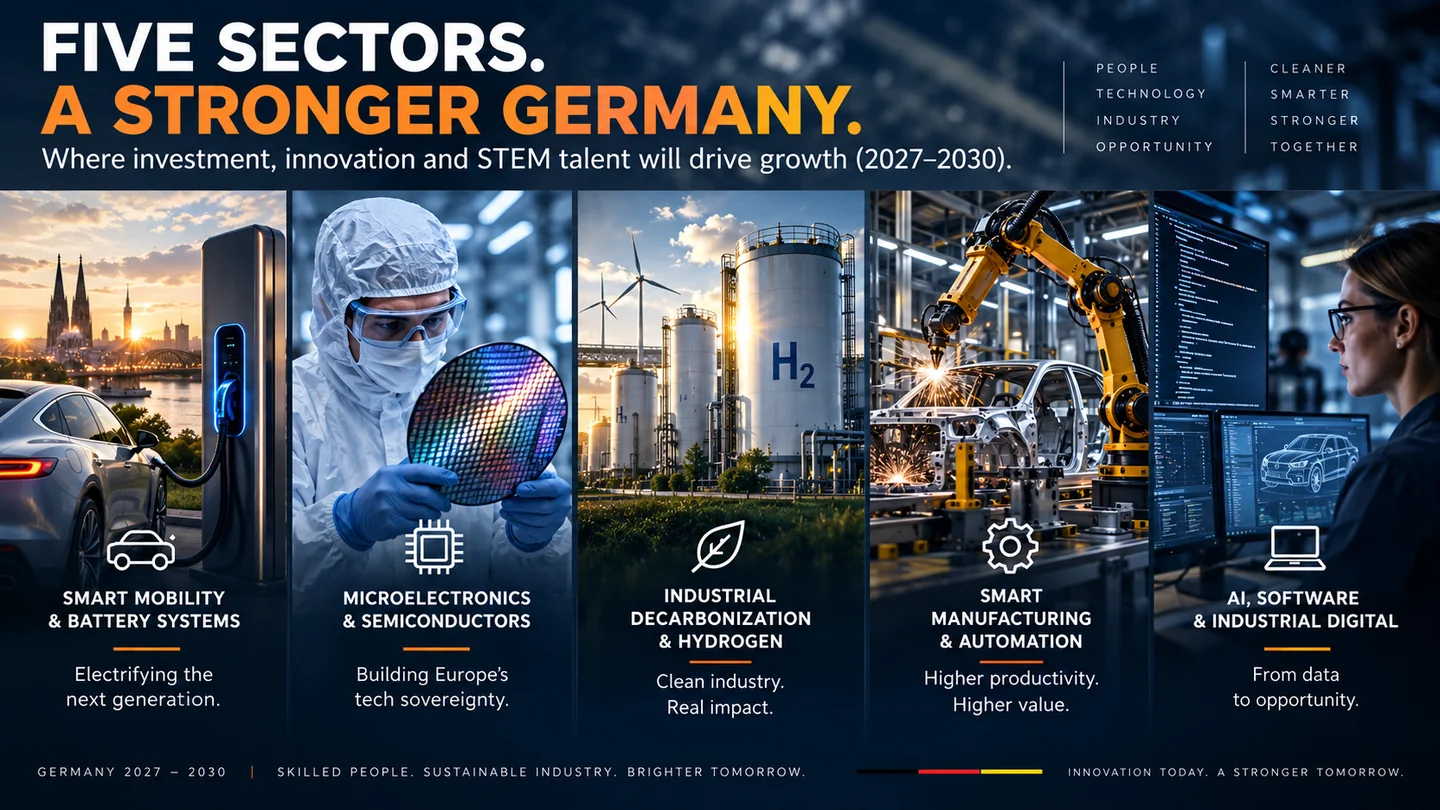
- 01Smart Mobility & Battery Systems
- 02Microelectronics & Semiconductors
- 03Industrial Decarbonisation & Hydrogen
- 04Smart Manufacturing & Automation
- 05Energy Systems, Smart Grid & Industrial AI
Smart Mobility & Battery Systems
Battery integration, power electronics, e-drive systems, thermal management, validation and industrialisation.
Microelectronics & Semiconductors
Process engineering, equipment, yield, quality, cleanroom operations, supply-chain resilience and industrial microelectronics.
Industrial Decarbonisation & Hydrogen
Electrolysers, hydrogen systems, process integration, clean steel, safety, controls and regulated plant delivery.
Smart Manufacturing & Automation
Robotics, machine vision, controls, digital twins, predictive maintenance and connected production systems.
Energy Systems, Smart Grid & Industrial AI
Grid control, HVDC, redispatch, industrial software, operational data and AI deployed inside physical systems.
The strongest career opportunity may sit at the interfaces: the battery engineer who understands industrialisation; the semiconductor specialist who can lead quality and supply risk; the mechanical engineer who can integrate controls and data; the grid professional who can navigate regulation as well as system design. Cross-disciplinary capability is difficult to recruit because it combines depth with translation.
The paradox: job loss and skills shortages at the same time
Industrial transformation can remove jobs while creating shortages. There is no contradiction. Routine-heavy legacy roles can contract as investment moves towards system-level engineering, software-rich products, industrial data, regulatory assurance and complex programme integration.
A role may disappear because its product architecture, process or cost base is being retired. At the same time, employers can struggle to find people capable of integrating a new architecture safely and at scale. The labour market does not convert one group into the other automatically. Job titles, technical language, evidence and confidence often lag behind the underlying transfer potential.
This is why a headline about skills shortages should never be read as a promise of easy employment. Demand can be real and access still difficult. Employers buy evidence against a specific problem. Mid-career professionals need to show not only what they have done, but why their judgement remains valuable inside the next industrial system.
Mid-career STEM: what actually transfers
Experienced people do not start from zero. They reposition engineering judgement. The useful question is not, “Which entirely new profession should I become?” It is, “Which adjacent system values the decisions I already know how to make, and what specific gap prevents immediate credibility?”
| Legacy base | Adjacent transformation vector | Transfer bridge |
|---|---|---|
| ICE powertrain | E-drive / traction motor | Thermal, validation, systems and production judgement |
| Fossil plant | Hydrogen / electrolyser | Process safety, controls, rotating equipment and plant delivery |
| Traditional quality | Industrial AI / computer vision | Defect logic, metrology, root cause and process capability |
| Grid planner | Smart grid / HVDC | Network studies, protection, system control and regulation |
| Chemical batch engineering | Circular polymer / bio-process | Scale-up, process control, quality and safety |
The transfer bridge is where the career work sits. It requires a credible account of scope, decisions, risk and results, expressed in the language of the destination. The Career OS™ methodology treats this as diagnosis, positioning and evidence before search activity begins.
Public upskilling: the practical lever
The Federal Employment Agency’s €4.12 billion upskilling budget — 20% higher, an increase of €690 million — is important because transition needs time and employers often hesitate to carry the full cost. The Qualification Opportunities Act framework, commonly discussed through QCG support, and Qualifizierungsgeld, or QualiG, can under some circumstances contribute towards course fees or wages during qualifying training.
The detail matters. Support depends on the employer, employee, programme, provider and current rules. It should not be treated as a universal entitlement or as a guarantee that a course will lead to a role. Readers and employers should check current eligibility, approved-provider requirements and the exact funding conditions before making a commitment.
Upskilling works best when it closes a named market gap. A broad course selected because a sector sounds attractive is weaker than targeted learning validated through job specifications, employer conversations and real technical requirements. Public funding can reduce the cost of the bridge; it cannot choose the right bridge for you.
Where opportunity is clustering
Industrial opportunity is geographic because capability clusters. Suppliers, universities, research institutes, infrastructure and specialist labour reinforce one another. The report highlights five corridors where the signals are especially relevant.
Stuttgart / Southern Baden-Württemberg
Mobility, automotive engineering, advanced manufacturing, suppliers and the transition from legacy vehicle systems.
Munich / Upper Bavaria
Mobility, electronics, software, aerospace, R&D leadership and high-value technical programmes.
Silicon Saxony
Dresden, Freiberg and Chemnitz, with Magdeburg adjacency: semiconductors, microelectronics, equipment and advanced manufacturing.
Rhine-Neckar / Palatinate
Chemicals, process industries, industrial decarbonisation, circular materials and applied research.
Northern Coastal Green Energy Corridor
Wind, hydrogen, grid infrastructure, ports, energy systems and industrial-scale decarbonisation.
A corridor is not a guarantee of a vacancy. It is a better place to investigate ecosystems: which organisations are investing, which technical problems recur, which suppliers sit behind the visible names, and where your evidence already overlaps with demand.
What this means for Career OS™ and the reader
The practical sequence is straightforward. First, identify which part of your present capability remains valuable when the sector label is removed. Second, choose the transformation vector where that capability solves a real problem. Third, name the smallest specific gap between your evidence and the target. Fourth, find employer evidence that confirms or rejects the hypothesis.
For somebody planning an external move, the Career OS™ MOVE pathway helps sequence direction, positioning, evidence, search, interviews and offer decisions. For somebody staying inside an organisation while its priorities change, Career OS™ PROPEL focuses on role positioning, visible outcomes, influence and progression. The distinction matters: one pathway creates external access; the other builds leverage where you are.
Engineers who need to translate deep technical experience into market language can also use the practical guidance on career positioning for experienced engineers. None of this requires a hard sell or a premature career decision. It requires a testable transfer hypothesis and enough evidence to learn whether the market agrees.
One action to do today
Write your first transfer hypothesis.
Take your current role and write down the three technical capabilities that would still matter if your sector changed around you tomorrow. Then identify one adjacent growth domain in Germany where those capabilities already have value. That is your first transfer hypothesis.
Source note
This abridged article is derived from the September 2026 Eich Dyn Career OS Whitepaper, German Industrial Transformation & STEM Labor Outlook (2027–2030). Quantitative claims on public investment, debt servicing, inward investment, projects and upskilling reflect the supplied source material. The interpretation of what those signals mean for careers is Eich Dyn commentary.
Before external publication, the full whitepaper and this derivative article should link the underlying statistics to their original external sources. No figure in this article should be read as a guarantee of funding, eligibility, hiring or an individual career outcome.
Download the full 21-page whitepaper
German Industrial Transformation & STEM Labor Outlook (2027–2030)
Full macro-fiscal analysis, sector detail, funding mechanisms, STEM growth vectors, conversion matrices and references.
21-page whitepaper
Request the white paper
Enter your details to read the white paper in your browser or download the PDF. The article itself stays free to read — no card, no booking, no spam.
Related Germany research
Germany’s Automotive Reset
EV transition, China exposure, workforce restructuring and government intervention in German automotive.
Read →UK, Germany and US Job Market 2026
Skills demand and candidate competition across three important markets for experienced STEM professionals.
Read →Career Change After Automotive Redundancy
A practical method for translating engineering career capital into an adjacent sector.
Read →