
Staff Engineer vs Engineering Manager: Which Career Path Is Right for You?
Staff Engineers and Engineering Managers reach comparable levels of organisational influence, but they create leverage differently — one scales technical judgement, the other scales people, capability and delivery. This guide sets out the trade-offs, the readiness signals for each track and a framework for making the decision deliberately.
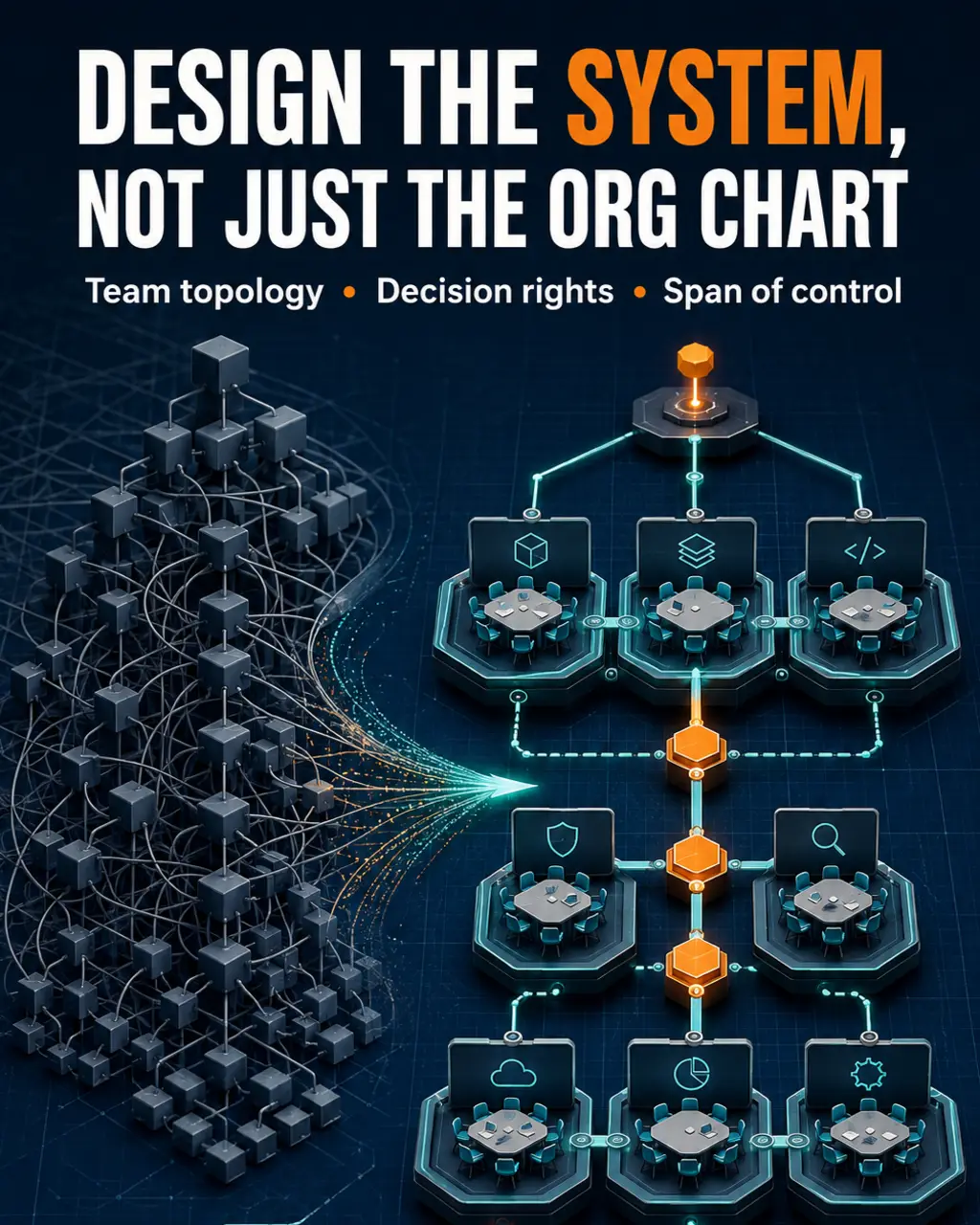
Staff Engineer vs Engineering Manager: the direct answer
Staff Engineers and Engineering Managers operate at comparable levels of organisational influence, but they create leverage in different ways. A Staff Engineer scales technical judgement — architecture, standards, technical direction and decision quality across teams. An Engineering Manager scales people and systems — team capability, delivery predictability, prioritisation, performance and organisational alignment. Neither route is inherently more senior, more prestigious or more valuable; they are two ways of increasing your impact beyond what you can personally build.
The decision is therefore not "am I good enough to manage?" but "which kind of leverage do I want to be accountable for, and which kind of work will still hold my attention in five years?"
Everything below is written to help experienced engineers answer that question honestly, with the trade-offs stated plainly rather than softened.
What does "Staff Engineer" mean in the UK and Germany?
In software and technology organisations, a Staff Engineer is normally a senior individual contributor one level above Senior Engineer who creates organisational leverage through technical leadership rather than formal people-management authority. They shape architecture, technical strategy and engineering standards, lead complex or ambiguous cross-team work, mentor other engineers, and influence decisions well beyond their immediate team. UK technology employers such as Monzo define the level in exactly these terms — an experienced individual contributor acting as a multiplier with broad technical and stakeholder impact — and operate it on a parallel ladder alongside management.
The title itself is not universal. Across traditional UK engineering sectors, and in many German and wider European organisations, comparable technical-career scope often appears under different names, and German employers frequently structure it as a Fachlaufbahn or Expertenlaufbahn rather than as a "Staff" level. In Germany the term Staff Engineer is increasingly used in software and international companies, but it sits alongside established titles rather than replacing them.
The mapping below is illustrative context only. These titles are not equivalent job levels: responsibilities, seniority and authority vary significantly by employer and sector.
| Context | Titles that may carry comparable senior-IC technical scope |
|---|---|
| Software and technology | Staff Engineer, Senior Staff Engineer, Principal Engineer, Architect, Distinguished Engineer, Fellow |
| UK traditional engineering (manufacturing, energy, rail, defence, aerospace) | Principal Engineer, Lead Engineer, Technical Specialist, Technical Authority, Technical Lead, Engineering Fellow |
| German and international engineering | Principal Engineer, Lead Engineer, Technical Lead, Architect, technical expert (Fachexperte / Fachspezialist), Expertenlaufbahn or Fachlaufbahn grades |
Two cautions matter when reading any of these titles. Chief Engineer is a particular trap: in automotive, aerospace and defence it frequently carries far broader product, programme or safety authority than a Staff Engineer, so it should not be treated as an equivalent. And in less mature ladders, "Lead" or "Specialist" titles sometimes describe a single-team senior engineer rather than genuine cross-organisational scope.
The practical rule for both markets is the same: when comparing a Staff Engineer with an Engineering Manager, compare scope, accountability and the source of organisational leverage rather than the job title alone. The comparison in this guide holds wherever those things hold, whatever the level is called in your organisation.
Why this decision becomes difficult at Senior and Lead level
Up to senior engineer, progression is largely legible. You take on harder problems, own more of the system, and become the person others consult. The work compounds in a direction you can see.
At the point where the next step is Staff or Engineering Manager, the ladder forks and the signals become ambiguous for three reasons.
The first is that both paths look similar from the outside. A senior engineer leading a significant piece of work already writes design documents, mentors colleagues, negotiates scope with product, unblocks other teams and represents the work to stakeholders. That behaviour is evidence for both routes, so it does not disambiguate anything.
The second is that most organisations promote by opportunity, not by preference. A team loses its manager, a delivery problem needs an owner, and the strongest senior engineer is asked to step in. Many careers change track through a vacancy rather than a decision, and the engineer discovers a year later that they have accidentally chosen.
The third is that the two roles feel the same in the first ninety days and diverge sharply afterwards. Early management is mostly coordination, which resembles technical leadership. The genuine divergence — performance conversations, hiring, capacity trade-offs, protecting a team from organisational noise, and rebuilding a delivery system that is not working — arrives later, once the initial goodwill has worn off.
Making this a deliberate choice rather than a reaction to circumstance is the single most valuable thing an engineer can do at this stage.
Staff Engineer vs Engineering Manager: comparison table
| Dimension | Staff Engineer | Engineering Manager |
|---|---|---|
| Primary leverage | Technical judgement, architecture and standards applied across teams | People, capability, delivery systems and organisational alignment |
| Technical depth | Deepens; expected to hold the hardest technical context in the domain | Broadens but flattens; sufficient depth to judge, question and sponsor decisions |
| People accountability | Influence and mentoring without formal authority | Formal accountability for performance, development, retention and hiring |
| Delivery accountability | Accountable for technical viability and design integrity | Accountable for commitments, predictability and throughput of the team |
| Decision horizon | Eighteen months to several years on architecture and platform direction | One quarter to eighteen months on capacity, roadmap and team shape |
| Stakeholder exposure | Engineering leadership, architects, security, other Staff engineers, occasionally customers | Product, programme, finance, HR, senior leadership, peer managers |
| Coding expectations | Substantial, though increasingly selective, high-leverage and prototype-oriented | Minimal on the critical path; tooling, spikes and non-urgent work at most |
| Mentoring and coaching | Technical mentoring, design review, raising the standard of engineering practice | Career coaching, feedback, development plans, difficult conversations |
| Performance management | Provides input; does not own the outcome | Owns it, including underperformance, promotion cases and calibration |
| Hiring | Technical assessment, bar-raising, panel design | Owns the loop, headcount, offers, onboarding and team composition |
| Architecture | Sets direction, resolves cross-team technical disputes, owns technical strategy | Sponsors, funds and protects it; ensures it is decided, not necessarily by whom |
| Organisational influence | Through technical credibility and written argument | Through relationships, sponsorship, resourcing and forums |
| Typical success measures | Systems that scale, decisions that hold, standards adopted, technical risk reduced | Team outcomes, predictability, capability growth, retention, stakeholder trust |
The table's most useful line is the last one. Staff Engineers are judged on whether their decisions survived contact with reality. Engineering Managers are judged on whether their team produced outcomes without burning out. If one of those sentences describes the scoreboard you would want to be measured against, you have most of your answer already.
What Staff Engineers actually do
The most common misconception about the Staff Engineer role is that it is awarded to the strongest coder. It is not. Staff-level scope is defined by the breadth of the problem you can be trusted with, not the speed at which you can produce code.
Genuine Staff-level work usually looks like this.
Owning technical direction across team boundaries. A Staff Engineer is typically responsible for a domain, platform or technical theme that no single team owns — data architecture, service decomposition, reliability, developer productivity, security posture. The defining feature is that success requires several teams to change what they do.
Turning ambiguity into a decision. Much Staff work begins as an unstructured problem: performance is degrading, the release process is failing, two teams disagree on an interface, or a proposed product direction is not technically viable. The output is often a written document that ends an argument, not a pull request.
Raising the standard of engineering practice. Design review, testing strategy, incident quality, architectural guardrails and the enforcement — usually through persuasion — of standards that outlive the person who wrote them.
Reducing technical risk before it becomes a delivery crisis. The most valuable Staff Engineers are noticeable mainly for the failures that did not happen, which makes the role harder to evidence and easier to under-recognise.
Selective, high-leverage engineering. Staff Engineers still build, but they choose where. The prototype that proves a migration is feasible, the framework that ten teams will use, the tricky core of a system with no second owner.
What Staff Engineers generally do not do is take formal accountability for people. They may influence promotion cases, mentor extensively and shape hiring bars, but they do not own performance outcomes, and they cannot resolve a problem by reallocating a person.
What Engineering Managers actually do
The equivalent misconception about engineering management is that it is either technical heroics with extra meetings, or administration. Both are failure modes rather than descriptions.
Building the team's capability. The core management asset is a team that is more capable in twelve months than it is today. That means development plans that are actually pursued, deliberate stretch assignments, feedback given early enough to be useful, and coaching that does not collapse into doing the work yourself.
Owning the delivery system. Not the individual project — the system that produces projects. Planning, capacity, dependency management, work in progress, the quality of estimates, and the ability to say what will and will not be delivered with enough confidence for the business to plan around it.
Prioritisation and organisational alignment. Managers spend a considerable proportion of their time ensuring the team is working on what matters, and that other parts of the organisation understand and accept the trade-offs. This is negotiation work, and it is largely invisible to the team when done well.
Performance and difficult conversations. Underperformance, interpersonal conflict, misaligned expectations, disengagement and, occasionally, exits. This is the part of management that cannot be delegated, cannot be automated and does not become comfortable — only more skilled.
Hiring and team composition. Defining the roles the team needs, running the loop, making offers, onboarding well and shaping the balance of seniority, specialism and temperament.
Technical judgement exercised at a distance. Good Engineering Managers remain technically credible. They ask the question that exposes a weak assumption, recognise when an estimate is optimistic, and know which decisions need a Staff Engineer's attention. What they stop doing is authoring the answer.
The most reliable indicator of whether someone is managing rather than merely supervising is what happens when they are on leave. A well-managed team continues to function; a heroically supervised one stalls.
What both paths have in common
The two routes are less different than the ladder implies, and the shared ground is where most senior engineers already operate.
Both require comfort with ambiguity and the willingness to act before certainty. Both require influence without authority: Staff Engineers cannot mandate, and Engineering Managers quickly discover that authority is a blunt instrument that erodes when used. Both demand cross-team leadership, because significant problems at this level rarely fit inside one team's boundary.
Both need strategic judgement — the ability to distinguish work that matters from work that is merely urgent — and both depend on written and verbal communication of a standard well above what senior engineering requires. Both reward organisational context: knowing how decisions are actually made, where budget sits, and which forums matter.
Above all, both are multiplier roles. In each case, your value stops being what you produce and becomes what you enable others to produce. Engineers who dislike that shift are usually happier remaining at senior level in a strong team than pursuing either path.
Readiness signals for the Staff or Principal route
You are likely ready for the senior individual-contributor track if several of the following are already true.
You are consulted on technical decisions beyond your own team, and your input changes the outcome. You write documents that other people cite. You have a track record of technical judgement that held up over time — decisions that looked cautious and turned out correct, or migrations that landed without drama.
You can hold a large system in your head and explain it to a non-specialist without either patronising them or losing accuracy. You are comfortable disagreeing with senior stakeholders on technical grounds and doing it in a way that keeps the relationship intact.
You have mentored engineers to a visibly higher standard without needing formal authority to do it. You notice technical risk before it materialises and you are willing to be unpopular about it.
Crucially, you find depth energising. Given a free week, you would investigate the architecture problem rather than restructure the team.
Readiness signals for the Engineering Manager route
You are likely ready for the management track if the following pattern is recognisable.
You already spend more time on coordination, unblocking and communication than you do on your own tickets — and you have stopped resenting it. You gain real satisfaction from an engineer improving, more than from shipping the feature yourself.
You have handled at least one uncomfortable conversation well: a colleague whose work was not good enough, a disagreement that had become personal, or a stakeholder expectation that had to be corrected. You have delegated something you cared about, and let the other person do it their own way.
You are interested in why the organisation makes the decisions it does, not just frustrated by them. You can plan work realistically and are willing to be held to what you said. You have been involved in hiring and have opinions about what the team is missing.
And, decisively, you would rather be measured by the team's outcomes than by your own output.
Warning signs that management may be the wrong move
Several motivations reliably predict an unhappy first year as a manager.
Wanting the title or the perceived status is the most common. Management is not a promotion in a mature engineering organisation; it is a different job with a comparable level.
Disliking feedback conversations is the second. If the prospect of telling a capable, likeable colleague that their work is not meeting the bar fills you with dread, that dread will not disappear — and avoiding those conversations is the single most damaging thing a manager can do to a team.
Reluctance to delegate is the third. Managers who cannot let work be done imperfectly by someone else become the bottleneck in their own team.
Needing to own the technical solution personally is the fourth. If your professional identity is bound to being the person who solved it, management will feel like a continuous loss.
Low interest in developing others, impatience with organisational process, and a belief that you would be managing "so that a bad manager doesn't get the job" complete the list. The last is well-intentioned and still a poor foundation.
Warning signs that Staff may be the wrong route
The senior individual-contributor track has an equivalent set of counter-indicators, discussed far less often.
Narrow technical ownership is the clearest. If your expertise is deep but confined to one service, one team or one legacy system, that is senior-engineer scope rather than Staff scope, and the gap is organisational rather than technical.
Reluctance to influence beyond your own team is the second. Staff Engineers spend much of their time persuading people who do not report to them and are not obliged to agree. Engineers who find that exhausting rather than interesting tend to stall at the boundary.
An inability to explain architecture and trade-offs to non-specialists is the third. Staff-level influence is largely exercised in writing and in rooms containing product, finance and executive stakeholders.
Insufficient organisational scope is the fourth, and the most frustrating. Some organisations have no genuine Staff-plus ladder — the top rung is senior engineer, and everything above it is management. Where that is true, the technical route requires a move rather than a promotion.
Finally, a preference for being given well-defined problems is a strong counter-indicator. Staff work usually arrives as a symptom, not a specification.
Not sure whether the technical or management track is right for you?
A Career Diagnosis tests your evidence against the standards used for Staff-plus appointments and first-time Engineering Manager roles, clarifies which route your experience genuinely supports, and establishes whether an internal promotion or an external move is the stronger next step.

A decision framework: where does your leverage come from?
This is reflective guidance, not a psychometric assessment. Its purpose is to make an implicit preference explicit, and the value lies in the sentences you write next to each score rather than the total.
Score each dimension from 1 to 5, where 1 is strongly the Staff pattern and 5 is strongly the management pattern.
| Dimension | 1 — Staff pattern | 5 — Management pattern | Score |
|---|---|---|---|
| Preferred source of leverage | A decision or design that many teams rely on | A team that performs beyond the sum of its members | |
| Energy | Ends the day energised by solving a hard technical problem | Ends the day energised by a good conversation with an engineer | |
| Accountability appetite | Comfortable owning technical correctness | Comfortable owning other people's outcomes and commitments | |
| Time horizon | Multi-year architectural direction | Quarterly capacity, delivery and capability building | |
| Response to ambiguity | Investigates until the problem is understood | Structures the situation so others can move | |
| People issues | Would prefer a colleague's manager handled it | Would rather handle it personally and early | |
| Technical depth | Losing depth would feel like losing yourself | Losing depth is an acceptable trade for wider impact | |
| Organisational influence | Prefers influence earned through technical credibility | Prefers influence earned through relationships and sponsorship | |
| Desired working week | Long blocks of focused work, some meetings | Many short interactions, little uninterrupted focus |
A total below 20 points clearly towards the Staff or Principal track. Above 34 points clearly towards management. Between the two, the score is not the answer — the dimensions where you scored at the extremes are. A candidate who scores 3 across the board is usually describing a strong senior engineer or tech lead who does not yet have enough exposure to either role to choose, and whose next step is experimentation rather than commitment.
The "desired working week" line deserves particular weight. It is the dimension people underestimate most and regret most, because it describes the texture of every day rather than the shape of a career.
Can you switch between Staff Engineer and Engineering Manager?
Yes, and more easily than the folklore suggests — but reversibility has a shelf life.
Returning to senior individual contribution after one to three years of management is common and is generally treated as a considered decision rather than a failure, particularly where you leave a functioning team and a successor behind. Your technical judgement will have broadened even as your hands-on currency has faded, and most of what has decayed is tooling familiarity rather than engineering ability.
After roughly five years in management, the return becomes materially harder. Not impossible, but you will be competing against engineers whose depth has compounded throughout that period, and you will usually need to re-establish credibility through demonstrable recent technical work.
The reverse move — Staff Engineer to Engineering Manager — remains available almost indefinitely, and Staff Engineers who move into management often make unusually effective managers because they already understand leverage, ambiguity and cross-team influence.
Two practical points protect optionality. First, preserve evidence on both sides: managers should retain visible architectural involvement, design review participation and technical decision authorship; Staff Engineers should retain mentoring, hiring and initiative-leadership evidence. Second, keep the record specific. Evidence of technical or leadership impact written down at the time is worth considerably more than a recollection reconstructed three years later, and it is the single asset that makes a track change credible to a hiring panel.
Compensation and seniority: what actually varies
Two things are worth stating plainly, without numbers, because published salary data at this level is unreliable and varies enormously by company, sector and location.
First, in organisations with a mature engineering ladder, Staff Engineer and Engineering Manager are usually mapped to the same level, with equivalent base and equity bands. Principal Engineer typically maps to Senior Engineering Manager or Director. Where the ladder is immature, the technical track often stops early, and management becomes the only route to higher bands — which is an organisational limitation rather than a truth about the professions.
Second, management is not automatically the higher-paid or more senior path. In many product and infrastructure companies, senior technical specialists in scarce domains are compensated at or above their management peers. Conversely, in organisations where engineering is a cost centre rather than the product, the technical ceiling is frequently lower.
The practical implication is that compensation is a question about a specific employer, not about the choice itself. If money is a significant factor in your decision, investigate the ladder, the published levels and the actual population of people above Staff in that organisation — not the industry in general.
How to test the choice before committing
The most reliable way to decide is to sample the work. Most of the following can be arranged without changing roles.
To test management: cover for your manager during leave, with genuine handover rather than a token arrangement. Take formal responsibility for onboarding a new joiner. Run planning and retrospectives for a quarter and own the resulting commitments. Join the hiring loop, run debriefs and write the summaries. Support a struggling colleague through a defined improvement period alongside their manager. Deliberately delegate a piece of work you would rather do yourself, and coach rather than intervene. Pay attention to how you feel at the end of those weeks, not to whether you performed well — most senior engineers perform well at these tasks and still dislike them.
To test the Staff route: take ownership of a technical problem that crosses at least two teams. Write the design document that resolves an unsettled architectural argument, and shepherd it to a decision. Volunteer for the reliability, security or developer-productivity theme nobody owns. Present a technical trade-off to a non-technical audience and see whether it changes their decision. Mentor two engineers formally over a quarter.
Six months of deliberate sampling produces a far better decision than a year of speculation, and both sets of experiments strengthen your evidence base regardless of which route you eventually choose.
Positioning yourself for Staff Engineer
If the evidence points towards the technical track, position around scope and judgement rather than skills and technologies.
Demonstrate breadth of problem, not breadth of stack. Show decisions that crossed team boundaries and held up over time. Make written artefacts visible: design documents, technical strategies, post-incident analyses that changed practice. Evidence adoption — a standard or platform that other teams chose to use is worth more than one they were instructed to use.
Where your organisation has no Staff-plus ladder, treat that as the constraint it is. The route to a Staff title in that case is usually an external move to an organisation that has the level, which is a repositioning exercise rather than a promotion campaign.
Positioning yourself for Engineering Manager
If the evidence points towards management, the work is to build and then evidence management behaviour before you hold the title. The software engineer to engineering manager guide covers the individual-contributor route in depth, and the tech lead to engineering manager guide covers the transition from recognised technical leadership into formal accountability.
When you are ready to apply or make a promotion case, the engineering manager CV and resume guide explains how to reposition a technical CV around leadership evidence rather than delivery history, and the engineering manager interview questions guide covers the behavioural, delivery and people scenarios that first-time panels use. For the wider ladder — from first-line management through to director and VP — see the engineering manager career path guide and the broader engineering management overview. If you have not yet decided how to structure the move at all, how to become an engineering manager sets out the standard route.
Internal promotion or external move: PROPEL and MOVE
Career OS™ separates these two situations because they require different work.
Use PROPEL when the decision resolves towards progression inside your current organisation. The task is to build visible evidence against your employer's actual promotion criteria, secure a sponsor with influence in the calibration process, and create the internal narrative that makes your appointment the obvious answer when a role opens. This applies equally to a Staff promotion and a first management appointment.
Use MOVE when the ceiling is structural — no Staff-plus ladder, no management vacancy, or a manager who needs you to remain exactly where you are. The task then becomes external repositioning: reframing your history around the level you are targeting, building a CV and LinkedIn profile that read at that level, and preparing for panels who have no institutional knowledge of your contribution.
The most common error is applying MOVE tactics to a PROPEL situation — job hunting out of frustration when the internal route was viable but unmanaged.
Your decision plan: 30 days, 90 days, 6 to 12 months
This is a plan for making the decision, not a plan for a first ninety days in a new role.
Next 30 days. Complete the decision framework above and write a paragraph beside each extreme score. Have honest conversations with one Staff Engineer and one Engineering Manager about what they actually did last week, including the parts they disliked. Ask your own manager which ladder your organisation genuinely supports and what the criteria are in writing. Audit your evidence on both sides and note where it is thin.
Next 90 days. Run one experiment from each track — one management experiment and one Staff-scope experiment — with defined start and end points. Record what energised you and what drained you, weekly and briefly. Identify the two largest gaps in your evidence for your leading option and start closing them. Keep a written record of impact as it happens.
Next 6 to 12 months. Commit to a direction and make it visible. Tell your manager and your sponsor which track you are pursuing and ask explicitly what would need to be true for the appointment to happen. Take on a piece of work that is unambiguously at the target level and see it through to a measurable outcome. Reposition your CV and LinkedIn profile around that level rather than your current one. Reassess at the six-month point: if the internal route has produced no movement and no credible timeline, the question becomes MOVE rather than PROPEL.
Common mistakes
Treating management as the default next step. In organisations with a real technical ladder it is a sideways change of discipline, and choosing it by default produces reluctant managers and diminished engineers.
Deciding on compensation folklore rather than the actual ladder. Investigate the specific employer's levels; the industry generalisation is almost always wrong for your case.
Waiting to be offered. Both tracks reward engineers who state their direction clearly. Ambiguity about your intent is usually read as a lack of ambition.
Sampling only one side. Engineers who test management without testing Staff scope frequently conclude that management is the only way to increase impact.
Confusing being consulted with having scope. Being the person everyone asks is senior-engineer behaviour; owning a cross-team problem to a decision is Staff behaviour.
Abandoning technical credibility on day one of management. The managers who struggle most are those who disengage from technical judgement entirely and lose the ability to challenge their own team.
Not recording evidence. Both tracks are evidenced through specific, dated, attributable impact. Reconstructing it years later is the most avoidable difficulty in this entire decision.
Eich Dyn supports this decision as a career consultant for engineers and through technical leadership career consulting. Where the next step is a management panel, interview consultation for engineering managers prepares you for the people, delivery and stakeholder scenarios those panels test. Senior engineers often search for engineering leadership coaching at this point; what usually produces a decision — and then an appointment — is structured consultancy: diagnosis, evidence, positioning and a plan.
FAQ
Is a Staff Engineer higher than an Engineering Manager?
Usually neither. In organisations with a mature engineering ladder, Staff Engineer and first-line Engineering Manager are mapped to the same level with comparable compensation bands. They differ in the type of leverage they create — technical judgement across teams versus people, capability and delivery systems — not in seniority.
Should I become a Staff Engineer or an Engineering Manager?
Choose by the work rather than the ladder. If you gain energy from depth, architecture and technical judgement that outlives you, the Staff route fits. If you gain energy from developing people, resolving ambiguity through others and owning team outcomes, management fits. If the answer is unclear, sample both for a quarter before committing.
Do Engineering Managers still write code?
Rarely on the critical path. Some coding continues in small teams and early-stage companies — prototypes, tooling and non-urgent work — but managers who retain critical-path code usually become the constraint on their own team's throughput and neglect the parts of the job only they can do.
Can I move from Engineering Manager back to Staff Engineer?
Yes. Returning to senior individual contribution within one to three years is common and generally treated as a considered decision rather than a failure. After around five years the return is harder, because you will be competing with engineers whose technical depth compounded throughout that period.
What is the difference between a Staff Engineer and a Principal Engineer?
Scope and time horizon. Staff Engineers typically own a domain or technical theme spanning several teams; Principal Engineers usually operate across a business unit or the whole engineering organisation, with a multi-year horizon and greater involvement in technical strategy and executive-level trade-offs.
Is Staff Engineer or Engineering Manager better paid?
It depends entirely on the employer. Where the technical ladder is mature, the bands are usually equivalent, and scarce technical specialists are sometimes paid above their management peers. Where the ladder stops at senior engineer, management becomes the only route to higher bands. Investigate the specific organisation rather than industry averages.
What is the difference between a Tech Lead and a Staff Engineer?
A Tech Lead is accountable for the technical success of a specific team's work and usually leads within one team boundary. A Staff Engineer owns technical direction across team boundaries, typically for a domain or platform, and is judged on decisions that several teams depend on. See the tech lead to engineering manager guide for how that role relates to formal management.
How do I know if I would enjoy engineering management before I try it?
Sample the work rather than imagining it. Cover for your manager during leave, own onboarding for a new joiner, run planning and retrospectives for a quarter, and join the hiring loop. Pay attention to how those weeks felt rather than to whether you performed well — most senior engineers perform well and still discover they dislike the work.
Can you go from Staff Engineer to Engineering Manager later?
Yes, and it is a common and often successful move. Staff Engineers already understand leverage, ambiguity and cross-team influence, so the transition is usually about adding people accountability — feedback, performance, hiring and capacity — rather than learning leadership from the beginning.
Make the decision deliberately, then build the evidence for it.
Eich Dyn works with senior engineers and technical leaders on readiness assessment, leadership positioning, CV and LinkedIn repositioning and interview preparation — supported by 300+ stage-by-stage resources and 49 AI tools built for senior technical careers.
Go deeper on the next decision.
Supporting Career OS™ guides for engineers and technical leaders moving into management.

Engineering Management — full guide
Roles, skills and career options at a glance

Engineering Manager Career Path
Progression from engineer to director and VP
Software Engineer to Engineering Manager
Making the IC-to-leadership transition into a first EM role

How to Become an Engineering Manager
Preparing for your first EM role

Tech Lead to Engineering Manager
Moving from technical leadership into formal people management
First-Time Engineering Manager Guide
Leading your first engineering team with confidence

Engineering Manager 30-60-90 Day Plan
Executing a credible first ninety days in a new EM role

Engineering Manager CV & Resume Guide
Repositioning a technical CV around leadership evidence

Engineering Manager Interview Questions
Interview and promotion panels

Director of Engineering Interview Questions
Executive-level interview preparation: scaling, strategy and stakeholders