
Career OS™ diagnostic guide
The Six Career Pain Points Holding Experienced Professionals Back
Most experienced professionals who feel stuck have not lost their ability. The friction usually sits in one of six places — clarity, positioning, CV and LinkedIn, job search, interviews or negotiation — and it often shows up somewhere other than where it started. Diagnose before you prescribe.
By Dai Jones · Published
Why I wrote this
Career pain points are rarely obvious when they first appear. Most of us keep progressing, delivering and collecting responsibility without stepping back to ask whether the career itself is still moving in the right direction. We become highly skilled at the work that earns our salary, yet invest far less in the mechanics that govern our career: how we review direction, position value, choose opportunities, present evidence, build market access and negotiate the outcome.
I wrote this guide to help experienced professionals recognise where friction is developing before it becomes prolonged frustration or an expensive career decision. Use it as a diagnostic walkthrough rather than a checklist. The objective is not to change everything; it is to find the right intervention before applying more effort.
Why career problems are so often misdiagnosed
Careers operate as systems. Direction shapes positioning; positioning shapes the CV and LinkedIn profile; those assets shape the opportunities you attract; targeting shapes interview preparation; and interview performance shapes the offer. When one part is weak, the pain often appears somewhere else.
That is why generic advice disappoints experienced people: it prescribes before it diagnoses. A low response rate is treated as a CV problem, a difficult interview as a confidence problem. In engineering terms, a warning light tells you something is wrong — not which component has failed.

The six diagnostic areas
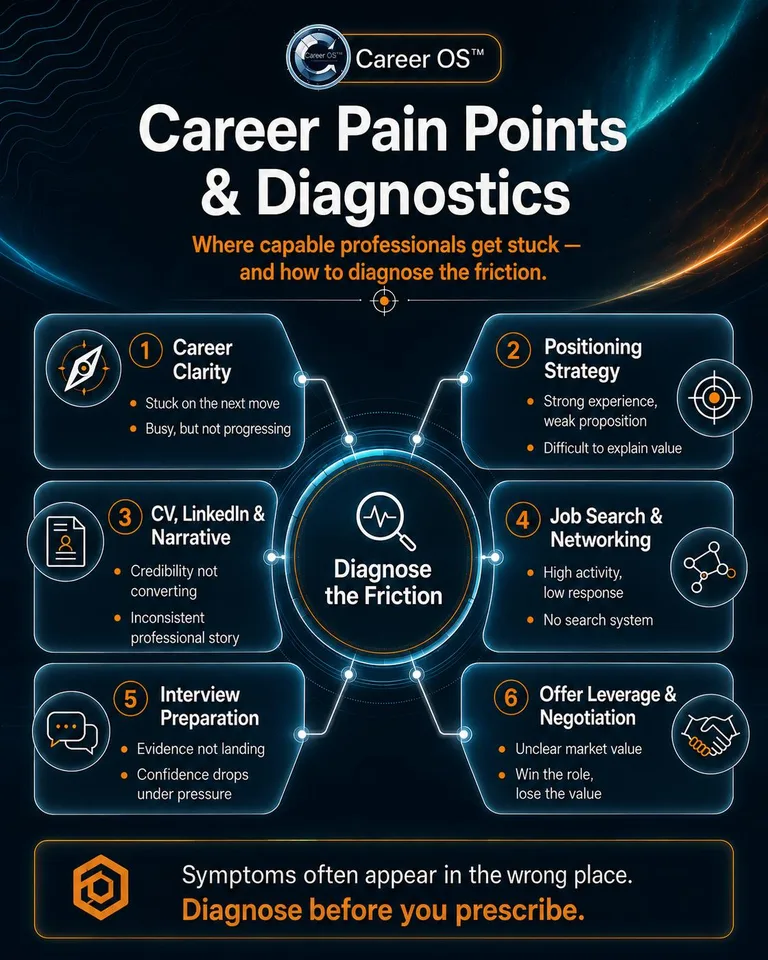
The Career OS™ framework identifies six distinct sources of career friction. Each produces a different pattern of symptoms and needs a different intervention.
| Stage | Career pain point | Diagnostic focus |
|---|---|---|
| 1 | Career clarity | Direction |
| 2 | Career positioning | Proposition |
| 3 | CV, LinkedIn and narrative | Conversion |
| 4 | Job search and networking | Pipeline |
| 5 | Interview preparation | Performance |
| 6 | Offer leverage and negotiation | Protected value |
1. Career clarity
Diagnostic focus: Direction
Clarity often fails quietly. You remain active — updating documents, scanning roles, considering qualifications — without a defined destination or criteria that would let you recognise the right role. The fix is a decision, not more activity.
Common signals
- Stuck on the next move
- Busy, but not progressing
- Too many options, none evaluated with discipline
2. Career positioning
Diagnostic focus: Proposition
Inside an organisation, value is carried by reputation and context. The external market sees none of that. Positioning connects what you have done, what you can do, the evidence that proves it and the problem the employer needs solved — turning a career record into a proposition.
Common signals
- Strong experience, weak proposition
- Difficult to explain your value
- Pitch too broad; leadership and commercial impact underplayed
3. CV, LinkedIn and narrative
Diagnostic focus: Conversion
A CV is part of a conversion system, not a history file. Senior professionals rarely lack evidence; they have too much. Make the consequence of the work visible — scale, risk retired, delivery recovered — and align every asset to the same proposition.
Common signals
- Credibility not converting into interviews
- Inconsistent professional story across CV, LinkedIn and letters
- Responsibilities listed, outcomes missing
4. Job search and networking
Diagnostic focus: Pipeline
A busy search can still be ungoverned. Define the market before entering it, work several channels — recruiters, direct targeting, former colleagues, sector contacts — and treat networking as relationship-led market intelligence. Track conversion so you learn where the market responds.
Common signals
- High activity, low response
- Over-reliance on job boards and Easy Apply
- No tracker, rhythm or conversion data

5. Interview preparation
Diagnostic focus: Performance
Interview difficulty is often an evidence-retrieval problem rather than a confidence problem. Build a bank of examples around the capabilities the role tests, know where your contribution begins, and connect each answer to the reason the question was asked.
Common signals
- Strong evidence not landing
- Confidence drops under pressure
- Long, over-technical answers

6. Offer leverage and negotiation
Diagnostic focus: Protected value
The offer is where you protect the value created at every earlier stage. Decide your market range, preferred outcome, minimum position and walk-away conditions before the offer arrives, and evaluate the whole package rather than salary alone.
Common signals
- Unclear market value
- Premature acceptance out of relief
- Focus on base salary alone
CPD, promotion and MOVE vs PROPEL
The same six pain points apply whether you are changing employer or progressing where you are. Continuing professional development and promotion cases fail for the same reasons a job search does: unclear direction, an under-positioned contribution, weakly evidenced outcomes, limited visibility with decision-makers, and a promotion conversation entered without preparation.
Career OS™ MOVE is the pathway for moving — a new role, sector or employer — and works through clarity, positioning, assets, search, interviews and offers. Career OS™ PROPEL is the pathway for progressing inside your current organisation — purpose and direction, role positioning, outcomes and evidence, presence and influence, execution and leverage. Diagnose which pathway you are on before choosing the intervention.
MOVE & PROPEL guidebooks →Career OS™ tools →Progression & leadership guides →
Diagnose before you prescribe
Before rewriting another CV or submitting another twenty applications, ask where the friction is actually occurring. A professional may not need six interventions — often one critical correction lets the rest of the system work. If you work in engineering or a technical field, see career coaching for engineers and career consultancy for engineers, or browse the Knowledge Centre Index.
Get the complete 17-page PDF article free
The full Career OS™ diagnostics walkthrough, with every chapter and reflection prompt. Enter your first name and email to receive access.
Frequently asked questions
What are the most common career pain points for experienced professionals?
The most common career pain points are unclear career direction, weak market positioning, ineffective CV and LinkedIn profiles, an unstructured job search, inconsistent interview performance and insufficient salary negotiation preparation. These problems are interconnected, so a weakness early in the process can later appear as low response rates, declining confidence or a poor offer.
Why am I not progressing despite having strong experience?
Strong experience does not automatically produce progression. It must be translated into a clear market proposition, supported by evidence and aligned with an employer need. Experienced professionals can remain overlooked when their CV, LinkedIn profile and narrative describe responsibilities rather than the problems they are credible to solve.
Why am I applying for many jobs but receiving little response?
High application volume with low response often indicates a targeting or job-search strategy problem rather than a lack of effort. You may be relying too heavily on public job boards, applying for weak-fit roles or under-using recruiter relationships, direct outreach, professional networks and referrals.
How can I improve senior-level interview performance?
Senior interview performance improves when career evidence is selected, structured and rehearsed around the employer’s requirements. The aim is not to memorise scripts but to create organised retrieval, so leadership, technical, commercial and stakeholder evidence can be presented clearly under pressure.
Should I negotiate a job offer?
Evaluate any offer against market evidence, the scope of the role and the complete package. Professional negotiation does not need to damage the relationship; it should be a measured discussion about salary, pension, bonus, flexibility, title, responsibilities and the wider value of the opportunity.