Career Change Consultation for Experienced Professionals
Eich Dyn provides structured career change consultation for experienced professionals who need a viable target, credible positioning and a search route that works through Career OS™.
Transferable STEM Skills
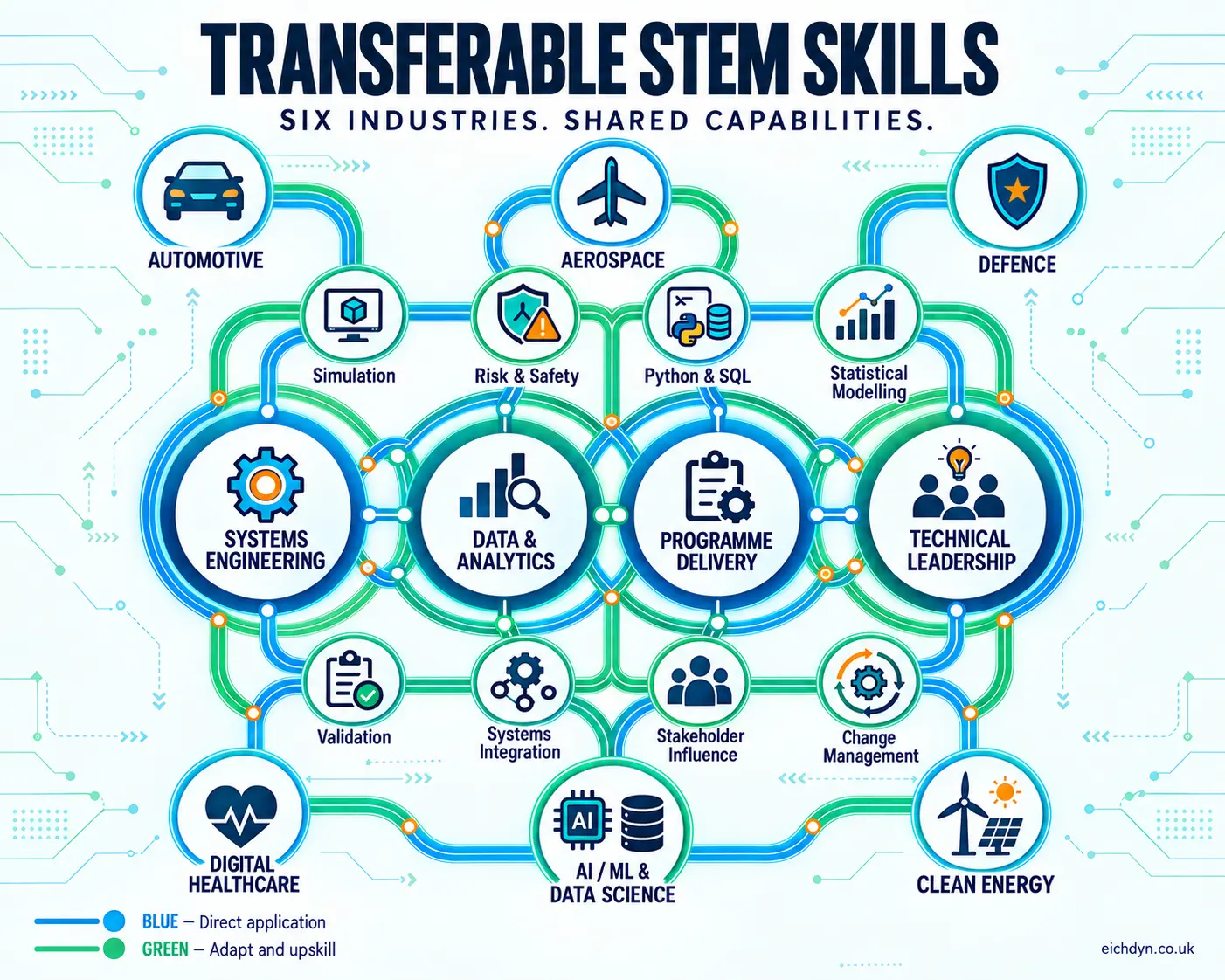
Use this diagram as a discussion map, not an eligibility chart. The blue and green connections distinguish potential direct application from adaptation and upskilling. A shared capability still needs to be checked against the particular role, product, standards and operating environment.
What is career change consultation?
Career change consultation tests whether a pivot is viable, then makes it credible: transferable evidence, repositioned experience, a target that matches the market and a search route that reaches decision-makers. Eich Dyn delivers this through Career Diagnosis and the Career OS™ MOVE path.
Why I wrote this page
I wrote this page because changing sector should not mean pretending your previous career never happened. My perspective comes from 37 years of engineering leadership and 3 years of specialist coaching. Engineering teaches you to interrogate a requirement, test assumptions and work with evidence. Those habits matter just as much when the system you are trying to change is your own career.
I want experienced STEM professionals to distinguish a genuine gap from a communication problem. You may need new knowledge, but you may also be describing valuable work in language that only your existing employer understands. My approach is to make both visible: what you already bring, and what you still need to learn. That is more useful than telling you that every skill transfers, or that you must start again.
This page gives you a practical way to investigate a pivot before making an expensive commitment. It is guidance, not a promise of a particular role, salary or outcome. Your circumstances, the target market and the evidence you can substantiate all matter.
— Dai Jones
Why most career pivots stall
Pivots rarely fail because the professional lacks capability. They fail because the target is undefined, the experience is presented in the language of the old sector, the transferable evidence is implied rather than proven, or the search relies on applications into systems that screen for exact matches.
A change of direction is a positioning problem before it is a job-search problem. Once the target is specific and the evidence is translated, the market response usually changes faster than people expect.
Career Change Coaching vs Career Change Consultation
Career change coaching typically explores options and motivation. Career change consultation tests viability against the market, then rebuilds positioning, evidence and search strategy so the pivot is credible to the people making hiring decisions.
Many people search for career coaching when they need structured career support. Eich Dyn is consultancy-led: the work is delivered through Career Diagnosis, Career OS™ and strategic career consultation rather than generic coaching. The main service page is career consultancy for career change.
How Career OS™ handles a change of direction
The MOVE path runs through Career Diagnosis, Positioning Strategy, Evidence & Profile, Search & Networking, Interview Mastery and Offer Negotiation. For a pivot, the weight sits in the first three stages: define a target the market recognises, position experience against it, and evidence transferable outcomes in terms the new audience values.
Choose a target problem, not just a new industry
A credible cross-sector STEM pivot starts with a problem an employer needs solved. “I want to leave automotive” describes your starting point, not your value to the next organisation. A more useful hypothesis is: “I want to apply my systems integration and validation experience to complex products in a safety-conscious engineering environment.” You can then test that hypothesis against specific roles.
Build a shortlist of two or three role families rather than pursuing six sectors at once. Review several current UK vacancies in each family. Extract recurring responsibilities, tools, standards and evidence requirements. Note location, travel, working arrangements and salary constraints alongside technical fit. Separate requirements that are genuinely essential from preferences you should investigate in conversation.
Illustrative examples, not client results: an automotive validation engineer might investigate test and verification roles in aerospace or clean energy; a manufacturing improvement specialist might explore process development in medical-device manufacturing; a programme leader might examine delivery roles in advanced manufacturing or infrastructure. These are starting hypotheses, not statements that someone is qualified for every role in those sectors.
Defence roles may have security or nationality conditions, and healthcare or safety-critical work may require specific regulatory knowledge. Verify the actual vacancy and employer requirements. Similar technical vocabulary does not make accountability, approval processes or legal obligations identical.
Translate your experience into evidence the new sector recognises
Transferable skills become persuasive when the reader can see where you used them. Replace “strong stakeholder management” with a short account of the conflicting requirements, the decision you enabled and the result you can verify. Preserve technical depth while translating unfamiliar product names, internal acronyms and organisation-specific job titles.
Create an evidence inventory with five fields: target requirement, relevant example, your individual contribution, substantiated outcome and remaining gap. Distinguish your work from the team's work. Where a result was shared, explain your responsibility rather than claiming sole ownership. Where figures are confidential, use an approved range, a non-sensitive comparison or a qualitative outcome with clear boundaries.
The XYZ structure is a useful discipline: accomplished X, as measured by Y, by doing Z. Y need not be a dramatic percentage; it can be a verified milestone, an accepted test result or a documented reduction in rework. If you do not have the measurement, do not create one. The Career Impact Metrics and XYZ resources help organise that thinking, while the engineering CV guide helps translate it into a readable application.
Illustrative wording: “Coordinated mechanical, electrical and software interfaces through agreed verification gates, resolving conflicting acceptance criteria before release.” Use a sentence like this only if it accurately describes your work, and add a real outcome where you have one. It is not a ready-made achievement to copy into a CV.
Bridge the gaps with targeted learning and practical proof
Classify each gap before choosing a course. A mandatory qualification or registration is different from unfamiliar sector terminology; both differ from lacking an example of applying a tool. Check essential credentials with the employer or relevant professional body. For technical learning, define an output you can show rather than collecting certificates without a clear purpose.
A proportionate bridge project might analyse a public dataset, develop a small requirements-and-verification plan or compare integration risks using publicly available information. Explain the question, assumptions, method, limitations and conclusions. Label it as independent work or a training exercise. Do not imply that a hypothetical design has been certified, deployed or accepted by a commercial customer.
Ask an informed practitioner to challenge your reasoning. What terminology is wrong? Which constraint have you missed? What would make this evidence useful in an interview? Feedback can reveal whether you need deeper knowledge, a more relevant project or simply a clearer explanation. Respect their time and do not ask them to approve work beyond their competence.
Keep employer intellectual property and sensitive information out of portfolios. Rebuild an example using public or synthetic inputs where appropriate and state that you have done so. In regulated work, a portfolio can demonstrate your approach but cannot substitute for mandatory supervised experience, authorisation or qualifications.
Network to understand the work before asking for an opportunity
Networking is most useful when it improves your understanding, not when it becomes a mass request for referrals. Identify people doing the target role, engineering managers recruiting it and professional communities discussing its challenges. Look for credible industry events, specialist groups and former colleagues whose work connects with your intended direction.
Make a specific, modest request: “I am exploring verification roles outside automotive. Which differences in standards and delivery practice should I understand before applying?” Ask what evidence a hiring manager would expect, which gaps are material and which titles accurately describe the work. A conversation is not a promise of employment; permission to mention someone's name should never be assumed.
Keep a short research log: person or source, what you learnt, which hypothesis changed and the next action. Follow up with thanks and a relevant update rather than repeated requests. If several conversations expose the same gap, address it. If the target proves unsuitable, narrowing or changing it is a productive result, not failure.
Visibility should reinforce your chosen positioning. A concise profile, a thoughtful technical post or a properly labelled portfolio example can help someone understand your relevance. Avoid announcing expertise you have not yet demonstrated. The goal is to become recognisable for useful, evidenced capability, not to appear omniscient about a new sector.
Turn the pivot into a Career OS™ plan
Career OS™ is the methodology that connects direction, positioning, evidence and execution. For an external change of employer, sector or role, MOVE is the relevant path. If the real objective is greater scope or progression within your organisation, PROPEL may be more appropriate. Neither path removes the need to test assumptions against actual opportunities.
Begin with the Career Needs Navigator if you are unsure which path fits. It identifies MOVE or PROPEL; it is not the readiness score. The assessment page explains the next readiness step. Use the result as a starting point for investigation, not a substitute for your judgement.
Then write a one-page pivot plan: target role family, reasons for fit, three strongest evidence examples, two priority gaps, people to speak with and a review date. Each action should produce something observable: a revised positioning statement, a verified achievement, practitioner feedback or a completed bridge exercise. Review what the market is telling you before increasing application volume.
A Career Diagnosis consultation with Dai can help examine that plan and decide where structured support is useful. Bring a current CV, a few representative vacancies and your evidence inventory. The aim is a clearer, more credible next step—not a guarantee that a particular employer will hire you.
Who this is for
- Experienced professionals moving sector, function or role type
- Technical specialists moving from delivery into leadership or advisory work
- Academics and researchers moving into industry
- Professionals leaving a long tenure in one organisation
- Anyone who has explored pivot coaching and now wants a tested, evidenced plan
What happens after you book
After booking, you have a private 1:1 Career Diagnosis with Dai Jones to identify your current position, the blockers holding progress back, your likely market value and the best-fit Career OS™ route.
This is a structured career strategy consultation — not a generic call or a quick CV review.
Career blockers
What is limiting your progress, visibility or market response.
Market value
How your experience, technical depth and leadership capability should be positioned.
Best next step
Whether Career OS™, MOVE, PROPEL or another route is the right fit.
Choosing the right kind of support
Is this the same as career pivot coaching?
Many people search for career pivot or career change coaching. Eich Dyn is consultancy-led: Career Diagnosis first tests whether the intended pivot is realistic, then Career OS™ rebuilds positioning and evidence so the change is credible to hiring decision-makers.
Will I have to start again at a lower level?
Not necessarily. Level is usually determined by how transferable capability is evidenced and positioned, not by sector history alone. That is the work.
What if I am not sure what to change to?
That is common and it is what Stage 1 addresses. Direction is established from your strengths, evidence, constraints and market demand rather than from a personality label.
Career pivot coaching and change consultation — questions
Can I move from automotive engineering into another sector?
Yes, a move can be credible where your engineering capability matches a real requirement. Systems integration, validation, supplier management, programme delivery and technical leadership may be relevant to aerospace, defence, clean energy or advanced manufacturing. Match the specific role rather than assuming sectors are interchangeable. Check its standards, safety obligations, eligibility and any required qualifications; a sector change does not guarantee an equivalent title or salary.
How do I identify my transferable STEM skills?
Start with work you can evidence, not a list of adjectives. Record the problem, your contribution, the methods used and the outcome. Then compare those examples with target-role requirements. Separate capabilities you can apply directly from those needing adaptation, such as using validation experience under a different regulatory framework. Systems engineering, data analysis, programme delivery and stakeholder influence are useful categories, but each needs a concrete example.
How can I prove my suitability without experience in the new sector?
Show relevant evidence from your current sector and be explicit about its limits. Add a small independent project, a public-data analysis, a requirements exercise or a practical training assignment addressing a target-sector problem. Label it as independent work, explain assumptions and seek informed feedback. Never present an exercise as commercial delivery, disclose confidential employer material or invent performance figures. A portfolio demonstrates reasoning; it does not replace regulated experience or mandatory credentials.
Do I need new qualifications or upskilling before a career pivot?
Not every pivot needs a new degree. Examine several relevant vacancies and speak to practitioners to distinguish mandatory qualifications, preferred credentials and skills you can demonstrate another way. Prioritise genuine blockers: a required licence, a sector standard or a tool used in the target role. Choose learning with an applied output and assess cost, time and relevance before committing. Check current eligibility and registration requirements with the appropriate employer or professional body.
How do career pivot coaching and Career OS™ work together?
Coaching can help you examine motivation and choices; Eich Dyn's consultancy-led approach also tests direction, positioning and evidence against the market. Career OS™ is the methodology organising that work. The Career Needs Navigator helps identify MOVE for an external change or PROPEL for internal progression; it is not a readiness score. Career Diagnosis then explores your circumstances and the appropriate next step. Neither coaching nor Career OS™ guarantees a job, promotion or particular salary.
Test the pivot before you commit to it
A Career Diagnosis establishes whether your intended change is viable, what evidence it requires and which Career OS™ route fits — before you invest months in applications.