How to Tailor Your CV to Any Job Without Rewriting It From Scratch
By Dai Jones, Eich Dyn Career Services Ltd · Published

The short answer
To tailor a CV to a job, identify the three to five problems the role exists to solve, then reorder and rewrite your profile and most recent achievements so they prove you have solved those problems before. You do not rewrite the whole CV — you change the top third, the order of evidence and the language, keeping every claim true.
Why a generic CV underperforms
A generic CV is written to describe you. A tailored CV is written to answer a specific hiring manager's question: can this person solve the problems I have? The two documents can contain the same facts and still perform very differently, because readers skim the top of the first page and decide quickly whether to read further.
Tailoring is therefore not about inventing a different version of yourself for each job. It is about selection, order and translation — choosing which true evidence goes first, and expressing it in the language the employer uses.
Step 1: Build a master CV once
Before you tailor anything, create a long "master" document that nobody else will see. For each role, list every significant achievement you can evidence: the situation, what you did, and the result. Aim for eight to fifteen entries per recent role. This is the raw material you will draw from. It removes the temptation to write new claims under time pressure, which is when exaggeration creeps in.
If you struggle to find measurable results, use our guides on quantifying CV achievements and writing achievements when you have no KPIs.
Step 2: Decode the advert into problems
Read the job description three times with a different question each time:
- What must this person deliver in the first year? (Often hidden in phrases such as "lead the transition to…", "stabilise…", "scale…".)
- What would make them fail? (Stakeholder complexity, regulatory exposure, a legacy platform, a stretched team.)
- Which words does the employer repeat? These are the terms a human screener and any applicant tracking system will look for.
Write the answers as three to five short problem statements. For example, a battery systems lead role might reduce to: deliver a validated pack design on a fixed programme date; integrate supplier cell data into a safety case; build a small team from scratch.
Step 3: Rewrite the top third
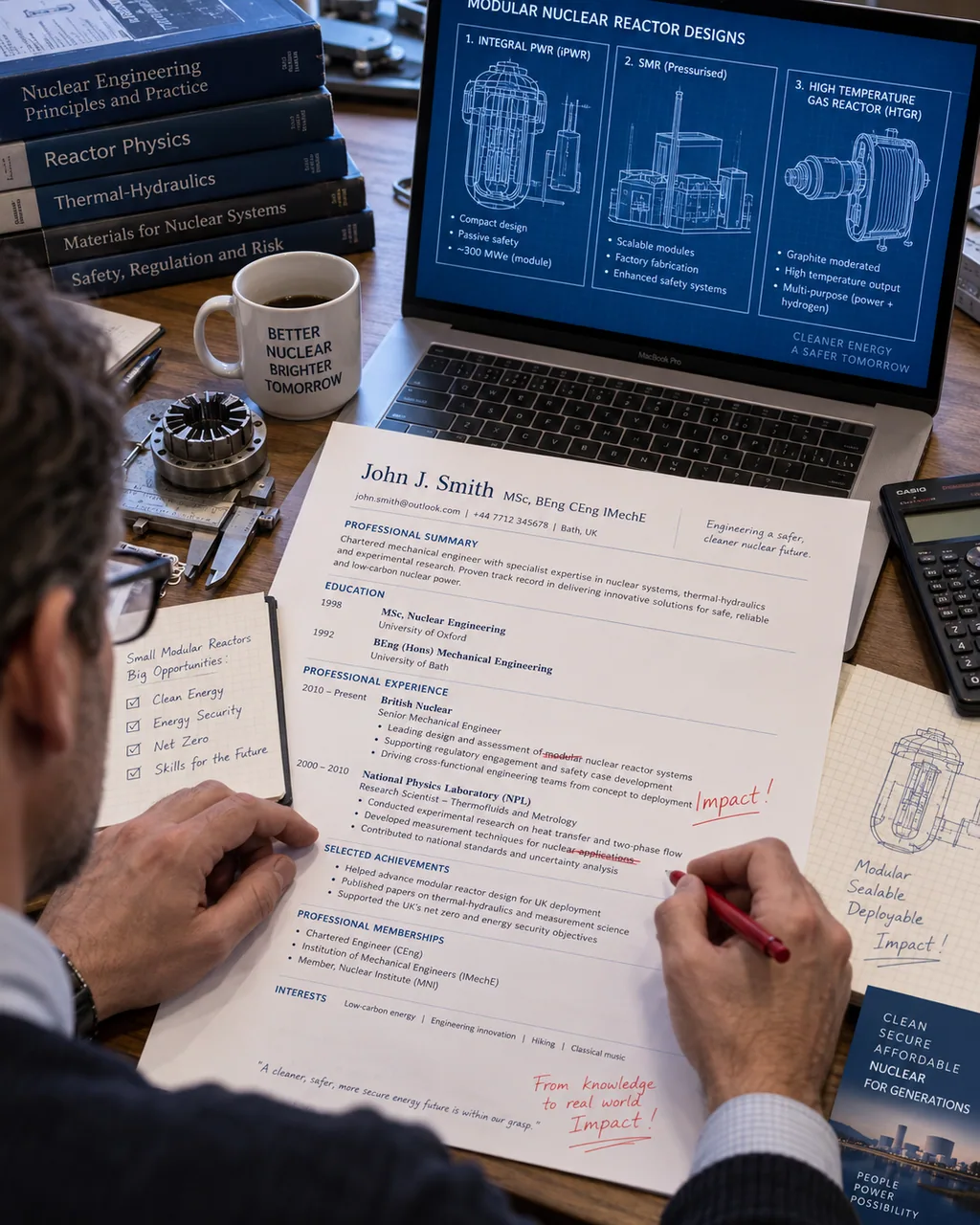
The profile, headline and first role carry most of the weight. Rewrite your profile so the first two sentences speak directly to the problem statements. Keep it factual.
Illustrative example (not a client case):
- Generic: "Experienced engineer with a strong background in mechanical design and project delivery."
- Tailored: "Chartered mechanical engineer who has taken three electrified powertrain sub-systems from concept to validated production design, integrating supplier test data into safety documentation and leading teams of up to eight engineers."
The tailored version uses the employer's vocabulary (validated, supplier, safety, team) and points to evidence the reader can find further down.
Step 4: Reorder achievements, do not just add keywords
Within each recent role, move the achievements that match the problem statements to the top. Drop or shorten those that are irrelevant. Two strong, relevant bullet points beat six generic ones.
Keyword matching matters, but stuffing terms into a skills list is weak tailoring. A term is most persuasive when it appears inside an achievement: "Introduced design FMEA across the module team, closing 41 high-severity actions before tooling release" says far more than "FMEA" in a list.
Step 5: Check credibility and consistency
Finally, read the CV as a sceptical reviewer would:
- Does every claim in the profile have supporting evidence lower down?
- Do dates, titles and responsibilities match your LinkedIn profile?
- Would you be comfortable explaining every number at interview?
If the answer to any of these is no, fix it before you apply. The National Careers Service guidance on CV sections is a sensible baseline for structure; the aim here is to go further on relevance.
How long tailoring should take
With a good master CV, tailoring a single application should take roughly 30–60 minutes: 15 minutes decoding the advert, 20–30 minutes rewriting the profile and reordering evidence, and a final consistency check. If it takes far longer, the master document is usually missing evidence rather than wording.
When tailoring is not enough
If you are tailoring carefully and still not securing interviews, the issue may be targeting or positioning rather than the document. Read why your CV isn't getting interviews, or use the Career Needs Navigator to check whether the roles you are applying for fit your evidence.
Frequently asked questions
Should I tailor my CV for every application?
Yes, for any role you genuinely want. With a master CV in place, tailoring the profile, the order of achievements and the language usually takes under an hour, and it materially improves how relevant you appear to a reader skimming the first page.
Is it dishonest to change my CV for different jobs?
No, provided every statement remains true. Tailoring is selecting and ordering real evidence and using the employer's terminology. It becomes dishonest only if you claim experience, titles or results you cannot evidence.
How many keywords from the job description should I include?
There is no reliable magic number. Include the core technical and role terms the advert repeats, but place them inside achievements where possible rather than in a long list, so they read as evidence to a human reviewer.
What part of the CV matters most when tailoring?
The top third: headline, profile and your most recent role. That is where a reader forms a first impression, so it should speak directly to the problems the role exists to solve.
Do I need a different cover letter as well?
If the application asks for one, yes. Use it to connect two or three of your strongest relevant achievements to the employer's stated priorities, rather than repeating the CV.
Sources and further reading
Examples on this page are illustrative and are not client results. Practice observations reflect Eich Dyn's experience, not statistical research.
Want an expert view of your CV?
Ask for a free CV appraisal to see where your evidence or positioning needs strengthening. If you need more, CV writing and the Career Diagnosis are paid services with published prices.