
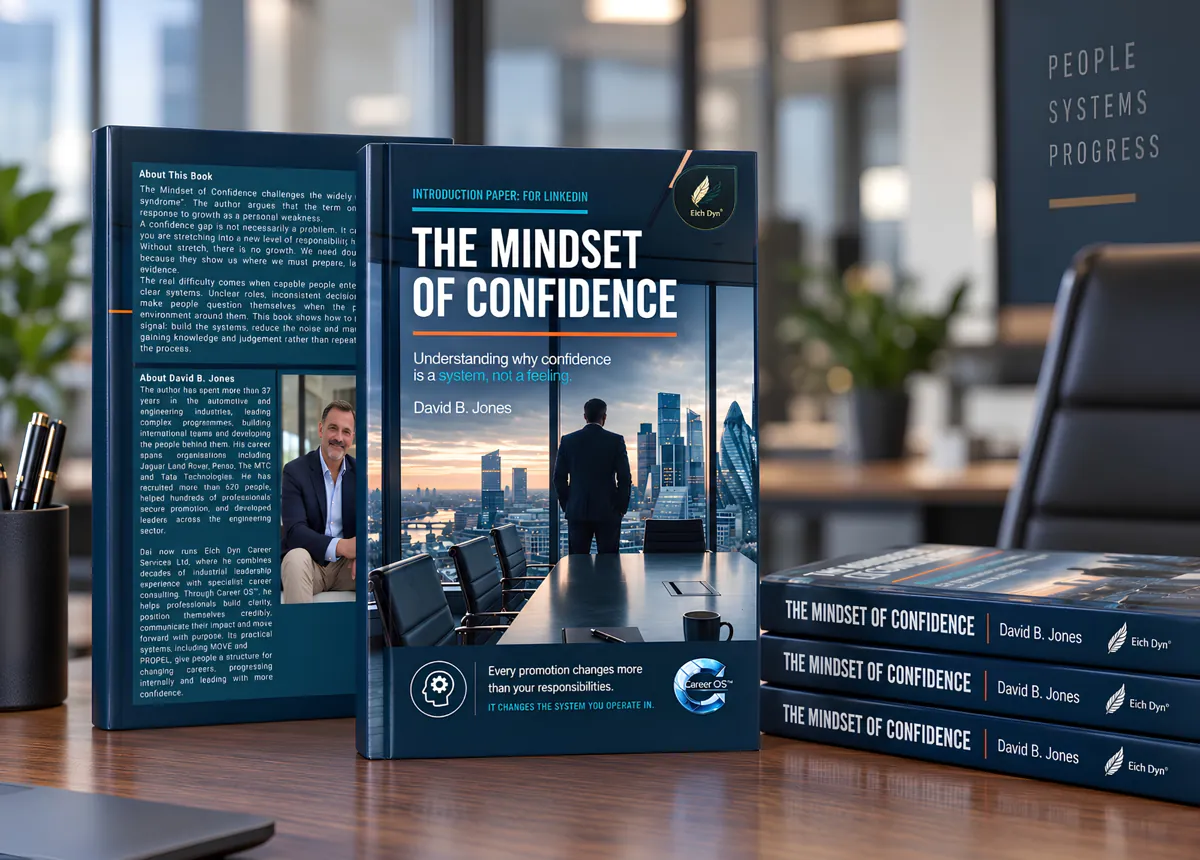
The Mindset of Confidence
Understanding why confidence is a system, not a feeling.
By Dai Jones
Availability
Published globally on Amazon · Kindle · Paperback · Hardback.
Why I wrote this book
I was head-hunted for TTL to lead the VLD programme: roughly 720 people across six countries, with a brief to deliver a platform and two vehicles in a little over two years — something no European or American OEM or engineering service provider had previously achieved in quite that way. We did it. It was extraordinary. It almost broke me, it pushed three of my Chief Engineers enormously hard, and it forced countless engineers to grow faster than they thought possible.
But before I started, I doubted whether I was ready for the role. That self-doubt is one of the reasons I wrote this book. Fortunately, we were working within an established, mature engineering service provider with strong systems already in place. We were not trying to invent the operating system at the same time as inventing the product. In start-ups, those two challenges often arrive together: invention of process on top of invention of product, frequently compounded by weak financial discipline or insufficient financial acuity. That combination can destroy otherwise brilliant businesses.
The lesson I carried forward was that confidence did not come from suddenly “feeling confident”. It came from preparation, systems, evidence, capable people, clear decisions, disciplined execution, and learning fast when the gaps became visible. The gaps were not proof that I should shrink from the challenge. They were signals showing where I needed to grow.
“Confidence is not the absence of gaps. It is knowing what to do when the gaps appear.”
Confidence is a system, not a personality trait
We tend to describe confidence as though it were a temperament — something a person either has or lacks. That description is comfortable and largely useless, because it offers nothing to work on. In practice, the people who hold their nerve under consequential pressure are rarely the ones with the strongest feelings about themselves. They are the ones with the clearest information, the best-prepared options, and a method for deciding when the information is incomplete.
Treating confidence as a system changes what you do on a Monday morning. Instead of waiting to feel ready, you build the components that make readiness observable: what you know, what you can prove, who you can rely on, how you make decisions, and how quickly you close a gap once you have seen it. Each component can be strengthened deliberately. That is the whole argument of the book, and it is the same argument that runs through Career OS™.
What high-responsibility roles expose
A larger role does not simply add volume. It changes which weaknesses matter. Detail that was previously someone else’s problem becomes your judgement call; relationships you could once avoid become the route through which work actually happens; and the cost of an unmade decision starts to exceed the cost of an imperfect one. This is why capable people often feel least confident at precisely the moment they have been promoted for competence.
The useful response is diagnostic rather than emotional. Name the specific capability the new role demands — commercial reasoning, programme governance, stakeholder influence, technical arbitration — and treat each as a gap with an owner, a plan and a deadline. That is a considerably faster route to steadiness than trying to talk yourself into feeling assured.

The danger of inventing process and product at the same time
On the VLD programme, the product was genuinely hard, but the method for delivering it was not in question. Mature processes, established governance, competent functions and a working financial discipline meant the organisation could concentrate its inventiveness where it created value. Confidence, in that environment, is partly inherited from the system you are standing in.
Younger organisations frequently attempt both inventions at once — the product and the operating system that builds it — and often while cash discipline is still immature. Nothing about that is a moral failing; it is simply a much larger surface area of uncertainty, and it explains why talented teams can work extremely hard and still struggle. The professional lesson is to know which invention you have signed up for, and to be honest about the support structures that exist around you.
What professionals can learn from engineering programmes and start-ups
Large programmes teach sequencing, evidence and the discipline of a decision log. Start-ups teach speed, resourcefulness and the value of testing an assumption before committing to it. A career benefits from both. Sequencing prevents you from making consequential moves in the wrong order; testing prevents you from building an entire plan on an unexamined belief about what the market wants.
Applied to your own progression, that means running your next move like a small programme: a defined outcome, evidence of capability, named stakeholders, a realistic schedule and review points where you are willing to change your mind. The case for treating a career as a system sits directly alongside this chapter.
From self-doubt to useful evidence
Self-doubt is usually specific, even when it feels general. Interrogated properly, “I am not ready” resolves into two or three concrete uncertainties — an unfamiliar commercial model, a scale of team you have not led, a stakeholder group you have never had to persuade. Once specified, each becomes a question with an answer, and the answer is almost always evidence: what you have already done that is closest to it, what you need to learn, and who can tell you whether your reasoning holds.
This is the same discipline that makes interviews and negotiations go well. Decision makers are not persuaded by assurance; they are persuaded by proof of judgement. The book treats evidence-building as the practical engine of confidence, which is why it connects so closely to positioning work such as positioning, CV and LinkedIn evidence.
Building capability deliberately
Capability rarely arrives through exposure alone. It arrives when exposure is paired with structure: a harder problem, a shorter feedback loop, someone competent enough to challenge your conclusions, and a record of what you learned that you can actually show later. Left unstructured, ten years of experience can amount to one year repeated ten times.
So build it on purpose. Choose the next problem for what it will teach you as well as what it will pay. Keep a working record of decisions and outcomes. Ask for review from people whose judgement you respect rather than people who will agree with you. Over a few years this is the difference between a career that happens to you and a career you are running.

Questions about the book
What formats is The Mindset of Confidence available in?
The book is published globally on Amazon in Kindle, paperback and hardback. No audiobook edition is available.
Who is the book written for?
Experienced professionals carrying real responsibility: senior engineers, technical specialists, managers, programme leaders and executives who are stepping into larger roles, changing direction or leading through pressure.
How does the book relate to Career OS™?
The book explains why confidence behaves like a system — preparation, evidence, people, decisions and execution. Career OS™ is the governed six-stage method Eich Dyn runs with clients to build that system deliberately rather than hope it appears.
Where can I buy the book?
It is sold through Amazon worldwide. The purchase link is published on this page and on the Career Development Books collection page.
One thing to do today
Believe in yourself and know that every new challenge or career move will expose gaps. Those gaps are signals to grow, not reasons to shrink. Grasp them. Make yourself better every day — more knowledgeable, more useful and more employable.