
Chapter 2 of 7
Chapter 2: Professional Development – Nurturing Your Professional Growth
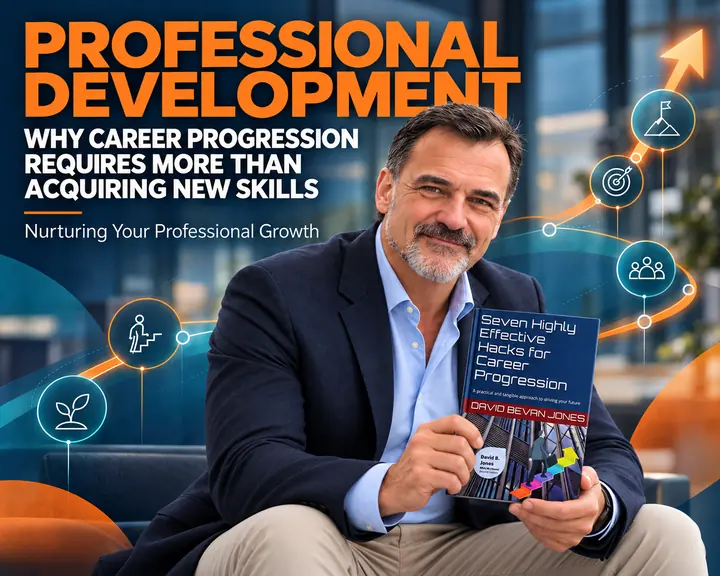
Why Career Progression Requires More Than Acquiring New Skills
Professional development is not simply about accumulating qualifications, attending courses or becoming more experienced at the work you already know how to do. It is about deliberately increasing the scale, breadth and quality of what you are capable of contributing, and ensuring that the experience accumulated throughout a career is progressively converted into judgement, adaptability, leadership capability and readiness for greater responsibility.
Adapted from Chapter 2 of The Seven Highly Effective Hacks for Career Progression by Dai Jones, 2025.
By Dai Jones ·
Why I wrote this
There is an important distinction between acquiring a skill and developing as a professional, because although the two are clearly related, they are certainly not the same thing. You can learn a new software package, complete another qualification, become proficient in a methodology, attend a leadership programme or add another technical competency to your repertoire, and every one of those activities may be valuable, but none of them necessarily means that you have developed in the broader professional sense. Development occurs when new knowledge and experience begin to change the scale and quality of the contribution you are capable of making, when they improve your judgement, allow you to handle greater ambiguity and responsibility, broaden the range of people and problems you can work with, and ultimately make you more useful to an organisation than you were before.
This is the central theme of Chapter 2 of The Seven Highly Effective Hacks for Career Progression. Chapter 1 considered skills acquisition and the importance of deliberately building capability; Chapter 2 takes the next step and asks what we subsequently do with those skills, because capability that is acquired but never stretched, tested, reflected upon or applied in more demanding situations can remain surprisingly static. Development therefore includes goal setting, challenging assignments, feedback, resilience, continuous learning, mentoring, networking, leadership, adaptability and calculated risk, but I increasingly see these not as isolated career-development activities, but as interconnected mechanisms through which an experienced professional continues to evolve.
I wrote the book because there are many things about career progression that I understand now, after decades of engineering, programme leadership, people development, international working and more recently career consultancy, that I would have found enormously useful to understand when I was in my twenties. One of the most important is that organisations are generally very good at giving us work, because that is fundamentally what they need us to do, but the work the organisation needs from us today does not automatically create the development we will need tomorrow. Sometimes the two align perfectly and a demanding project, an excellent manager or a new responsibility stretches us at exactly the right moment; on other occasions, we can spend several years becoming increasingly efficient at work that no longer materially expands our capability.
That distinction becomes particularly important in mid-career, when competence itself can become something of a trap. By this stage, an experienced engineer, scientist, programme manager or technical specialist may already be extremely capable, trusted by colleagues and valuable to the organisation, and because they perform well they are repeatedly given the type of work they are already known to deliver successfully. There is an understandable logic to that from the company's perspective, but from the individual's perspective there is a risk that another five years of experience becomes largely another five years of applying the same capability, rather than five years in which the scope, complexity and level of judgement have materially increased.
A career can become longer without becoming materially broader.
That is why professional development deserves to be treated as part of the architecture of a career rather than simply an annual appraisal discussion or a list of training courses.
What does professional development really mean in mid-career?
For me, professional development is the deliberate process through which somebody increases the quality, breadth and scale of what they are capable of contributing, and whilst formal training can certainly form part of that process, much of the most important development takes place somewhere else entirely. It happens when you take responsibility for something you have not previously controlled, when you are required to influence people over whom you have no authority, when you make an important decision without the comfort of perfect data, when you lead specialists who know considerably more than you do about their individual disciplines, or when you are forced to adapt because the environment, technology or organisation has changed around you.
This is one of the reasons I am cautious about using years of experience as a proxy for professional maturity. Two people can both have twenty years in the same industry and yet have experienced very different careers. One may have spent those years deepening a valuable technical specialism, perhaps deliberately and very successfully, whilst another may have moved through different products, functions, technologies, countries, leadership environments and commercial situations, with each transition requiring a slightly different professional response. Neither route is automatically superior, because the correct development path depends upon the destination, but what matters is recognising whether the experience being accumulated is relevant to the future you actually want.
For somebody in the early stages of a career, development may reasonably concentrate heavily on becoming technically credible, learning professional disciplines, understanding how the organisation works and proving that they can deliver independently. As responsibility increases, however, development gradually changes character because the individual is no longer being judged simply on the quality of their personal output. Their success increasingly depends upon their judgement, the decisions they make, their ability to integrate several disciplines, their commercial understanding, the quality of people they develop and their capacity to create an environment in which other highly capable professionals can succeed.
That transition is especially important in STEM careers because technical excellence is often the foundation upon which credibility has been built. It is entirely understandable that an engineer who has progressed because they are technically strong will continue investing in technical strength, and frequently that remains extremely valuable, but at some point the marginal career return from becoming another ten per cent better technically may be lower than the return from learning how to lead people, manage commercial trade-offs, influence senior stakeholders, communicate complex information or make decisions at greater scale.
The capability that created the first fifteen years of success can therefore become insufficient for the next fifteen unless something new is deliberately added to it.
Why is a job title not a professional development plan?
Goals such as “become a Director”, “move into leadership”, “become a Chief Engineer” or “get promoted in the next two years” need to be treated carefully. They are perfectly legitimate career ambitions, but they are not development objectives because they describe the position somebody wishes to occupy rather than the capability they must develop to perform it effectively.
The more useful exercise is to reverse the question and ask what an excellent person at that level is expected to do that you are not yet routinely doing, because that begins to expose the real development requirement.
If you want to become an Engineering Director, for example, what size of organisation will you need to lead, what financial accountability will you hold, what types of strategic decisions will you be expected to make, how much customer and commercial exposure will you require, and what evidence will demonstrate that you can develop leaders rather than merely supervise technical work? If you want to become a Chief Engineer, what level of whole-system judgement will be expected, how will you make trade-offs between competing attributes and functions, and can you command the confidence of senior specialists without attempting to become the deepest expert in every room?
These are the questions that convert a title into a development agenda.
I saw this repeatedly during the many years I was involved in people development at Jaguar Land Rover, where from 2002 through to 2016 I held significant responsibilities for developing engineering talent and leadership capability. At one stage I chaired people-development activity across Vehicle Engineering, covering more than 1,500 people, and subsequently chaired a wider company people-development group affecting more than 10,000 employees. Across that period I had the opportunity to observe large numbers of engineers progressing through different stages of their careers and to see what distinguished those who successfully moved into greater responsibility.
What became increasingly apparent was that the strongest candidates were rarely simply those who wanted promotion the most strongly, nor were they necessarily the technically brightest person in their immediate peer group. More often, they were the people who had gradually built a broader body of evidence: they had taken on difficult work, exposed themselves to different problems, developed other people, learnt to communicate beyond their own discipline, built trust and demonstrated that they could already operate successfully in significant parts of the role they wanted next.
The formal promotion then became less of a leap into the unknown and more of a recognition that their capability had already begun to outgrow their current position.
Promotion should follow capability rather than be expected to create it.
Why do stretch assignments matter so much?
One of the strongest themes in professional development is the value of challenging assignments, because development accelerates when somebody is required to operate beyond the limits of what has become familiar. A good stretch assignment can build capability, confidence, resilience and professional reputation whilst exposing somebody to broader networks and more complex problems, but I would add one important qualification from experience: a stretch assignment is valuable not simply because it is difficult, but because it requires you to become different in order to succeed.
One of the clearest examples in my own career came in early 2022, when I was asked to apply for a Vehicle Line Director role at Tata Technologies. At the time I had been operating as a Chief Engineer for approximately two years in an SME of around 250 people, where the budgets I was accustomed to managing were typically in the region of two to three million pounds. The opportunity now in front of me was on an entirely different scale: responsibility for a programme worth approximately $150 million and a global engineering organisation of more than 700 engineers.
I would be rewriting history if I suggested that I immediately looked at the opportunity and thought, “Of course I can do that.” My actual reaction was much more cautious. I understood the size of the responsibility, I could see how much larger the organisation was than anything I had previously led directly and I questioned whether the jump from Chief Engineer in a relatively small organisation to Vehicle Line Director across a programme of that scale was simply too large.
The self-doubt was real, and I think it is important to say that because there is a tendency in career writing to retrospectively make every significant move look inevitable. It rarely feels inevitable when you are standing immediately in front of it.
What changed my perspective was a conversation with Steve Hayward, a former Vice President of Tata Technologies who had travelled through senior automotive engineering leadership himself and whose judgement I respected. I explained the opportunity and the scale of my concerns, expecting perhaps a careful discussion about whether the role might be too large a step, but his reaction was much less complicated. He laughed and essentially told me:
Of course you can do that. That is fully within your capability.
That comment mattered enormously, not because I needed somebody simply to reassure me, but because the reassurance came from someone who understood the environment and the role sufficiently well for his judgement to carry weight. There is a substantial difference between motivational encouragement and informed calibration. Somebody who does not understand the job can tell you that you can achieve anything you set your mind to, but somebody who understands the role, understands your experience and can genuinely compare the two is doing something much more useful: they are helping you determine whether the perceived gap is real or whether part of it exists primarily in your own mind.
The subsequent interview reinforced the point. It was more of an informal fireside discussion with the Vice President and several senior Chief Engineers than a conventional high-pressure interview, but as the conversation progressed it became increasingly clear that they were not assessing the imaginary Vehicle Line Director I had constructed in my head; they were assessing the actual capability and experience I had accumulated over decades. They understood there were areas I would need to learn, as there always are when somebody moves into materially larger responsibility, but they could also see the technical judgement, programme delivery, leadership, integration and decision-making capability that already existed.
The title was new and the scale was substantially larger, but much of the professional architecture underneath it was not.
Self-doubt, readiness and the psychological gap created by seniority
That experience changed how I think about self-doubt. I do not regard it as inherently negative because, in moderation, it keeps us grounded and forces us to examine where the genuine gaps sit, what we do not yet understand and where additional support may be required. The problem occurs when self-doubt becomes a one-sided analysis in which we catalogue every weakness whilst giving almost no weight to the strengths accumulated over twenty or thirty years.
Experienced professionals can actually become particularly vulnerable to this because they understand enough to appreciate the complexity of senior roles. They know what can go wrong, they understand how many stakeholders may be involved and they are aware of the consequences of poor decisions, whereas somebody earlier in their career can occasionally appear more confident simply because they do not yet recognise all of that complexity.
A more useful assessment therefore asks both questions: where might I struggle, and what am I already demonstrably strong at?
This is a theme I subsequently developed further in The Mindset of Confidence, because confidence is frequently misunderstood as the absence of uncertainty. I do not believe that is realistic, particularly when somebody is moving into a genuinely developmental role. Confidence is not pretending there are no gaps; it is recognising the gaps, understanding which ones can be closed and still having sufficient belief in the capability underneath them to step forward.
Sometimes the development gap between where you are and where you want to go is considerably smaller than the psychological gap created by the title.
Why does the operating system around the role matter?
The Vehicle Line Director experience also reinforced another lesson that I think senior professionals should consider when evaluating a stretch opportunity: the difficulty of a larger role depends enormously upon the maturity of the operating system you inherit.
If you enter an organisation where engineering processes, programme governance, design-release procedures, reporting methods, decision forums and technical responsibilities already function reasonably well, then the system has momentum. It may require significant improvement, but you are not creating the entire machine from nothing; your job is to understand it, identify where friction sits, challenge weaknesses, support the people operating within it and make the system progressively more effective.
I often describe this as oiling the wheels. The machine already turns, and your responsibility is to help it turn more effectively, more reliably and in the right direction.
That is fundamentally different from entering an organisation where the procedures do not exist, responsibilities remain unclear, capability gaps are significant and the operating model itself has to be created whilst the programme is simultaneously being delivered. In that environment, you are effectively building the system at the same time as trying to use it, which can be dramatically more difficult even if the nominal team size or budget appears smaller.
A 700-person engineering organisation with mature programme controls, established technical procedures and strong functional leadership may therefore in some respects be easier to lead than a 150-person organisation in which the basic systems, governance and capability have yet to be created. The first has greater scale, but the second may contain considerably greater organisational entropy.
The wider career lesson is that a larger title or budget does not automatically mean the transition is beyond you, just as a smaller organisation does not automatically mean the role will be easier. You need to assess the operating environment, the people around you, the quality of the systems, the support available and the extent to which your existing capability transfers into that context.
A stretch assignment should enlarge capability, not simply test endurance.
Why do feedback and reflection matter more as you become senior?
One of the less obvious consequences of career progression is that the amount of useful feedback you receive can actually reduce as your responsibility increases. Early in a career, feedback is almost unavoidable because your work is reviewed, specialists correct your assumptions, managers question your decisions and the organisation generally expects you to be learning. As you become more senior, however, people become increasingly selective about what they tell you, particularly when you have formal authority over them.
This creates an obvious development risk: the person with the greatest influence over the organisation can gradually become the person receiving the least candid information about their own effectiveness.
The quality of the question therefore matters enormously. “How am I doing?” is likely to produce reassurance, whereas asking “Where am I becoming a bottleneck?”, “What am I doing that makes this team less effective?” or “If my responsibility doubled, what would prevent me succeeding?” creates a much more useful discussion because it invites somebody to identify a limitation rather than confirm a strength.
Earlier in my career I placed considerable emphasis on accountability, and there is nothing wrong with that because people need to understand what they own, what good delivery looks like and when something is expected. However, as the scale of my responsibility increased, I began to understand that simply holding somebody accountable is only one side of the leadership equation. If the person lacks the resources, information, authority, organisational cover or time required to succeed, repeatedly reminding them of the target does very little to improve the probability of delivery.
That experience gradually changed how I approached coaching and leadership, and it is why I often adapt the traditional GROW model into GROWS, with the additional S standing for Support.
Goal, Reality, Options and Way Forward create an excellent structure for thinking through a problem, but I believe the final question has to be what support is required to make the chosen course of action achievable, because leadership is not simply about establishing expectations and then waiting to see whether somebody meets them; it is also about creating the conditions in which capable people have a realistic opportunity to succeed.
Reflection then converts those experiences into judgement. Two people can work through the same programme crisis, sit in the same meetings and see the same technical failures, but if one simply moves immediately into the next piece of work whilst the other examines what happened, why it happened and what they would do differently next time, they have not necessarily gained the same amount of development.
Experience is valuable, but only when something is learnt from it.
The setback that changed the direction of my career
Professional development is sometimes written about as though it is a clean sequence of increasingly impressive achievements: acquire a skill, take a larger role, succeed, gain promotion and repeat the process. Real careers are rarely that neat, because development also occurs through rejection, redundancy, mistakes, programmes that go wrong, changes in leadership and opportunities that disappear unexpectedly.
One of the most significant examples in my own career came in 2019, after what had been a long period of strong achievement at Jaguar Land Rover. I had spent the vast majority of my career there, working across major vehicle programmes, advanced engineering, technology development and people leadership, and I had built a professional identity closely associated with the organisation.
That is why being called in and effectively told those fateful words, “your services are no longer required at this company,” came as a genuine shock.
The impact of an event like that is broader than losing a job title. You lose the familiar structure around the role, the organisation you understand, people you have worked with for years, the company car, the benefits and, to some extent, a version of the professional identity you have carried for decades.
What changed my position considerably was that I had received some excellent advice before the decision arrived. Andrew Foster, an excellent Chief Engineer, had challenged me to think seriously about the risk I was facing and, more importantly, to decide what I was going to do about it.
That advice forced action rather than passive optimism.
I began networking hard, speaking to people outside my immediate environment and creating options before I urgently needed them. As a result, by the time the setback became real I already had a firm offer to move into a Chief Engineer position elsewhere.
That did not make redundancy pleasant, nor did it remove the sense of shock, but it meant that what might otherwise have become an extended period of uncertainty became a transition from one professional environment into another.
Your network should not be constructed after the crisis begins; it is part of the resilience that protects you before the crisis arrives.
Why professional capability needs to be portable
The new role took me into a completely different environment, an SME of fewer than 200 people, and the contrast itself became highly developmental because the operating model, commercial pressures and pace were significantly different from those of a major automotive OEM.
The organisation was involved in specialist engineering activities, including rear-wheel-steered London taxis developed from Mercedes vehicles and several other niche programmes, but the role quickly expanded into something much broader. We helped move the business further towards full production capability, eventually putting around 5,000 aircraft seats into service and delivering approximately 250 Mercedes-AMG GT Black Series vehicles across Europe and America with advanced carbon-fibre tailgates and active rear aerodynamic systems.
What initially felt like a major professional setback therefore became the beginning of a much broader development period, because I was exposed to a smaller and more entrepreneurial environment in which the distance between an engineering decision and the financial or operational consequence was often significantly shorter.
The experience also forced me to recognise something that sounds obvious now but did not necessarily feel obvious after spending so much of my career in one organisation:
My professional value was not owned by Jaguar Land Rover.
Technical judgement travelled. Programme leadership travelled. The ability to integrate functions travelled. People leadership travelled. Decision-making travelled. The ability to understand a complex product and ask the right questions travelled.
What did not travel automatically was familiarity with the system around me, and that distinction helped me separate organisational knowledge from genuinely portable professional capability.
With hindsight, there was another important consequence. Before leaving Jaguar Land Rover, becoming a Chief Engineer within that organisation had at one stage appeared to be a natural destination because that was the leadership structure I understood and the progression route around me. However, the nature of the role had evolved and it was no longer necessarily aligned with how I wanted to operate.
The disruption therefore forced a question that career momentum had allowed me to postpone:
If I were designing the next stage of my career from scratch, would I still choose the destination I had previously assumed I wanted?
The subsequent sequence became Chief Engineer, then Vehicle Line Director, then consultant and eventually the creation of my own business, with the ability to support professionals internationally and work remotely around the world.
None of that was visible when the original setback happened.
I do not think we should romanticise redundancy or failure, because setbacks can create very real financial, professional and emotional pressure. The more useful observation is that setbacks contain information. They expose the resilience of our network, the portability of our skills, the strength of our professional identity and the number of options we created before circumstances forced us to use them.
Development is a system
When I look back across the professional development themes within this chapter — goals, stretch assignments, feedback, reflection, resilience, networking, mentoring, adaptability and leadership — I no longer see them as separate activities.
They form a system.
Goals provide direction, stretch assignments create new experience, feedback helps us understand our performance, reflection turns experience into judgement, and networks and mentors expose us to perspectives we would struggle to generate alone. Support allows development to occur without simply overwhelming the individual, whilst adaptability allows the development plan itself to evolve as circumstances change.
This is also why I would never recommend treating a professional-development plan as a fixed twenty-year roadmap. Careers are too dynamic for that. Companies change ownership, technologies move, industries contract or expand, personal priorities change and opportunities appear that could not reasonably have been predicted several years earlier.
The objective is therefore not certainty.
It is direction combined with adaptability.
How does professional development fit into Career OS™?
This distinction sits naturally within the Career OS™ approach we use at Eich Dyn because development cannot sensibly be separated from career direction and positioning.
A client may initially believe they have a CV problem because that is the visible artefact: they are not progressing, interviews are not arriving or they feel ready for something larger, so naturally the instinct is to rewrite the document.
Sometimes that is exactly the problem.
Sometimes it is not.
If the target role genuinely requires commercial responsibility, customer exposure, leadership scale or strategic decision-making that the individual has not yet developed, better wording cannot solve the underlying gap.
That is a development problem.
Conversely, if the individual has already demonstrated the capability repeatedly but it is buried beneath twenty years of detail and poorly articulated on the CV or LinkedIn profile, then the issue is positioning.
Those are completely different career problems and therefore require different solutions.
That is why Career OS™ begins upstream with Career Diagnosis and Positioning Strategy before moving into Evidence & Profile, Search & Networking, Interview Mastery and Offer Negotiation.
Direction comes first.
How should an experienced professional build a development agenda?
I would begin by looking backwards before looking forwards, because your career already contains considerable evidence about how you develop most effectively.
Which assignments changed you most?
Which managers accelerated you?
Which responsibilities forced you to operate differently?
Which setbacks altered how you subsequently behaved?
Which pieces of difficult feedback have stayed with you?
Then examine the last two or three years of your career and ask what you can now do that you could not do before, what you can do at materially greater scale and where you are simply becoming more experienced at problems you already know how to solve.
The next step is to examine the future role rather than merely the future title. What decisions are people at that level making? Who are they influencing? What budgets and risks do they own? What ambiguity do they manage? What evidence would another organisation require before trusting you with those responsibilities?
The difference between that future picture and your current evidence becomes the development agenda.
Some of those gaps will require formal training or qualifications, but others will require experience, feedback, mentoring, networking, greater visibility, commercial exposure or a deliberately uncomfortable stretch assignment.
The important thing is to avoid assuming that development always comes packaged as a course.
Often it comes packaged as responsibility.
What I would tell my younger self
If I could speak to the younger version of myself, I would tell him to become technically excellent because credibility matters enormously, particularly in engineering, but I would also tell him not to mistake technical excellence for complete professional development.
I would tell him to volunteer for difficult work, but not simply for more work, because workload and development are not interchangeable. I would tell him to find leaders worth studying, not so that he could imitate them, but so that he could understand why their judgement differed.
I would tell him to actively seek feedback before annual appraisal time and to listen particularly carefully when the feedback was uncomfortable, because people rarely grow by repeatedly hearing what they already do well.
I would tell him to develop other people because teaching forces you to explain your own judgement and because one of the strongest tests of leadership is whether people become more capable after working with you.
I would tell him to build a professional network before he needed it.
I would tell him that losing one organisation does not mean losing the value accumulated while working there.
And I would tell him that self-doubt is not always an instruction to retreat. Sometimes it is simply evidence that the next step genuinely matters.
Most importantly, I would tell him that a successful career requires periodic strategic review in exactly the same way as any major engineering programme. Conditions change, assumptions become outdated, risks move, opportunities appear and occasionally the original destination itself needs to be challenged.
The development process should continue through all of it.
The question I would ask you now
If you are an experienced professional, particularly a senior engineer, technical specialist, programme leader, manager or executive, I would ask you to examine the last two years of your career and answer one question as objectively as possible:
What can you now do significantly better, or at a significantly greater scale, than you could two years ago?
If several strong answers come immediately to mind, your present environment is probably developing you.
If the answer is mainly that you are busier, carrying more workload and becoming increasingly experienced at familiar problems, then it may be time to think much more deliberately about what your professional development should look like next.
Career progression does not simply come from doing more.
It comes from becoming more capable, and that is why professional development should not be treated as an annual HR exercise or a collection of training courses, but as one of the central disciplines through which an experienced professional continues increasing their value, adaptability and readiness for whatever the next chapter of their career demands.
Frequently asked questions
What is the difference between skills acquisition and professional development?
Skills acquisition is the process of adding a particular capability, whether that is technical knowledge, software competence, a qualification, a methodology or another definable skill. Professional development is broader because it considers what happens when those skills are applied over time and whether they increase the scale, breadth and quality of what the individual can contribute. Somebody can therefore acquire several new skills without materially changing their career capability, whilst another person may develop substantially through greater responsibility, mentoring, difficult assignments, feedback and broader organisational exposure. Both are valuable, but they are not interchangeable. The important question is whether the skill being acquired contributes meaningfully towards the professional you are trying to become.
How do I know whether my current role is still developing me?
One of the simplest tests is to look at what has genuinely changed in your capability during the last two or three years. Can you now operate at a greater scale, make better decisions, influence more complex stakeholders, manage greater ambiguity or take responsibility for something you could not previously have handled? If the answer is yes, the environment is probably continuing to develop you. If your workload has increased but the nature of the problems remains largely unchanged, you may be becoming more experienced without becoming materially broader. That is not necessarily a reason to leave immediately, but it is a reason to think deliberately about what experience you need next.
Why are stretch assignments important for career progression?
Stretch assignments move somebody beyond established routine and require a new level of capability, judgement or behaviour. They can therefore accelerate development much more effectively than simply increasing the amount of familiar work. The key distinction is that the assignment should stretch capability rather than simply increase pressure. A valuable stretch role creates learning that remains useful after the assignment is over, whether that involves greater leadership responsibility, larger financial accountability, unfamiliar stakeholders, international exposure or a new operating environment. Support also matters. Stretch without resources, feedback or organisational support can quickly become attrition rather than development.
Is self-doubt normal when moving into a senior role?
Yes. In fact, some degree of self-doubt can be useful because it encourages somebody to examine the genuine gaps in their knowledge and experience rather than approaching a larger role with unjustified certainty. The difficulty arises when self-doubt causes the individual to focus exclusively on what they have never done whilst discounting the evidence accumulated across the rest of their career. A better assessment distinguishes between genuine capability gaps and gaps in scale or familiarity. Many senior moves involve doing things that are conceptually familiar but on a much larger organisational, commercial or geographic scale. Confidence should therefore be evidence-based, not blind.
How can I assess whether I am ready for a larger leadership position?
Start by analysing the work rather than the title. Identify the decisions, accountability, stakeholder relationships, financial responsibility and organisational complexity associated with the role, and then compare those requirements with evidence from your own career. Look particularly for transferable patterns. Have you already led complex work, managed ambiguity, developed people, made consequential decisions and integrated several disciplines, even if the previous organisation was smaller? Then identify what is genuinely missing. Some gaps can be closed during a transition; others may need deliberate development before the move becomes sensible. An experienced mentor, sponsor or coach can also help because they may assess your capability more objectively than you can assess it yourself.
Why does feedback become more important as you become senior?
As authority increases, people often become more cautious about giving candid feedback, even though the impact of the leader's behaviour is becoming greater. Senior professionals therefore need to create mechanisms through which useful feedback can still reach them, and that usually requires asking better questions than “How am I doing?” Questions about bottlenecks, decision-making, clarity, delegation and leadership impact are more likely to expose something useful. Feedback is not evidence of failure. It is information that allows performance and judgement to continue developing after the organisation has stopped automatically providing the constant correction that exists earlier in a career.
How can redundancy or a major career setback contribute to professional development?
A setback does not automatically become a positive experience, and redundancy in particular can create significant financial and emotional pressure. However, it often exposes aspects of a career that success can conceal. It can reveal how portable your skills really are, whether your network extends beyond one employer, how strongly your professional identity depends upon a particular company and how many options you had created before circumstances changed. My own departure from Jaguar Land Rover in 2019 was initially a major shock, but it ultimately demonstrated that the capability accumulated there could transfer successfully into a very different organisation and then into significantly larger leadership responsibilities. The lesson was not that setbacks are secretly good. It was that professional resilience can be built before they happen.
How does professional development fit into Career OS™?
Career OS™ begins by establishing career direction and understanding the evidence already available. This is important because a lack of career progression can have several completely different causes. Somebody may already possess the capability required for a target role but communicate it poorly, in which case the principal issue is positioning. Another person may present themselves extremely well but still lack important experience required at the next level, in which case the issue is development. Career Diagnosis and Positioning Strategy therefore come before profile-building, applications and interviews because we first need to understand whether the gap is one of capability, evidence, communication or some combination of all three.
Source and acknowledgement
This article is adapted and expanded from Dai Jones, The Seven Highly Effective Hacks for Career Progression, Chapter 2: Development – Nurturing Your Professional Growth.
The chapter draws upon my direct experience across engineering, programme leadership, advanced technology development, people development, international leadership and executive career consultancy.
Particular acknowledgement is made to Steve Hayward, whose judgement helped challenge my own assessment of readiness before the Vehicle Line Director opportunity, and Andrew Foster, whose advice before my departure from Jaguar Land Rover reinforced the importance of recognising career risk and creating options before they are urgently needed.
If you would rather apply these principles directly to your own situation with the author, a private Career Diagnosis provides a structured opportunity to examine your direction, career evidence, positioning, capability gaps and the decisions most likely to improve your next move.
The objective is not simply to improve a CV. It is to understand where you are going, what is preventing progress and what needs to change.